

November 2018 | Monitor on Psychology
Vol. 49 No. 10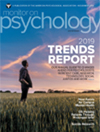
On the Cover: 2019 trends report
-
10 trends to watch in 2019
Our annual guide to changes ahead for psychologists in patient care, research, technology, social justice and more
-
Climate change is our call to action
Organizations and policymakers are tapping into psychologists’ expertise to find ways to mitigate climate change and help people adapt to a warming world
-
The rise of non-drug pain treatment
As the United States fights an opioid crisis, psychologists are in demand for nonpharmacological treatment options for chronic pain—though hurdles remain
-
A growing demand for sport psychologists
With the issues of mental health, violence and activism in sports on the rise, more athletes and teams are seeking the expertise of sport psychologists
-
A greater role in nutritional health
Both what we eat—and how we eat it—directly influence our mental health, according to growing research in the integrative field of culinary medicine
-
Re-envisioning long-term care
By fostering more person-centered care in these settings, psychologists are improving life for residents and caregivers
-
Shining a spotlight on equity
In an era of increased activism, psychologists armed with research are raising their voices on behalf of vulnerable populations
-
Big data gets bigger
Large data sets—generated by social media, wearables and other sources—are opening more avenues for researchers to explore real-world human behavior
-
Designing smarter tech tools
New technology in educational gaming, health-care communication, robotics and more is benefiting from psychologists’ input
-
Treating the misuse of digital devices
Psychologists are spearheading efforts to help wean people off technology
-
The ascent of digital therapies
Evidence-based apps could enhance — and in some cases, replace — medications for treating a range of mental health disorders


CE CORNER
Researchers have made a convincing case that prolonged grief is a disorder distinct from the normal grieving process

Features
Despite the increased attention on sexual harassment, few employers are taking stronger action to address the problem, finds an APA survey
At a growing number of colleges, students are helping their peers with mental health concerns and raising awareness of the need for care
An APA program is teaching parents and other caregivers how to replace harsh strategies with positive parenting skills
The Bucknell University geropsychologist is tapping the considerable power of older adults to help protect the environment
A look at a psychologist’s role in improving care for transgender people at a health-maintenance organization
The Suicide and Emotion Dysregulation Lab at the University of Southern Mississippi explores what makes people capable of suicide and the role firearms play
What's ahead at APA
Haica Rosenfeld uses a blend of mindfulness and other nondiet, evidence-based approaches to help women adopt attitudes and behaviors that support health
COLUMNS
From the CEO
Judicial Notebook
President's Column