
Technology offers tremendous opportunities to help people learn, manage their health and connect with others. But technological devices, products and services are only as good as their design—and psychologists have become integral to ensuring that these tools are easy to use and helpful to those they serve.
"Psychologists have an important role to play both in developing these tools to accomplish positive changes for people, and in understanding the outcomes of technology on things like health and well-being, life satisfaction, productivity, interpersonal relationships, education and health care," says industrial/organizational psychologist Tara Behrend, PhD, director of the WAVE (Workplaces and Virtual Environments) lab at The George Washington University.
Some of the many arenas where psychologists are playing leading roles include:
Drawing kids into science. Psychologists are increasingly tapping the power of technology to enhance education on every level. An example of collaborative work in the area is a National Science Foundation–funded projectopens in new window headed by computer scientist H. Chad Lane, PhD, an associate professor of educational psychology at the University of Illinois at Urbana-Champaign. Working with developmental psychologist K. Ann Renninger, PhD, of Swarthmore College in Pennsylvania, and astrophysicist Neil Comins, PhD, of the University of Maine, Lane is using the popular game "Minecraft" as a context for generating interest in science among children. They are helping children explore questions like what the Earth would be like if it didn’t have a moon (brief answer: extremely windy and not very habitable). Their version of "Minecraft" allows players to move freely throughout a world that Lane and his team have configured as a moonless Earth. Children are invited to post virtual signs in locations that look odd to them—where, for example, tides are behaving strangely or there is a lack of plant life—and then they receive brief education on the topic.
Lane’s research is framed by the work of Renninger and her collaborator Suzanne Hidi, PhD, of the University of Toronto, which finds that when people’s interest is effectively triggered by compelling experiences, learners will return to the subject again when given the opportunity. Lane’s challenge was to parlay children’s interest in "Minecraft" into a focus on science.
"For the ones who get it, you can see when it clicks," says Lane. "On the surface, kids might act like they aren’t interested in the science," he adds, "but then they start asking questions."
Improving health-care communication. Psychologists are also among those testing different technology vehicles for delivering vital health-care information. In a studyopens in new window reported online in June, psychologist Susan J. Persky, PhD, an associate investigator at the National Human Genome Research Institute (NHGRI), and colleagues at the NHGRI and the National Cancer Institute compared the way patients reacted to genomics-related information about their weight when they received it either from an internet-based virtual physician or from a virtual physician in immersive 3-D technology (a form of virtual reality).
Those receiving the information in immersive 3-D reported greater self-efficacy in managing their weight and greater intentions to engage in dietary and physical activity than those receiving it over the internet, the team found.
"It’s essential to figure out how we can best use technology to fill the gaps in current models of care," says Persky, "while also providing a better experience for patients and helping them to optimize their decision-making and their health."
Expanding the reach of psychological research. Other psychologists are jumping into the world of big data—using techniques for collecting and analyzing large data sets to uncover patterns, trends and associations that might not otherwise be apparent.
Psychologists at the University of Pennsylvania’s World Well-Being Projectopens in new window, for example, are using the methodology to examine stress at the county level. (For more on psychologists’ use of big data and the work of the World Well-Being Project, see the article.)
First, they built and tested a model for predicting individual-level stress by examining the language patterns of 2,700 consenting Facebook users who took Cohen’s Perceived Stress Scale. Those with high stress levels talked more about feeling depressed and ignored and having regrets, they found, while those with low stress levels were more likely to share pleasant or positive activities like taking trips with family. Applying this model to more than 6.5 million Twitter users and some 40 billion tweets, the team then found that stress levels were higher in some U.S. counties than others, and that those counties tended to have higher rates of smoking and diabetes and fewer opportunities to exercise than others, for example.
"These large data sets allow us to see that stress can be a feature of communities and not just of individuals," with myriad potential applications in public health, precision medicine and other arenas, says Anneke Buffone, PhD, lead research psychologist for the World Well-Being Project, who conducted the study with project colleagues Sharath Chandra Guntuku, PhD, Johannes Eichstaedt, PhD, and Lyle Ungar, PhD. (These data and more can be seen on a mapopens in new window for use by citizens, policymakers and others.)
 Designing better robots.
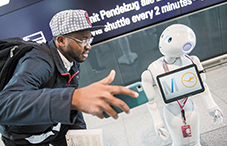
Still other psychologists are working with robotics designers to make these electronic helpers more relatable for humans. Key to that work is understanding what people think of social robots. In a study under review, Stanford University psychologist Jeff Hancock, PhD, and Stanford University colleagues Byron Reeves, PhD, and Xun "Sunny" Liu, PhD, asked 4,035 participants to rate social robots’ personal attributes on a variety of dimensions.
Intriguingly, participants rated robots in the same way that social psychologist Susan Fiske, PhD, of Princeton University, and others have shown that people rate people: They instantly judge them on dimensions of warmth, competence or both. What’s more, robots that people stereotyped as highly warm and highly competent looked like humans rather than machines—and they tended to be white. Such findings imply that stereotypes play a part in people’s perceptions of robots, and that designers should build accordingly, says Hancock.
"If you’re designing robots to enhance children’s sense of belongingness," for example, "you want the appearance of the robots to be similarly inclusive," he says.