
Lost in the tragic (and all-too-common) news reports of mass shootings is the fact that these incidents account for less than 2 percent of the annual 39,000 gun deaths in the United States, while a staggering 60 percent are the result of suicide, according to the most recent statistics. Until recently, however, researchers knew surprisingly little about the relationship between access to guns and how often they were used for suicide.
"It’s a controversial topic, and I think people have been afraid of tackling it," says Michael Anestis, PhD, who directs the Suicide and Emotion Dysregulation (SED) Lab at the University of Southern Mississippi (USM).
While the data on guns and suicide have long been readily available, according to Anestis, academics don’t tend to be gun owners, so they have been hesitant to study something they’re not familiar with. It took Anestis moving to Mississippi—a state with the nation’s 13th highest gun ownership rate—to start him looking into the role that firearms play in suicide.
"I spent a lot of time trying to understand the mechanics of firearms and how to talk about them knowledgeably," he says.
Digging into the data, Anestis found that the proportion of suicides involving a firearm, as well as the overall suicide rate, is higher in states with less-stringent gun control legislation in effect. In fact, in Mississippi, 70 percent of suicides are carried out with firearms—the highest rate in the nation. Though he advocates for universal background checks and longer mandatory waiting periods for gun purchases, Anestis acknowledges that no change in gun laws can overcome the fact that there are currently more than 300 million guns in the United States—one for nearly every single person in the country.
In response, a major focus of the SED Lab is understanding the psychology underlying gun ownership and gun storage behaviors and making this the basis for creating effective ways to support gun owners in adhering to safety measures, such as storing firearms unloaded and using trigger locks.
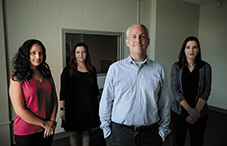
Seeking to determine the factors that influence gun-related suicides is the other major focus of the SED Lab, in particular studying what makes a person capable of looking past the fear of death and catastrophic bodily harm. Members of the lab, including five graduate students and a project coordinator, are exploring whether factors such as increased violent video game play might boost fearlessness and increased pain tolerance—characteristics that are prerequisites for dying by suicide.
Ultimately, the lab’s goal is to reduce the nation’s suicide rate by identifying which populations have the easiest access to guns as well as the characteristics that make people more likely to act on suicidal thoughts, then using this knowledge to help gun-safety advocacy groups craft the most effective safety messages.
Who is capable?
 Anestis joined the Florida State University (FSU) lab of Thomas E. Joiner Jr., PhD, as a doctoral student in 2005, the same year the senior scientist published his groundbreaking book, "Why People Die by Suicide." The book espoused Joiner’s interpersonal theory of suicide, which proposes that three components are necessary for a suicide completion. The first two components—thwarted belongingness/feeling disconnected from others and perceived burdensomeness—together produce the desire for suicide. The third component—acquired capability, or the learned ability to overcome one’s natural fear of death—makes suicide possible.
Even though researchers prior to Joiner had considered the factors leading to suicidal desire, the notion of suicide capability had not been part of the equation. "Joiner’s theory was paradigm shifting," Anestis says. "His work really influenced the questions the field now asks."
While working with Joiner, Anestis became most interested in the variable of capability—how people learn to overcome their fear of death. "Historically our field’s been terrible at differentiating between who’s going to think about suicide and who’s actually going to attempt suicide," Anestis says. In a series of papers published with Joiner, Anestis reported that individuals who attempt suicide are more tolerant of physical pain, are less fearful of death and bodily harm, and have a long history of painful or provocative behavior.
Focus on soldiers
Following a year-long residency at the University of Mississippi Veterans Affairs Medical Center, where he was exposed to clinical practice with former military service members, Anestis did a postdoctoral fellowship with the Military Suicide Research Consortium (MSRC) in Minnesota. He then returned to Mississippi to join the department of psychology at USM as an assistant professor in 2012. That same year, with a multiyear grant from the Department of Defense (DOD), Anestis launched the SED Lab to address research questions related to suicide capability, again focusing on military service members, a population with a unique perspective on pain and death.
"Soldiers need to have a certain fearlessness about death and a high physical pain tolerance to do their jobs well," says SED Lab member and graduate student Claire Houtsma. "At the same time, these attributes pose serious problems for some when they return home and have thoughts of suicide."
To study this population, Anestis and his team struck up a research partnership with Camp Shelby, a National Guard base just a few miles from USM. Historically, suicide rates among military personnel have been lower than those among the general population. But for the past few decades the military suicide rate has been creeping higher, with the numbers flipping around 2008. Since then, the military’s rates, especially those of National Guardsmen, have been higher than those of civilians, even after accounting for age and sex.
The partnership with Camp Shelby has been fruitful. One study led by Houtsma found that "moral injuries"—witnessing transgressions against one’s moral beliefs, such as the shooting of unarmed civilians—may increase feelings of thwarted belongingness (Psychiatry Researchopens in new window, Vol. 247, 2017).
In another study—in which SED Lab members, in partnership with FSU, assessed more than 2,000 active-duty military personnel and National Guardsmen—the researchers found that guardsmen score higher on measures of thwarted belongingness and perceived burdensomeness than do active-duty military personnel (Journal of Clinical Psychologyopens in new window, Vol. 73, No. 12, 2017), which may explain, in part, the particularly high suicide rate among guardsmen compared with active-duty personnel.
Suicide and firearms
Beyond exploring why increased numbers of military personnel were dying by suicide, Anestis began investigating the soldiers’ methods of suicide. The answer has led him to the central theme of his current research: the outsize role of firearms in suicide. While a little more than half of all suicide deaths in the United States are by firearm, those rates jump to about two-thirds among service members. "These folks are trained. They own at a much higher rate. They have great comfort with firearms," explains Anestis. "It’s not surprising that they’re more likely to use them in an attempt."
Digging deeper into the role of firearm ownership in suicide, Anestis and Houtsma recently reported that firearm ownership is associated with death by suicide above and beyond every other factor their team looked at, including mental illness, substance abuse and prior suicidal thoughts (Suicide and Life-Threatening Behavioropens in new window, Vol. 48, No. 2, 2018).
Anestis also began looking into gun-safety measures, which he calls the most valuable suicide-prevention tool. He and his wife, Joye Anestis, PhD, also a faculty member in the clinical psychology doctoral program at USM and an occasional collaborator, pored over data provided by the Centers for Disease Control and Prevention and the Giffords Law Center to Prevent Gun Violence and found that states with more stringent gun legislation—in terms of waiting periods, background checks, mandatory gun locks in some situations and open carry of handguns—have lower suicide rates than those with more lenient laws (American Journal of Public Healthopens in new window, Vol. 105, No. 10, 2015). The findings hold regardless of gun ownership rates. They also found that the states that would benefit the most from safety measures tend to be the most averse to them; survey data show that people in the states with the highest suicide-by-firearm rates also tend to be the least interested in practicing safe gun storage practices.
Amazon’s Mechanical Turk web service provides a platform for the SED Lab to administer online surveys about people’s beliefs in gun storage. Using the online surveys, the team discovered that many gun owners believe there’s no relationship between safe firearms storage practices and rates of death by suicide, despite clear evidence to the contrary (Journal of Affective Disordersopens in new window, Vol. 227, 2018). "Here again we have a situation where the folks who need it most don’t believe in it and we’re stuck with increasing suicide rates year after year," Anestis says.
Other questions that the SED Lab has recently addressed with online surveys and studies with USM undergraduates include whether the number of times a person has fired a gun and lax gun storage procedures are correlated with an increased measure of suicide capability (yes) (Journal of Psychiatric Researchopens in new window, Vol. 102, 2018), whether a self-reported lifetime of violent video game play increases fearlessness about death (yes) (Journal of Social and Clinical Psychologyopens in new window, Vol. 33, No. 6, 2014) and whether knowing someone who has died by suicide increases the likelihood of storing guns securely (yes) (Psychiatry Research, under review).
Project Safe Guard
Last year, Anestis, along with USM colleague Dan Capron, PhD, and University of Utah researchers Craig Bryan, PsyD, and AnnaBelle Bryan, MS, launched Project Safe Guard, a four-year randomized clinical trial with Mississippi National Guard members to learn more about safety counseling with firearms. In the trial, which is funded by the DOD through the MSRC, SED Lab staff administer to National Guard members either a 20-minute counseling session about gun safety or a 20-minute control session about general health topics such as stress management, sleep or diet. Study participants are also randomized into a group that gets cable locks for each of their firearms or a control group that does not get them. Anestis and his team will follow up at three and six months to inquire about changes in gun storage behavior. If the counseling works, he envisions launching peer-to-peer sessions at a point of entry for military personnel, such as basic training.
"This clinical trial is the pinnacle of everything I’ve been working towards—a large-scale project that could change the risk of death among individuals in crisis," Anestis says. "I feel extremely proud of that."
In the past year, through work with the American Association of Suicidology (AAS), Anestis has increasingly been in touch with DOD policy experts and advocacy groups including the Giffords Law Center to Prevent Gun Violence and the Educational Fund to Stop Gun Violence. He talks with these groups about ways to work toward advocating for legislative and nonlegislative changes. He also writes editorials and leads the SED Lab on AAS-sponsored Facebook Live events about gun safety. And earlier this year, Anestis published a book of his own, "Guns and Suicide: An American Epidemic." He has also been training his students to join the gun control conversation as part of their weekly group lab meetings.
"The need to engage with the broader community is vital—otherwise we’re going to continue to have a pretty muted effect on what goes on in the country," Anestis says. "So, I want to train my students to be warriors for their beliefs. I want them to live their values and live them loudly."
"Lab Work" illuminates the work psychologists are doing in research labs nationwide.