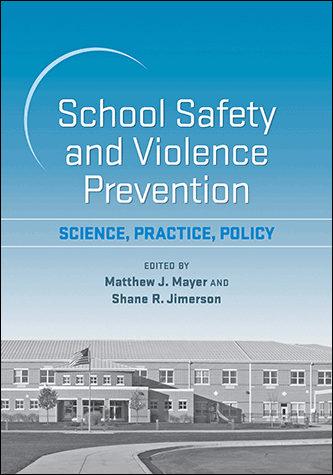
School Safety and Violence Prevention
Available formats
Also available from
This timely book presents a data-driven approach to preventing and responding to school violence.
As school violence receives increasing attention across the nation, the application of scientific knowledge is critical. For maximum effectiveness, transdisciplinary teams should use school data, logic models, and theories of change to design, implement, and evaluate interventions. Collaboration among key stakeholders is also necessary to address structural and systemic barriers to success with violence prevention.
By describing concrete methods for promoting safety in primary and secondary educational settings, this book will engage and enable school faculty, counselors, administrators, and other partners to better understand areas of common interest and learn how to work together more effectively.
Contributors
- The Importance of School Safety and Violence Prevention
Matthew J. Mayer and Shane R. Jimerson
I. Understanding Foundational Issues
- Conceptual Foundations and Ecological Influences of School Violence, Bullying, and Safety
Rami Benbenishty and Ron Avi Astor - School Climate, Bullying, and School Violence
Dorothy L. Espelage and Jun Sung Hong - Models of Health Promotion and Preventive Intervention
Jessika H. Bottiani, Anna Heilbrun, and Catherine P. Bradshaw - Mechanisms for Promoting and Integrating Schoolwide Discipline Approaches
Jeffrey R. Sprague, Sara A. Whitcomb, and George G. Bear - Supporting At-Risk and Marginalized Students
Tracey G. Scherr and Matthew J. Mayer
II. Working on Effective Change
- Collecting and Analyzing Local School Safety and Climate Data
Dewey Cornell and Francis Huang - Using Actionable Models to Leverage Local School Data
Jason Katz, Allison B. Dymnicki, David M. Osher, Sandra Williamson, and Evgeny Klochikhin - Designing Local Programming: Tools and Models
Jill Sharkey, Danielle Dougherty, Erika Felix, and Erin Dowdy - School Crisis Prevention, Response, and Recovery
Amanda Nickerson and Dewey Cornell - Promoting Collaboration Among Education Professionals to Enhance School Safety
Lindsey O'Brennan, Michael J. Furlong, and Chunyan Yang - School–Community Collaborations to Promote School Safety
Maury Nation, Joni W. Splett, Adam Voight, and Mark Weist - Evaluating School-Based Violence Prevention Programs: Challenges and Opportunities Now and Into the Future
Daniel J. Flannery and Albert D. Farrell
Index
About the Editors
Matthew J. Mayer, PhD, is an associate professor at Rutgers University. His published research includes analyzing national-level data, modeling school violence processes, related school safety issues, cognitive behavioral interventions, and methodological issues and evidence-based standards in social–behavioral research.
Dr. Mayer has led several transdisciplinary teams in research journal special issues and book projects addressing school safety. He is on the editorial board of Behavioral Disorders and the Journal of School Violence and is an associate editor of School Psychology Quarterly.
He led a Capitol Hill briefing on school safety for the American Educational Research Association and was on the association's task force on bullying prevention.
Shane R. Jimerson, PhD, is a professor at the University of California, Santa Barbara.
Dr. Jimerson is senior editor for international science for School Psychology Quarterly, past president of the International School Psychology Association, and president emeritus of APA Division 16 (School Psychology).
With more than 350 publications, including more than 25 books, his scholarship has provided insights aimed at promoting the prosocial development and safety of all students, with particular emphasis on science informing effective prevention, preparedness, and intervention programs.
He has contributed more than 300 presentations to diverse audiences across more than 25 countries.
With concrete methods for promoting safety in primary and secondary educational settings, School Safety and Violence Prevention...will engage and enable school faculty, counselors, administrators, and other partners to better understand areas of common interest and learn how to work together more effectively.
—Midwest Book Review
Mayer and Jimerson deliver a well-organized, well-thought-out, comprehensive volume on school safety and violence prevention. With contributions from a diverse group of interdisciplinary scholars, the insightful chapters will enable readers to grasp the foundational issues confronting schools today, glean insight into forming effective partnerships, and engage in the practical application of school-based research. This will be an invaluable addition to the literature on this topic.
—Ryan Randa, PhD
Department of Criminal Justice and Criminology, Sam Houston State University, Huntsville, TX, and Editor, Journal of School Violence
Mayer and Jimerson have brought together leading authorities on school safety and violence prevention. This book gets to the heart of what educators, researchers, and policymakers need to understand when confronting the physical, emotional, and social challenges of working in schools that face unprecedented threats and acts of violence. This book provides a foundation for creating safe and welcoming environments in schools across the nation and beyond.
—Edwin R. Gerler, Jr., EdD
Professor of Counselor Education, North Carolina State University, Raleigh, and Founding Editor, Journal of School Violence
This is the book the field so urgently needs. Chapters are closely interlinked to describe the complex but interrelated whole of school violence prevention. This refreshing approach will undoubtedly have an immediate and positive impact on professional practice and may well convey the message of hope that brings the next generation of thinkers and doers into the field.
—Jim Larson, PhD
Professor Emeritus, Department of Psychology, University of Wisconsin–Whitewater