
Judges in many landmark court cases have relied on behavioral science for their rulings, but perhaps less known is that they also rely on psychological science to improve how they manage their courtrooms and serve the public.
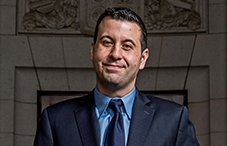
For that expertise, they turn to senior research associate Jason Cantone, JD, PhD, and his fellow researchers at the Federal Judicial Center (FJC), an independent federal agency dedicated to identifying ways to streamline and inform the work of the federal judiciary. Drawing on his dual training in law and psychology, Cantone tackles such questions as how district court judges and their staff might work differently to reduce the time it takes to complete a case and how they could communicate better with state courts to share resources and improve litigants’ access to justice.
Some of his work is also shaping judicial processes abroad: Cantone has made two trips to Uzbekistan as part of a team assisting that nation’s leaders on ways the country can strengthen its court system. The Monitor asked Cantone about psychology’s role in making courts more efficient and how he got his job.
What do you do at the Federal Judicial Center?
Most of my research is done in response to requests we get from judicial conference committees who are seeking to improve the federal judicial system. Sometimes committees ask us to do pilot studies to examine whether a new court procedure could make the judicial process less expensive and take less time.
Most of our research projects involve collaborative research teams. For example, a current study examines whether requiring parties to exchange information earlier in the trial process results in civil litigation taking less time and costing the parties less money. For the study, we plan to survey hundreds of attorneys, interview judges, and perform extensive coding and statistical reviews of the relevant cases. Once that’s done, we’ll report our findings to the committee of the Judicial Conference of the United States that requested the research.
Another project involved identifying what resources are out there for pro se litigants—people who are unrepresented by legal counsel in court. The judicial process can be very complicated and intimidating, so it’s important to identify what is out there for them, such as sample forms and information on filing dates. We examined what all 94 federal district courts provide for pro se litigants and wrote a report that was released. The next step is creating an online directory of those resources that people can use, which goes right to one of my core goals of increasing access to justice.
I also collaborate with our education division, which trains federal judges and federal court staff on case and court management, among other topics. One of our largest projects was to establish a set of competencies—the knowledge areas, skills and attributes required to be a successful judge—to inform what educational programs we offer federal judges and court staff. Another current project examines how we can incorporate important lessons from psychology, such as implicit bias, prejudice and issues members of minority groups, defined broadly, might face, into our educational curriculum and research projects.
What’s a typical day like for you?
It varies tremendously. I might be writing survey questions, examining dockets of federal court cases for a study, analyzing data or responding to data requests from conference committees or individual district courts.
Other days I might be interviewing a federal judge as part of our work to examine a court process in a specific district. While there is one federal court system, there are 94 district courts, and each court and judge might do things differently. One might be doing something that’s very effective to streamline cases and another might not, and we want to know why.
How did you learn about the job?
I first heard about the Federal Judicial Center during graduate school in the JD/PhD program at the University of Nebraska–Lincoln. Then, while I was working as an Air Force civilian at the U.S. Strategic Command, a graduate school colleague working here sent me the job announcement—that’s an example of how maintaining a strong network of colleagues in your field can be helpful.
I was immediately interested because it’s one of the few jobs out there that can bring together my interests in social science and psychology, law, and public service.
Your job has also enabled you to help judges in Uzbekistan as the country moves toward democratization. What have you accomplished there so far?
Their president announced recently a strategic plan to provide stronger guarantees for protecting citizens’ rights and freedoms and to ensure access to justice for citizens. They want to improve the efficiency of their judicial system and provide better legal aid, for example, and a nongovernment agency named Regional Dialogue arranged for my colleagues and me to meet with a series of high-ranking officials.
In 2017, my FJC associates and I presented a workshop on what competencies judges need to be successful. Many of the competencies we found essential for U.S. judges are also applicable to foreign judges, such as having a good understanding of the law and strong communication skills. Patience and even-temperedness are other attributes that are very important for a good judge. We also discussed how to promote lifelong education opportunities for judges in Uzbekistan to strengthen the judicial system and improve the quality of justice.
On a separate trip, the FJC director and I spoke at the country’s Supreme Court, Senate, Ministry of Justice, Ministry of Foreign Affairs, and at a law school on the psychology of conflict resolution and mediation procedures. Since that visit, their government passed a new law on mediation. I also spoke at an Uzbekistan think tank about the psychological issues associated with unlawful detention and solitary confinement.
How is your psychology training useful in this job?
One way I rely on my training in psychological methods is when I create or help create surveys. Psychology is also relevant when I am working on studies on such issues as alternative dispute resolution, which relies on a strong understanding of procedural justice and the psychological importance of people having their voices heard and being part of the judicial process.
One of my latest projects involved creating a pocket guide and websiteopens in new window for judges on how to enhance cooperation between state and federal courts. There are many issues that affect both federal and state courts, but if the judges don’t talk to each other, they can’t learn from each other about what works and what doesn’t. Improving communication and expanding cooperation on such issues as emergency preparedness are goals that tie right into lessons we often discuss in psychology and are essential to make the court system more effective and efficient.
What have you found most gratifying about this job?
Having the ability to take all the lessons we’ve learned about our judicial system and bring them to a foreign country—in my case, Uzbekistan—has been incredibly rewarding. One of the things that I wish psychologists did more of was look at psychological issues from an international perspective. While we do a lot of really good work in the United States, there are a lot of other countries that are also doing good work. It’s important for us to share that knowledge that we gain across countries and across cultures. We can learn a lot from each other.
Opinions are Dr. Cantone’s own and not the opinions of the Federal Judicial Center.