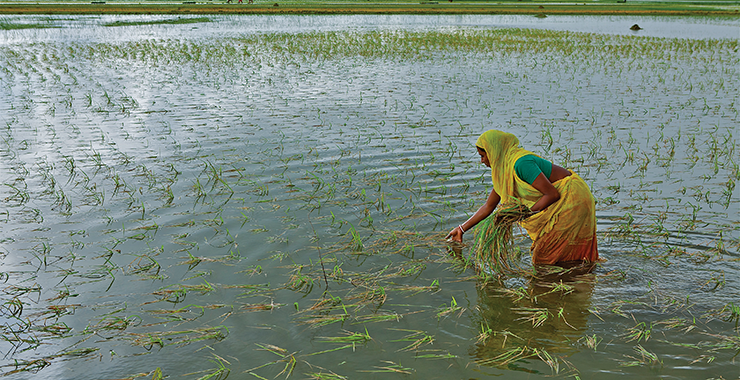
Farmers in rural Bangladesh face enormously difficult choices. Climate change is exacerbating heat spells that zap their crops and causing rising seas that damage their soil. To eke out a better living, some farmers migrate to cities to find work, but the risks are high. There is no telling if they will earn enough money to recoup their travel expenses, and they often have to leave family members behind to manage their land.
Why then, in the face of these obstacles, do some farmers choose to migrate? And when they do, how does it affect the communities they leave behind? These are some of the questions that psychologist Amanda Carrico, PhD, assistant professor and director of the Environment and Behavior Lab at the University of Colorado Boulder (CU Boulder), is trying to answer through large-scale surveys of households in rural southwestern Bangladesh.
Such questions are becoming more pressing as climate change makes farming throughout the world more difficult. One Bangladeshi family told Carrico they had agonized over their decision to find work in India—an especially daunting endeavor because India is increasingly hostile to migrants—and finally concluded they had few other options. Their farmland was not very productive, and the family realized it was vulnerable to cyclones and other environmental disasters.
“This is the way these stories almost always work,” says Carrico. The study of Bangladeshi farmers is just one of many she is conducting to understand how the environment influences behavior, and in turn how our behavior could affect the environment around the world. The international scope of her work is important, Carrico says, because environmental behavior is so dependent on context. “I can’t study a farmer in the United States and extrapolate that to make predictions about how Sri Lankan farmers are going to respond. And the same is true even in studying a farmer in India … because there’s so much politically and socially and culturally different there.”
Climate hot spots
Carrico’s research in Bangladesh began as a collaboration with geologists and other scientists at Vanderbilt University while she was a postdoctoral fellow at the Vanderbilt Institute for Energy and Environment (VIEE). For years the geologists had been tracking the highly dynamic area where rivers empty into the Bay of Bengal, causing a precarious situation for Bangladeshis living there. The geology team found out that the U.S. Office of Naval Research wanted to support research that could help predict the flow of migration throughout the world in coming decades. They reached out to Carrico and other social scientists at the university, who jumped at the chance to develop the project. Carrico ended up taking about half a dozen trips to Bangladesh between 2014 and 2016. She and her colleagues conducted a survey of nearly 1,700 households across 10 communities in southwestern Bangladesh and compiled a log of extreme weather events over the previous four decades. They found that farmers were more likely to make a first migrant trip, typically to a more urban area in Bangladesh, following a dry or warm spell, both of which have grown more frequent in the past couple decades (Population and Environment, Vol. 41, No. 1opens in new window, 2019).
Now, Carrico is launching the second phase of the Bangladesh research through her CU Boulder lab, with support from a National Science Foundation (NSF) grant. She is going back to Bangladesh, this time with graduate student Jeremiah Osborne-Gowey, to conduct in-depth interviews with community leaders and heads of household in a small subset of the villages from the first survey to understand what happens to the geographic regions when farmers take migrant trips away from them. Are they abandoning their farms, or are they investing more heavily in agriculture because, for example, migrants are sending money back?
For this research, Carrico is working with the Bangladeshi research organization Mitra and Associates and faculty at Khulna University, located in the region where the project takes place. The team hopes to get their findings out in reports that will be used by local government groups and nongovernmental organizations (NGOs). Although it will then be up to these bodies how they want to use the information, Carrico says one application might be helping to inform efforts to encourage people to migrate to cities such as Khulna or Mongla rather than the capital city of Dhaka, where housing and other infrastructure are already being overwhelmed by influxes of migrants.
In addition to her research in Bangladesh, Carrico has long been studying how environmental stress affects farmers in Sri Lanka—another nation severely affected by climate change. That work began as a collaboration with Lanka Thabrew, PhD, a hydrological engineer who was a fellow postdoc at VIEE. Thabrew, a native of Sri Lanka, wanted to study how farmers there make decisions, particularly about adopting new farming strategies such as irrigation techniques that require less water.
With money from an NSF grant, Carrico, Thabrew, psychologist Heather Truelove, PhD, and principal investigator George Hornberger, PhD, traveled multiple times to Sri Lanka from 2012 to 2017 to survey 1,300 farmers and their spouses.
They asked a range of questions about the farmers’ economic status, agricultural resources and crop yield, how much they felt like they could get help from neighbors, and whether they were trying new farming technologies and their perceptions of them. The researchers collaborated with government officials to design the studies and disseminate the data through white papers, peer-reviewed articles and short reports for policymakers. Among their findings: While many farmers are “water-stressed” and struggling with drought, the only government-recommended adaptation strategy that proved effective was planting drought-resistant hybrid seed varietals; other effective strategies, such as changing how farmers water their crops, had no detectable impact (Ambio, Vol. 46, No. 5opens in new window, 2017).
In fact, “a lot of the strategies [government bodies] were trying to promote were really difficult to implement [because] they [were] a big change for farmers,” says Nicholas Williams, PhD, who previously worked as a postdoctoral fellow with Carrico at CU Boulder. The bulk of Williams’s work during his fellowship in Carrico’s lab between 2015 and 2017 was to analyze the quantitative data from large farmer surveys and synthesize them with qualitative data from interviews. “You can learn a lot about trends across the landscape and across communities and within particular communities, but the ‘why’ questions don’t get answered with quantitative data,” says Williams, who is now a lecturer at California Polytechnic State University. Although the CU Boulder-based research team stopped collecting data when the NSF grant funding the work ended in 2017, Williams is still collaborating with Carrico to analyze data. They want to understand Sri Lankan farmers’ risk perceptions, particularly around climate change impacts such as drought and heat waves, and how these perceptions influence their likelihood of using hybrid seeds and other adaptation strategies.
Encouraging new behaviors
Throughout her projects in Sri Lanka and Bangladesh, Carrico has also kept one foot planted in domestic research. Currently the focus of Carrico’s U.S. work in her CU Boulder lab is around the phenomenon of “spillover,” or the effect that interventions to promote one pro-environmental behavior have on the likelihood of engaging in other pro-environmental behaviors.
Groups around the world have been split about how spillover plays out. Some psychologists and NGOs argue that encouraging people to take one positive action could lead them to other positive actions, while many policymakers and economists worry about a possible negative spillover effect—for example, that convincing people to buy more fuel-efficient vehicles will just lead them to drive more, explains Kaitlin Raimi, PhD, who was mentored by Carrico when she was a junior postdoctoral fellow at Vanderbilt. “One thing that is really great about Amanda is that she is very practical. She asks the questions that policymakers care about,” says Raimi, who is now an assistant professor of public policy at the University of Michigan.
In one meta-analysis of spillover studies, Carrico and Raimi concluded that carrying out a first action actually had a negative effect on whether a person did a second behavior, but it was very small (Nature Sustainability, Vol. 2opens in new window, No. 1, 2019). In another study, they found that adults who reduced their red meat consumption for one week in order to curb greenhouse gas emissions were no more likely to later agree to donate to an environmental group than control subjects who were not asked to reduce their meat intake (Environment and Behavioropens in new window, Vol. 50, No. 7, 2017). Nevertheless, the meta-analysis did reveal that engaging in an environmentally friendly action did increase intentions to do a second behavior, suggesting at least a positive attitudinal shift. Furthermore, such good intentions were more likely if individuals had been spurred to commit the first action by messages targeting intrinsic motivation rather than by negative, guilt-provoking messages.

Even though the effect of provoking good intentions was small in individuals, it could lead to meaningful results for proenvironmental interventions in large populations, the researchers noted. One practical example, Carrico says, would be that governments that fine residents for not composting their organic waste (food scraps), as several U.S. cities currently do, could appeal to people’s intrinsic motivation with messaging around social reasons such as helping their community, in addition to the coercive motivation of not being fined.
Carrico says she is motivated to study environmental behaviors at the individual level because the behaviors of individual Americans are responsible for about 40% of the nation’s greenhouse gas emissions. “I still want to see strong, aggressive government policies to address these kinds of concerns—I don’t think private governance supplants public governance—but it is still an opportunity that is available to us, especially while we are waiting for more robust government response,” she says.
Teaching the next generation
Carrico started doing applied environmental studies as a PhD student at Vanderbilt University after attending a presentation by two professors on using psychology to improve communication about air-quality alert days in Nashville. She started collaborating with the professors on this project, excited by the interdisciplinary work and the potential for psychology to have a more direct relevance to health and well-being.
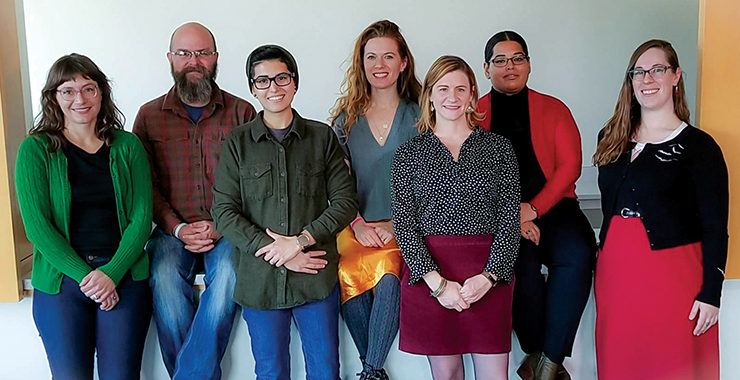
Since that time, about 15 years ago, Carrico thinks there has been mounting interest in applied psychology research. But, she says, more could be done to engage psychologists and other social scientists in environmental research. The labs of environmental social scientists are often housed within departments such as environmental studies, rather than within traditional psychology departments, and thus may be off the radar of psychology students, she says. (Her lab is within the environmental studies program at CU Boulder.)
On the other hand, environmental science students are not always aware of the connections between their discipline and psychology. Carrico teaches several environmental studies courses at CU Boulder and hopes that the material she covers will provide these students with tools for effectively communicating and educating about environmental issues. “A lot of times, environmental studies degrees are really depressing; they are just downers, learning about all these horrible things, and so I feel lucky that the content that I teach, my specialization, has a fairly actionable element to it,” she says.
“Lab Work” illuminates the work of psychologists in research labs.