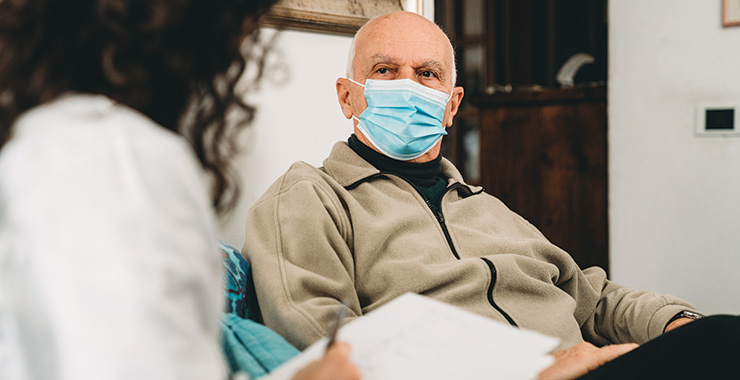
Looking back, clinical psychology doctoral student Meghan McDarby realized that she has always gravitated toward working with older adults. In high school, she volunteered on a long-term care unit at her local hospital, and in college at Cornell University, she volunteered at a nearby hospice and worked for a researcher who studied aging. Now, she is about to embark on her internship year at New York–Presbyterian/Weill Cornell Medical Center in New York City and plans for a geropsychology future studying palliative care and end-of-life issues.
“Our society undervalues older adults or thinks of them as lesser, and then older adults have to internalize that message as they age,” said McDarby, who plans to graduate in 2022 with her PhD from Washington University in St. Louis. “It’s especially apparent at end of life when people start to feel like they’ve become a burden to other people.”
[Related: Critical needs in gerontology]
McDarby will join a specialty with iron-clad job security, as the demand for geropsychologists has long outpaced the supply. Just 1.2% of psychologists describe their primary specialty as geropsychology, far fewer than specialties such as child/adolescent psychology (15.4%) or counseling psychology (9.4%), according to a survey of 4,109 doctoral psychologists conducted by APA’s Center for Workforce Studies (Moye, J., et al., Training and Education in Professional Psychologyopens in new window, Vol. 13, No. 1, 2019). Meanwhile, the U.S. population continues to age, with adults ages 65 and older projected to make up more than 20% of the population in 2030opens in new window, compared with 13% in 2010, according to U.S. Census Bureau data.
But geropsychologists working in this still relatively new specialty, which APA first recognized in 2010, believe that its expansion has been hampered by several factors, including lower reimbursement for treatment services given the reliance on Medicare rates, a limited number of faculty members to teach the next generation, and entrenched societal age biases.
“It’s ageism, partnered with misconceptions and misinformation,” said Brian D. Carpenter, PhD, a professor of psychological and brain sciences at Washington University in St. Louis who directs a clinical geropsychology lab there. “People have a conceptualization that with older adults the potential for therapeutic change later in life, for example, may be less than in younger people. Which is false, but that’s the belief.”
In addition, psychology students may not realize that older patients will need help with a range of issues, whether that is substance use, relationship difficulties, or stress at work, Carpenter said. “People think, ‘I don’t want to work with older adults because that would be depressing because all we’d do is talk about how sick they are and how close they are to death.’”
The need for additional trained geropsychologists is more apparent now than ever, as older adults, typically defined as individuals age 65 and older, have been notably affected by the pandemic. For many of those living in long-term care facilities, there has been acute mental trauma. Fewer than 1% of Americans live in those settings, but those residents make up 34% of all U.S. deaths from the virus, according to data as of early March from the COVID Tracking Project.opens in new window Meanwhile, the pandemic has revealed some of society’s biases against older adults, said Erin Emery-Tiburcio, PhD, ABPP, a member-at-large of the board of the Council of Professional Geropsychology Training Programs (CoPGTP).
For instance, during the early days when Italy was overwhelmed with COVID-19 cases, age was one of the factorsopens in new window considered during discussions about rationing ventilators, she pointed out.
But in other respects, this age group has shown more signs of resilience during the pandemic. One study, based on a survey in the spring of 2020, found that young adults ages 18 to 29 were most likely to report symptoms of psychological distress, with 24% of those surveyed reporting distress (McGinty, E. E., et al., JAMAopens in new window , Vol. 324, No. 1, 2020). Those least likely were adults ages 55 and older, with 7.3% reporting symptoms. Another recent study found that older adults were less likely to experience pandemic-related stress, life change, social isolation, and negative relationship quality than younger adults (Birditt, K. S., et al., The Gerontologistopens in new window , Vol. 61, No. 2, 2021).
For older adults, particularly those who are retired, the pandemic has not caused as many stressful life changes, such as struggling to work from home or oversee virtual school or recovering from a job loss, said Karen Fingerman, PhD, one of the study authors and the director of the Texas Aging and Longevity Center at the University of Texas at Austin.
Another possibility for their resilience is that older adults “are better with coping with big events because in the past they’ve lived through them,” she said. “The psychology part of it is that people get better at regulating emotion and they get better at coping.”
Cultivating a workforce
Psychology students interested in careers involving older adults can pursue one of several tracks, which may overlap to some degree, said William E. Haley, PhD, a professor in the School of Aging Studies at the University of South Florida. The term “geropsychologist” most often describes someone who works directly with older patients and has specialized in that area, he said.
Geropsychology training may be part of a doctoral program; CoPGTP lists 14 APA-accredited doctoral programs with either a track or practicum emphasizing geropsychologyopens in new window. Otherwise, students can begin to specialize in their internship year or during their postdoctoral training, Haley said. Board certification is offeredopens in new window through the American Board of Professional Psychology.
But just as badly needed, Haley said, are geropsychologists who work in academia, conducting research and educating the next generation. Leaders at CoPGTP have written about the challenges of some faculty positions going unfilled and more broadly about a lack of enough faculty in clinical or counseling programs with sufficient geriatric knowledge and strong track records in research to offer geropsychology as a major area of study (Hinrichsen, G. A., et al., Clinical Psychology: Science and Practiceopens in new window , Vol. 25, No. 2, 2018). There is also a third potential career path for psychologists who do not specialize in clinical aging, with some focusing primarily on research and conducting studies related to topics including cognitive, social, and neuroscience issues in aging, Haley said.
Sometimes psychologists gravitate to the specialty because of a close relationship with an older relative or exposure to older adults through volunteer work, according to a qualitative study based on semistructured phone interviews with 30 clinical geropsychologists. Others describe the influence of taking an intriguing age-related class as an undergraduate or graduate student (Merz, C. C., et al., Translational Issues in Psychological Scienceopens in new window , Vol. 3, No. 4, 2017).
Duke University geropsychologist Katherine Ramos, PhD, who spends about three-fourths of her time on research and the rest on clinical work, attributes her interest in geropsychology in part to getting to know her grandparents as a young child. From the age of 6 to 9, she lived with her grandparents in Colombia. She saw her grandmother’s commitment to art, her grandfather’s entrepreneurial drive, and their partnership in managing a farm along with their home.
“I also got to see and be witness to their own relationship that was independent of being Grandma and Grandpa,” said Ramos, an assistant professor in the Department of Psychiatry and Behavioral Sciences at the Duke University School of Medicine. “They really set the tone for my admiration and curiosity for older adults.”
But that is not a typical scenario, and many Americans develop ageist biases beginning at a young age, Haley said. To illustrate, he described a question that he usually asks undergraduates at the start of his Psychology of Aging course, one that attracts not only psychology majors but students pursuing premed, humanities, and other areas. “What percentage of adults ages 65 and older live in nursing homes?” he asks. The reality is fewer than 5%, he said. But students’ responses have ranged from 20% to as high as 60%.
Given that many young adults can lack a firm grasp on what life after 65 looks like, it is no wonder more choose to work with children and adolescents rather than older patients, Haley said. “If you think that you’re going to be working with people who can’t really benefit or are impaired, you’d rather work with people who have their whole lives ahead of them,” he said.
One recent focus of APA’s Committee on Aging has been developing resources across educational levels, including for high schools and colleges, to create opportunities for students to interact with and be exposed to issues involving older adults, said Ramos, a member of the committee. For instance, a college human development course could include an assignment that asks students to interview an older adult about their lives, she said.
In his course, Haley strives to refute the myths of aging. Each semester he sees examples of students who shift their career lens—whether that might be in psychology or another area—to planning to work in some regard with older adults. “Other students, even if they don’t switch gears, they now have an appreciation for the problems of older people,” he said.
Bridging the gap
Though prior generations of older adults may have been more reluctant to seek help for mental health problems, shifting demographics will further boost the demand for trained geropsychologists, Fingerman said. “Certainly, the youngest baby boomers and Gen X have much more of a culture of using therapy,” she said.
With so few geropsychologists, the reality is there are never going to be enough for this wave of older adults, but plenty of other psychologists can help fill that gap with some additional training, Carpenter said.
“No matter what group of patients you work with, you need to know something about aging,” he said. “Because even if you’re working in pediatric psychology, for example, there are a lot of grandparents who are raising young kids.”
Slightly more than one-third of psychologists—most often those who specialize in rehabilitation psychology, clinical neuropsychology, or clinical health psychology—already report frequently or very frequently seeing older patients, according to an APA Center for Workforce Studies survey.
A CoPGTP workgroup has been developing online curricula to provide foundational training in age-related issues for psychologists already regularly working with older adults, or those who want to expand their practice into that area. Some of the areas that will be incorporated include curricula regarding attitudes about older adults, adult development, and aging, as well as foundation in assessment and intervention (Hinrichsen, G. A., et al., Clinical Psychology: Science and Practiceopens in new window , Vol. 25, No. 2, 2018).
The goal is to create a roughly 16-hour set of online modules that will be available by 2022, said Emery-Tiburcio, who is closely involved with the curricula’s interprofessional development through their Geriatrics Workforce Enhancement Programopens in new window and serves as codirector of the Rush Center for Excellence in Aging at Rush University Medical Center in Chicago. CoPGTP leaders have already agreed to provide a certificate to those who complete the modules. The certificate will also address basic competencies for social workers, psychiatrists, and other clinicians, Emery-Tiburcio said.
For those psychologists who decide they want to specialize in treating older adults, expect a multifaceted career treating a mix of patients with diverse backgrounds, needs, and goals, said Kelly Trevino, PhD, who codirects the Psycho-Oncology in Aging and Cancer Laboratory at Memorial Sloan Kettering Cancer Center in New York City. “One of the main messages that geropsychology is trying to get out is, if you’ve met one 65-year-old, you’ve met one 65-year-old,” said Trevino, who also chairs APA’s Committee on Aging.
Patients can range from someone who has recently retired and is struggling with that transition to a patient who arrives in a wheelchair with an adult child who has become increasingly frustrated with the parent’s forgetfulness and communication difficulties. In the latter example, therapy may center on developing communication strategies so the patient and caregiver can interact better and working with the caregiver on ways to ease burnout, she said.
Carpenter described how one of his older patients is fretting about long-standing drug and alcohol use and its long-term impact on his body. “He’d like to get sober now before it does any permanent damage.” Another client, in her 90s, recently became widowed and is trying to sort out the emotions of living alone as well as the logistics of daily life.
It is gratifying work, Carpenter said, echoing what other geropsychologists often express. “As a rule, [the patients] tend to be so appreciative of whatever you do for them,” he said, noting that perhaps that is because society tends to overlook older individuals despite their broad perspectives and the accumulated wisdom and knowledge they contribute.
He added, “I really love the stories. I learn so much about life and history and things that I’ve never experienced before. I’m always amazed at how much I get out of these relationships.”