For decades, the United States Army selected officers for leadership positions in a standard—if unremarkable—way: A group of senior officers reviewed personnel files and decided which candidates were best suited for command. In 2020, all of that changed thanks in part to the largest-ever gathering of psychologists in the history of the U.S. Army.
Hopefuls for battalion command, which involves leading a unit of approximately 1,000 troops, now attend an annual NFL Combine–style event at Fort Knox, an Army installation in Kentucky. Over the course of 4 days, candidates complete tests of physical and cognitive fitness, tackle a team problem-solving exercise with a group of other officers, undergo a psychological assessment, and attend a double-blind panel interview. The result is a rank-ordered list of officers who are deemed ready for command, not yet ready for command, or alternates.
The new data-driven selection process, known as the Battalion Commander Assessment Program (BCAP), launched in 2020 with the goal of reducing bias in the way officers are chosen for leadership positions. For example, officers from historically underrepresented ethnic groups achieved favorable outcomes during pilot tests of BCAP at least as oftenopens in new window as officers from majority groups.
“We can confirm that CAP-selected commanders are more cognitively capable, better communicators, more physically fit, and less likely to display counterproductive leader behaviors than those officers who would have been selected by the previous system,” said Col. Robert O’Brien, chief of staff of the Army’s Command Assessment Program (CAP), which is now expanding beyond battalion command to help select leaders across the Army.
Compared with the earlier method of selection, BCAP has resulted in a 34% changeopens in new window in the final list of officers chosen for command. In other words, more than a third of officers selected for command by the BCAP process would not have been chosen by the earlier system of file review.
Psychologists helped create the BCAP process by working to develop, validate, and apply assessments that capture officers’ strengths and developmental needs in a standardized way.
“This really looked at the whole person—your emotional side, your physical side, your mental side, and your strengths and weaknesses,” said Lt. Col. Katie Slingerland, who was a candidate in the inaugural BCAP event in January 2020 and is now a battalion commander, in a video about the program. “I thought this assessment was much more in-depth, much more thorough, and more of a 360-degree approach.”
Developing standardized assessments
BCAP was developed by the Army Talent Management Task Force and underwent a series of pilot tests in 2019. Since its official launch the following year, more than 1,500 officers have participated in the program.
Army psychologists were instrumental in developing BCAP’s standardized tests and semistructured interviews based on validated best practices from the field of industrial and organizational psychology (Highhouse, S., et al., Essentials of Personnel Assessment & Selection [2nd ed.]opens in new window, Routledge, 2015; Farr, J. L., & Tippins, N. T. [eds.], Handbook of Employee Selection [2nd ed.],opens in new window Routledge, 2017). About 50 operational psychologists also support the program each year by interpreting cognitive tests, conducting one-on-one behavioral evaluations, and advising the final interview panel.
“A lot of what psychologists bring to the table is helping the Army avoid any potential bias or other adverse impact due to a lack of consistency,” said military research psychologist Melissa Wolfe, PhD, chief of the Leadership Research Assessment and Doctrine Division at the Center for the Army Profession and Leadershipopens in new window at Fort Leavenworth in Kansas.
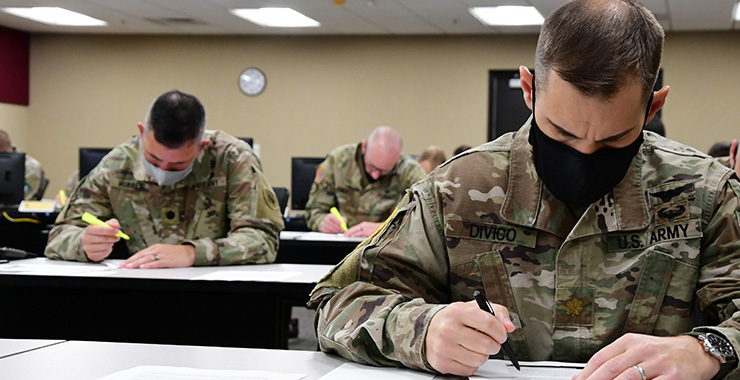
For candidates, the week begins with a series of assessments. To demonstrate their written communication skills, each officer must read a journal article about a national security–related topic and respond with a critical essay. They also complete standardized tests of physical fitness, including 2 minutes of push-ups, 2 minutes of sit-ups, and a timed 2-mile run.
Officers also undergo a series of cognitive and noncognitive tests. The first measure abilities required for strategic leadership, including intelligence and reasoning. The latter evaluate qualities like temperament and attitude.
Those assessments are based on the Army’s leadership requirements model (LRM), which psychologists helped create and validate. The LRM is based on 20 years of longitudinal research on leadership effectiveness in the Army (ADP 6-22: Army Leadership and the Professionopens in new window, 2019). It includes core competencies and attributes that define what leaders should do and the characteristics enabling those actions, such as discipline, humility, judgment, and innovation.
That model also forms the foundation for the second major stage of the evaluation process: a peer and subordinate feedback assessment developed by Wolfe and her team. For each officer, at least 10 peers and 10 subordinates complete an anonymous assessment that includes items about successful leadership behaviors as well as opportunities to note toxic or counterproductive leadership, such as abusive behaviors.
With a completion rate over 70%, the Army has already collected nearly 100,000 responses through the new multisource assessment tool. The peer and subordinate feedback provided about the candidates has been overwhelmingly positive, said Wolfe, and helps provide more nuanced insights into officers’ strengths, for example whether someone excels at personnel development or has visionary qualities.
“In the past, officer selection has always been top-down,” she said. “Taking a bottom-up or lateral look at how someone is performing to help provide a more holistic picture has been pretty revolutionary for the Army.”
Bias-free evaluations of competency
BCAP’s third major component is a two-part psychological assessment. BCAP candidates are divided into small groups to negotiate a set of challenging conceptual scenarios that require collaboration and teamwork. Psychologists and senior officers observe how candidates interact with their teammates throughout the exercise, including how they behave as a leader and as a follower.
Each candidate also completes an interview with an operational psychologist, which is not a mental health assessment but rather an evaluation of suitability for command. The interview includes questions about personal and professional background, military history, and how the officer interacts with various people and situations.
Army psychologists formulated the questions and designed a system that helps reduce bias during the interview. All information gathered on candidates is anonymized to mitigate biases related to areas such as gender, race, military unit affiliation, and military badges. Furthermore, the psychologist who interviews the candidate is never the psychologist who provides a summary of the candidate’s performance to the voting panel.
“Psychologists offer the ability for the voting panel members to better understand an individual’s cognitive, interpersonal, and behavioral attributes in relation to their readiness to lead and develop future soldiers,” O’Brien said.
The process culminates with a double-blind panel interview where candidates are asked follow-up questions about the peer and subordinate feedback, how they performed on various assessments, and how they interacted with teammates during the group leadership exercise.
The candidate sits on one side of a partition; the panel—comprising five voting members and three nonvoting members, including a senior operational psychologist—sits on the other side. This format is designed to reduce bias in scoring candidates and to put candidates at ease when answering questions. Of course, this does not eliminate all identifying factors—for example, interviewers can still differentiate between male and female candidates.
To further reduce potential sources of bias, panel members also receive training from the CAP senior operational psychologist on best practices for conducting objective semistructured interviews. They learn about common cognitive biases that can influence ratings, such as the tendency to favorably judge candidates who seem similar to themselves or to evaluate people relative to one another rather than based on the objective requirements of the position. Each interviewer also undergoes rater accuracy training, where they practice watching sample candidate interviews and scoring them based on a behavioral rating scale. Panel members also complete a brief anti-bias refresher training session each morning before they conduct interviews.
“Overall, the system allows the entire CAP team to make data-driven, actuarial decisions regarding performance versus subjective impressions of the candidate,” O’Brien said.
The final product of BCAP is a rank-ordered list of officers that determines who is and who is not yet ready for command, followed by a slating of officers to lead various battalions. All officers who attend BCAP receive developmental feedback, and almost all of those identified as not yet ready for command may attend BCAP the next year to compete again.
Expanding new assessments
Following the successful rollout of BCAP, military leaders are working to apply the program’s methodology to assess and select leaders across the Army, including through the Colonels Command Assessment Programopens in new window. Other military service branches, including the United States Navy and United States Air Force, have also expressed interested in adopting BCAP’s framework for leadership selection.
The military is also designing further tools to support Army personnel. All BCAP participants are offered 5.5 hours of executive coaching following the program. The task force has also created the Army Talent Alignment Process, a data-rich online marketplace that helps officers find assignments that match their skills, knowledge, and preferences. Psychologists play a key role in the development and refinement of such resources, Wolfe said, and these resources are continually evaluated for accuracy and effectiveness.
“The bottom line is you want to make data-driven decisions,” she said. “Psychologists know the best practices for ensuring that every decision we make is based on evidence and is consistent.”