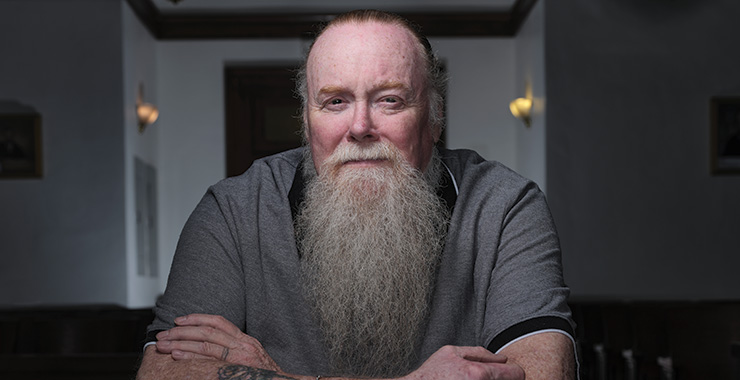
For Red Gilbert, 6 years in state prison proved easier than living through the first 5 months after his release.
After he left jail, with no job and nothing but $50 and a bus ticket in his pocket, Gilbert experienced daily uncertainty and stress including unstable housing, mostly in homeless shelters.
“I know that makes no sense,” said Gilbert, who now works as a mental health and reentry peer specialist for Texas RioGrande Legal Aid in South Texas. “But [in prison] I didn’t have to worry about eating. I didn’t have to worry about having a roof over my head. I didn’t have to worry about having a bed to lay down in. All of this stuff was provided for me. I was just caged in.”
Gilbert, who left prison in 2007, benefited from more of a safety net than many of the more than 7 million people annually who are released from U.S. jails and prisons. He was married, and his wife stood by him while he served time for several drug convictions and then while they tried to find work and housing. But given his record, Gilbert was turned away more times than he could count, until he landed a job about 3 months after his release.
Still, he said, “You are set up to fail. I had somebody, but we didn’t have anything else.”
These days, Gilbert is part of a cadre of peer specialists, reentry services, and other nationwide efforts designed to connect formerly incarcerated men and women with housing, behavioral health care, and other vital help. The goal, including the use of techniques to address criminogenic risk factors such as antisocial attitudes or antisocial peers, is to reduce the risk of reincarceration. Among former prisoners, 5 out of 6 will be arrested at least once in the first 9 years after their release, according to a U.S. Department of Justice analysis published in 2018.
Psychologists, who already provide assessment and treatment within the criminal justice system, play a notable role with reentry efforts, including holding leadership roles in programs, supervising caseworkers, and coordinating between the legal system and rehabilitation efforts. There has been evidence that such reentry initiatives can successfully reduce recidivism, according to a review of research (Peters, R. H., et al., The American Journal of Drug and Alcohol Abuse, Vol. 43, No. 4, 2017opens in new window).
Still, such efforts are dwarfed by the massive needs of these vulnerable individuals during the first year following release, particularly the first several months, psychologists say. Despite notable programs and initiatives emerging over the past decade, more investment and focus are required at this critical juncture, said Sarah Desmarais, PhD, president of Policy Research Associates in Delmar, New York, which oversees projects that include operating the Substance Abuse and Mental Health Services Administration’s (SAMHSA) GAINS Center for Behavioral Health and Justice Transformationopens in new window.
“It is the most significant period of time in a person’s involvement in the criminal legal phase,” she said. “I really believe we can do a lot of important work and treatment while they’re in custody. And it can fall apart if we don’t have the right supports and safety nets in place to support their successful reentry.”
Black adults and youth are notably impacted by systemic racism at every stage of the criminal justice system, according to data compiled on racial disparities by the Prison Policy Initiative, a nonprofit research and advocacy organization in Northampton, Massachusetts. The analysis, which relies upon federal data, found that Black individuals are more likely to be arrested or incarcerated than White individuals. For instance, 2,272 out of every 100,000 Black men were incarcerated in state or federal prison in 2018, more than double the rate of Hispanic men (1,018 per 100,000) and more than 5 times the rate of non-Hispanic White men (392 per 100,000).
Once incarcerated, individuals of all demographic backgrounds are likely to be coping with at least one behavioral health condition. Among those in U.S. prisons, 37% report a mental health diagnosis, as do 44% of people in jails, according to a 2017 report by the U.S. Department of Justice.
Moreover, no one can avoid being incarcerated without suffering some degree of trauma on top of any preexisting sexual, psychological, or physical trauma, said Sandra Smith, PhD, a peer programs manager for Via Hope, a Texas-based nonprofit organization. She created Via Hope’s reentry peer specialist certification training, which has been completed by more than 80 formerly incarcerated men and women, including Gilbert.
“There is a specific trauma related to being incarcerated that is pretty much indescribable,” said Smith, who was incarcerated herself 2 decades ago. “First of all, it’s losing your liberties—losing the ability to do anything on your own. And you’re constantly being yelled at. You’re constantly being demeaned.”
From there, individuals walk into a world where the logistics can prove overwhelming—everything from finding a job and somewhere to live to keeping up with parole and avoiding the old neighborhoods, people, and patterns that landed them behind bars in the first place. This world also may be unrecognizable. One psychologist described how caseworkers in her program devote considerable time to teaching individuals how to use a smartphone, as well as how to use the subway metro cards.
“It’s like climbing Mount Everest in your bare feet,” said Arizona forensic psychologist Joel Dvoskin, PhD. “It’s kind of amazing that a fair number of people don’t come back right away,” he said. “It’s a tribute to the human spirit that people manage to do this without much help.”
Chicken and egg
Too often, these individuals didn’t receive help for mental health or substance use challenges prior to their incarceration, said Roger Peters, PhD, a clinical psychologist and emeritus professor in the Department of Mental Health Law and Policy at the University of South Florida in Tampa. Peters coauthored a study that looked at prior treatment among more than 18,000 men in U.S. jails and found that 62% didn’t report any previous behavioral health care (Hunt, E., et al., Psychiatric Rehabilitation Journal, Vol. 38, No. 1, 2015opens in new window).
“These are people who have never engaged voluntarily in treatment, for the most part, and who aren’t savvy to what the benefits of treatment are,” Peters said. Plus, amid the often macho culture of men’s jails and prisons, seeking out behavioral health care can be viewed as a sign of weakness or vulnerability, he said.
In cases where individuals are taking prescribed medication while incarcerated, the clock begins to tick upon release to get them into care before their pills run out, said Robert Morgan, PhD, a researcher in mental health care and the criminal justice system, as well as dean of the College of Health and Human Sciences at Southern Illinois University in Carbondale. “Oftentimes they’ll leave with a seven-day supply, something to give them at least a little bit of a start, but not much,” he said.
The risk of overdose is particularly high shortly after release, said Jessica Klaver, PhD, a forensic psychologist and chief program officer at the Center for Alternative Sentencing and Employment Services (CASES)opens in new window, a private nonprofit organization in New York City. They are also vulnerable to rearrest for minor crimes rooted in poverty and immediate needs, she said.
“They’re coming out and they have no money,” Klaver said. “They have no job. They steal things like toothbrushes. They steal deodorant. It’s crimes that make you want to cry.”
Looking back, Gilbert believes that he struggled with undiagnosed depression during his first months. How could someone not, he said? “It’s very, very depressing to realize that you literally have nothing but what you’re carrying on your back.”
In his peer specialist role, Gilbert gets referrals from a six-county region in South Texas, low-income men and women who have been arrested and have a mental health diagnosis or substance use issue. Gilbert provides support from the time of arrest through court hearings and jail, striving to line up mental health treatment, housing options, and other safety net services to help after their release.
They aren’t required to work with him, and some don’t. But Gilbert, whose client load was supposed to be 12 to 15 people, was working with more than 60 individuals in various stages of the criminal justice system last summer. “There needs to be more people doing what I do,” he said.
Once released from jail, these individuals often face the same chicken-and-egg dilemma that Gilbert did. It’s difficult to land a job without the stable housing that’s needed to get a decent night’s sleep and keep clothes clean. But to find housing—already a steep challenge when one has a prior conviction—a paycheck is required, he said.
In Gilbert’s case, he frequented Goodwill’s employment center in San Antonio so often, getting on the computer to search for jobs, that a director there offered him employment helping customers and restocking. “It was easier to hire me to work for them, than to look at me every day,” he said with a laugh.
Easing community reentry
At one of the reentry programs operated by CASES that assists people leaving state prison, caseworkers work hard to make contact prior to release, to explain the services that the program provides, and to gain insight into their most pressing needs, Klaver said. For instance, she said, “It’s January in New York, what size boot do you wear?”
They put together a duffel bag with a few items of clothing, underwear, socks, snacks, and toiletries. The caseworker brings that bag—a small up front investment to hopefully avert minor thefts later—to the first meeting at the parole office.
At that meeting, the caseworker hopes to build the client’s trust with the organization, Klaver said. “It’s all about engagement in the beginning.” Once that baseline of trust is in place, “maybe we could cajole them to go see that psychiatrist,” Klaver added.
Similarly, the mental health agency Community Connectionsopens in new window reaches out to Washington, D.C., residents shortly before their prison release. Many of these individuals are typically referred because of a history of mental illness, said David Freeman, PsyD, chief clinical officer at the Washington, D.C.-based nonprofit organization that provides behavioral health and other services to marginalized residents. They assist with obtaining services, such as applying for Medicaid and housing programs, and provide psychotherapy blended with case management, he said.
“The psychotherapy part is, What is it that you want to accomplish? What are the things that are going to trip you up? Who do you trust? How do you check that out?”
Even if a plan had been developed before the release of an individual, such as housing, it can soon fall apart, Freeman said.
“Thoughtful housing plans are extremely rare,” he said. “A lot of times the plans that people make are on a wing and a prayer.” For instance, an estranged daughter might agree to having a formerly incarcerated parent live with her, not knowing what else to say. But once the parent arrives, it becomes clear that the housing situation is already overcrowded, which causes stress levels to rise, and the plan doesn’t end up working out.
To help mental health clinicians better understand the issues and logistics involved with reentry, the GAINS Center provides some online resources. In addition, Policy Research Associates also operates SAMHSA’s SOAR (SSI/SSDI Outreach, Access, and Recovery) Technical Assistance Centeropens in new window, which among other services, offers free online training to teach clinicians, case managers, and others how to enroll eligible individuals into disability and other programs, Desmarais said.
Finding ways to pay for behavioral health treatment and medications can pay off significantly, said Desmarais, who has conducted related research. One study she was involved with looked at hospitalized Medicaid recipients with schizophrenia or bipolar disorder and found that 31% were arrested at least once after being released from the hospital, mostly for misdemeanor charges. But routine outpatient treatment, including medication and mental health services during the first 90 days after hospitalization, significantly reduced arrests for misdemeanors and felonies (Van Dorn, R. A., et al., Psychiatric Services, Vol. 64, No. 9, 2013opens in new window).
Working in a leadership role, psychologists can also leverage their expertise to bridge gaps between the criminal justice, legal, and behavioral health systems, said Abigail Tucker, PsyD, a Denver-based clinical psychologist with extensive work in the criminal justice system and is the chief strategy officer for Polara Health, a nonprofit behavioral health provider in Prescott, Arizona.
In recent conversations with local county jail officials, Tucker learned how frustrated they were that people too often relapsed following release. “If you are struggling with substance use, there is a forced sobriety that happens while you’re in detention,” she said. “It can look like you’re all clean and ready to go. But it’s a controlled environment.”
Starting earlier this year, formerly incarcerated individuals with substance use issues prior to incarceration are now taken directly to Polara Health’s residential treatment program upon release, where they are typically treated for 2 to 4 weeks, Tucker said.
Therapeutic complexities
In the first several months after release, individuals may often cope relatively well, buoyed by their return to the community, Morgan said. But over time, initial plans may unravel, as their job prospects look bleaker or their living situation doesn’t work out.
“Those stressors start to build,” Morgan said. “And without appropriate access to mental health care to help manage things and provide support, that’s when people start to get overwhelmed and start to deteriorate.”
When providing therapy, it is important that psychologists address not only mental health issues but also any criminogenic risk factors that may boost the risk for recidivism, said Morgan, who is among those researchers who have studied these risk factors. One recent study that Morgan coauthored, which looked at the eight criminal risk factors among patients hospitalized in psychiatric facilities, found that those with risk factors were more likely to have been previously involved with the criminal justice system (Bolaños, A. D., et al., Law and Human Behavior, Vol. 44, No. 4, 2020opens in new window).
In a therapeutic session, a psychologist could work with a patient to identify friends or family members who demonstrate antisocial traits and develop strategies to minimize contact with them, Morgan said. A stoplight mnemonic approach can be useful, he said, asking the patient to sort peers into those who are red light individuals, with antisocial behaviors and criminal justice involvement, and others who fall into the yellow or green light categories. For an upcoming family barbecue, a psychologist might encourage a patient to think through how to limit interactions with red light individuals in pursuit of more time with prosocial friends and relatives, he said.
During meetings with patients, Freeman helps them think through how they will cope with elements of their postrelease plan, particularly scenarios that might be far from ideal. As one example, he said, someone might have planned to live with a sister while failing to consider that it would mean interacting with his or her abuser, who visits on weekends.
First, someone must be willing “to acknowledge that the plans that they have laid out are fraught,” Freeman said. If no housing alternative exists, the next step is to brainstorm approaches for when the abuser visits. First, though, recognition is vital, he said. “I need a strategy. I need some help figuring out how I’m going to handle that. Other than hiding in my room, storming off, or getting high.”
In her work, Tucker has trained therapists to watch out for interpersonal cues and remember that even seemingly routine questions—asked to better assist that individual—might feel more like a police interrogation. That therapist might be one of the first individuals someone who has been recently released has interacted with on the outside, she said.
If the interview seems to be off to a bumpy start, Tucker trains therapists to suggest taking a break. That way both parties can separate for a brief stretch, and the therapist can get guidance from a supervisor.
Despite the therapeutic challenges involved, this work can be profoundly meaningful, Morgan stressed.
“They have great need and not a lot of people who are willing to help them,” Morgan said. “It’s an opportunity to help people at their lowest point and to really make a significant impact in somebody’s life.”