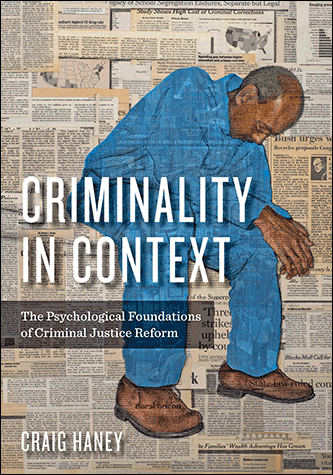
Criminality in Context
In this groundbreaking book that is built on decades of work on the front lines of the criminal justice system, expert psychologist Craig Haney encourages meaningful and lasting reform by changing the public narrative about who commits crime and why.
Based on his comprehensive review and analysis of the research, Haney offers a carefully framed and psychologically based blueprint for making the criminal justice system fairer, with strategies to reduce crime through proactive prevention instead of reactive punishment.
Haney meticulously reviews evidence documenting the ways in which a person’s social history, institutional experiences, and present circumstances powerfully shape their life, with a special focus on the role of social, economic, and racial injustice in crime causation. Haney debunks the “crime master narrative” — the widespread myth that criminality is a product of free and autonomous “bad” choices — an increasingly anachronistic view that cannot bear the weight of contemporary psychological data and theory.
This is a must-read for understanding what truly influences criminal behavior, and the strategies for prevention and rehabilitation that follow.
Foreword
Shadd Maruna
Preface
Introduction
- Individualistic Myths and the Crime Master Narrative
- Risks and Contexts: An Alternative Paradigm for Understanding Criminality
- Criminogenic Trauma: Social History and the Life Course
- Institutional Failure: State Intervention as Criminogenic Risk
- Criminogenic Contexts: Immediate Situations, Settings, and Circumstances
- Poverty: Structural Risk and Criminal Behavior
- The Criminogenics of Race in a Divided Society: Racialized Criminality and Biographical Racism
- Individualistic Myths and the Disregard of Context: Deconstructing “Equally Free Autonomous Choice”
- Reorienting the Law: Context-Based Legal Reforms
- Pursuing Social Justice: An Agenda for Fair, Effective, and Humane Crime Policy
Afterword
Since his early work on the Stanford Prison Experiment, Craig Haney has become one of the nation’s most highly regarded scholars whose research, writing, and testimony have helped to transform the criminal justice system.
He served on a National Academy of Sciences committee studying mass incarceration, and his front-line observations and analyses have been cited by the United States Supreme Court.
He has seen firsthand how social and economic injustice operate to produce crime in our society and how often the criminal justice system acts to worsen rather than alleviate these problems.
He lives in Santa Cruz, California.
Instead of punitive, oppressive, and racist social control, the author vividly delineates a model of compassionate, innovative, and progressive reforms that will transform the current “politically” driven, chaotic system into an effective criminal justice model. Including policing, the judicial system, and the penal system in the realm of criminal justice reform, Criminality in Context is a wonderful read for all people vested in better understanding the intersections among crime, legal and penal policy, and the criminal justice system as a whole.
—Choice