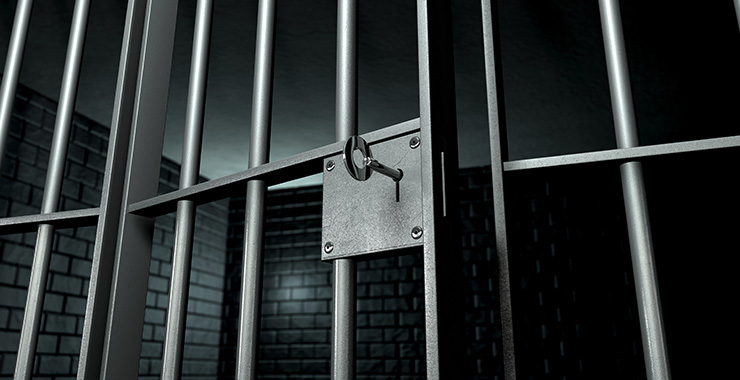
Prisoners held in solitary confinement at the Pontiac Correctional Center (PCC) in Illinois are typically entitled to 1 hour of exercise time, or “yard time,” 5 days per week. The prisoners remain alone during yard time, but they are allowed to exercise in either an outdoor cage or an indoor recreation room. Prisoners placed on “yard restriction” because of major conduct violations receive only 1 hour per month outside of their isolation cell.
In some cases, inmates are also denied that 1 hour per month. Michael Johnson, an inmate with mental illness at PCC, received no exercise time over the course of an entire year. Johnson had a diagnosis of bipolar disorder, severe depression, and a skin-picking disorder, and had survived numerous suicide attempts. He also frequently violated prison rules, including spitting at others, refusing to clean his cell, damaging property in his cell, possessing contraband, and covering himself in feces. As a result, Johnson was held in solitary confinement for nearly his entire 3-year term of incarceration at PCC, and he was almost continuously placed on yard restriction because of his misconduct. During his year without any yard time, Johnson’s psychological symptoms were exacerbated: He suffered hallucinations, excoriated his flesh, and repeatedly smeared feces on himself. He also suffered physical effects such as nosebleeds, respiratory problems, and headaches because of his inability to exercise.
The harsh consequences of solitary confinement have been well established through psychological research. Some negative effects, including hallucinations, self-mutilation, aggression, depression, and suicidal ideation, are observable within days (Haney, C., Crime & Delinquency, Vol. 49, No. 1, 2003opens in new window). Even when inmates receive daily yard time, the forced social isolation, reduced stimulation, idleness, and loss of access to activities, visitation, and property during solitary confinement cause devastating impacts (Haney, C., Annual Review of Criminology, Vol. 1, 2018opens in new window).
Courts have traditionally acknowledged that exercise is a “human need” akin to food and warmth (Wilson v. Seiter, 1991opens in new window). Most courts hold that a prison may deprive an inmate of all out-of-cell exercise only if the inmate poses a security risk (Campbell v. Cauthron, 1980;opens in new window Williams v. Greifinger, 1996opens in new window). Prolonged exercise deprivation is therefore ordinarily unlawful when imposed merely to punish misbehavior.
Johnson filed a lawsuit in 2022 alleging that his prolonged denial of exercise violated the Eighth Amendment’s prohibition against cruel and unusual punishment. However, the 7th Circuit Court of Appeals rejected Johnson’s claim, citing the “continuous, serious, and sometimes highly dangerous” violations that Johnson committed, “including spitting on inmates or guards and throwing urine and feces” (Johnson v. Prentice, No. 18-3535 at 14, 7th Cir. 2022opens in new window). The Court of Appeals held that prolonged deprivation of exercise does not violate the Eighth Amendment unless the deprivations were imposed “for some utterly trivial infraction of the prison’s disciplinary rules.” This ruling represents a significant departure from the majority rule that prolonged deprivations of exercise are consistent with the Eighth Amendment only when necessary for the security of prison staff and inmates.
Johnson has petitioned the U.S. Supreme Court to review his case, citing the split among the federal circuits created by the 7th Circuit’s ruling. As of this writing, the court has not yet decided whether to grant the petition (Johnson v. Prentice, No. 22-693opens in new window).