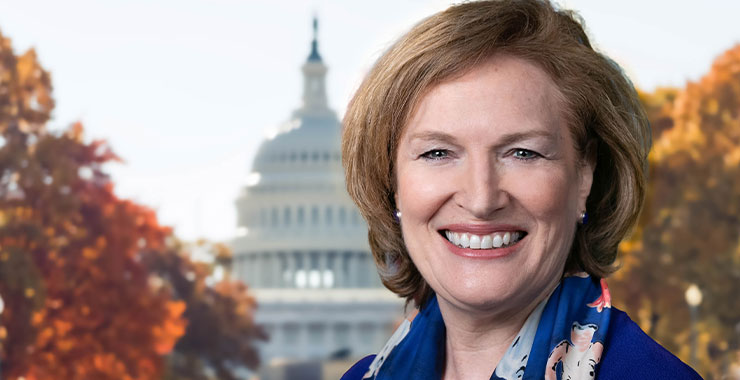
After working across public agencies including NASA, the CIA, the FBI, and the Transportation Security Administration, industrial and organizational (I/O) psychologist Elizabeth Kolmstetter, PhD, is no stranger to the challenges facing the federal workforce. But work has changed in the post-Covid-19 era, and employers are looking for new ways to balance flexibility and productivity. So, in 2022, when Kolmstetter was recruited as chief people officer of the Cybersecurity and Infrastructure Security Agency (CISA), the newest agency of the Department of Homeland Security (DHS), focused on protecting the nation’s critical infrastructure from physical and digital threats, she jumped at the chance to build a company culture (almost) from scratch.
“Now that we’ve entered the hybrid era, we have to design the workplace to create meaningful connections while allowing people as much flexibility as possible in terms of where and when they work,” she said. “It’s uncharted territory.”
Kolmstetter spoke with the Monitor about the course she is mapping.
What does a chief people officer do?
I was recruited by CISA’s director, Jen Easterly. Her goal was to create a people-first agency that cares for employees as people, not as workers here to get a paycheck. There are chief people officers in the private sector, but usually human resources operations are included underneath that person. Director Easterly’s vision was to make it a separate role. We have a chief human capital officer focused on things like hiring, pay, benefits, annual appraisals, and retirement. They make sure we have the right people with the right tools. But what is the employee experience at CISA? Are people at risk of burnout or disengagement? I’ve been charged with driving the people-first culture that supports well-being, engagement, and success. That, in turn, ensures we have the organizational capacity to achieve the agency’s mission of preventing cyberattacks.
What are the challenges facing CISA’s workforce?
CISA is growing rapidly. Our workforce is about 3,100 civil servants, and a third of them have been hired in just the past 2 years. It’s largely a STEM workforce, a lot of engineers and analysts looking at vulnerabilities in technology. Because technology touches everything, cybersecurity touches everything: hospitals, education, the electric grid, water supply, physical infrastructure, chemical security, and more. The workload in cybersecurity just keeps growing, and we need enough people to do this complex work.
As a national security agency, we have staff on alert in our control centers 24/7. The pace of hacks and cybersecurity attacks is unforgiving, so I’m always concerned about stress and burnout. We need to create balance between work and personal life so our people can maintain physical and mental resilience. Another challenge has to do with our agency’s identity and culture. Although the agency was created in 2018, CISA existed as a smaller entity within DHS headquarters almost 20 years before that. So, there’s new infrastructure and new ideas, but also legacy employees who are steeped in doing things the way they’ve been done for years. We have to create a new culture that works for everyone.
What kinds of programs and policies are you establishing?
We want to make sure that our people are healthy and well, which means training our supervisors and managers to see employees holistically and recognize that our organizational culture is flexible about meeting people’s needs. We built a CISA Cares program that provides wide-ranging support services for mental and physical health and well-being, including psychiatry and psychology services, as well as a program affording 3 hours per week of duty time for physical fitness. We have a weekly town hall meeting that often features experts speaking about topics like burnout, resilience, and suicide prevention. And we’ve rolled out psychological safety training based on the work of Harvard Business School researcher Amy Edmondson, PhD. We think a lot about how to create a safe space where people can be authentic and feel safe raising ideas and concerns. That’s just for starters.
Are there strategies you are developing that could be a model for other workplaces?
We’re being very intentional about building a new culture, and I do think it could serve as a model. We’ve created a culture council that includes representatives from every division. Different departments have very different missions, and this council allows us to make sure we are thinking of everyone as we scale best practices across the organization. We’re also doing a lot with diversity and inclusion. CISA has worked hard to recruit a diverse workforce that reflects the makeup of the American people. We’re embedding diversity and inclusion into all our programs so it’s part of our DNA. The culture council is also designing a new employee recognition program focused around our 12 core principles, including fostering belonging, diversity, inclusion, and equality and leading with empathy.
We’re also thinking a lot about internal mobility. I/O psychologist Edie Goldberg, PhD, has done a lot of research on this, and I agree with her that we don’t think about it enough as a talent source. People today aren’t content to sit in the same job for 30 years, nor should they be. When people are ready to expand their experience, they often think they have to get another job somewhere else. I’m trying to build an internal mobility program so that people have those workforce development opportunities without having to leave. It will also include rotations into the private sector, where people can work for a year or two with our private partners before bringing those skills back to CISA.
We have also designed a custom 360-degree feedback program that all supervisors, managers, and executives participate in, as well as a culture dashboard that is defined with metrics, in areas such as feedback, engagement, training and mentoring, diversity, and telework. Year after year, we can compare those metrics to ensure that we’re creating the healthy culture we’ve envisioned.
When people talk about measuring productivity, they’re often still just counting outputs. For our national security mission, productivity includes collaboration, partnering, teamwork, information sharing, awareness, trust, and flexibility. That kind of productivity doesn’t come from sitting alone at your desk at home building widgets. We need more psychological research on the benefits of person-to-person connections as well as “alone time” or “thinking time” so employers can determine the right mix. Hybrid work is here to stay, and psychologists have to weigh in on this if we’re going to balance the benefits of remote work with the importance of human connection.