American Psychological Association. (2024, March 4). What do people really want in their work? Meaning and stability. Monitor on Psychology, 55(1). https://www.apa.org/monitor/2024/01/trends-meaning-stability-workplaces
When it comes to employment, Americans in all sorts of occupations—from auto workers to Hollywood actors, from startup founders to restaurant servers—are feeling unsteady thanks to artificial intelligence (AI), reverberations of the pandemic, job design, and other factors, psychologists say.
“Instability of work is something that has been part of humanity, and it feels like it’s getting worse in some ways because it is getting worse,” said David Blustein, PhD, a professor in Boston College’s Department of Counseling, Developmental, and Educational Psychology.
“The number one thing people are craving right now is stability—especially in their workplaces,” said Ella F. Washington, PhD, an organizational psychologist and professor of practice at Georgetown University’s McDonough School of Business.
But the future of work isn’t all bleak: An unstable ground is strengthening workers’ resolve to advocate for meaning, well-being, and work-life balance on the job, and psychologists are poised to help.
“We know how to improve jobs and to improve motivation, to increase people’s satisfaction, and also to make it so that they add value,” said Susan J. Lambert, PhD, codirector of the Employment Instability, Family Well-Being, and Social Policy Scholars Network at the University of Chicago.
In other words, working toward greater stability, she added, “is good for business and it’s good for people, and I think it’s really good for society.”
Origins of instability
Instability at work doesn’t just mean the threat, or reality, of layoffs. Researchers define it as “a state in which the consequences of a mismatch between an individual’s functional and/or cognitive abilities and demands of their job can threaten continuing employment if not resolved” (Brain Injury, Vol. 20, No. 8, 2006opens in new window).
Maybe someone’s not paid enough to maintain their lifestyle, maybe they can’t keep up with the pace, maybe they lack a sense of belonging, maybe their environment is straight-up toxic.
However workers experience it, the pandemic is perhaps the most blatant driver of instability at work—continuing to shake up the literal ground many employees stand on as employers experiment with hybrid schedules. While research suggests more flexibility largely benefits workers’ mental health and productivityopens in new window, quickly-shifting mandates on who should work where and when can be disorienting, as can an office environment that’s just not the same.
Employees are “not necessarily in the same location when they are ‘on location.’ They’re not necessarily, or rarely, with the same configurations of people and activities that they were before,” said Amy Wrzesniewski, PhD, a professor of management at Wharton at the University of Pennsylvania who studies meaning at work. “So maybe people are in the office a few days a week, but the office isn’t the office anymore.”
Job design is contributing to instability too, said Lambert, a professor at the University of Chicago Crown School of Social Work who studies work scheduling practices among low-wage workers.
“A lot of jobs have just been so fragmented that people can’t complete a whole job from beginning to end, and they can’t take pride in it,” she said. It’s easier for a salesperson who sees a purchase all the way through to reap satisfaction, for example, than someone whose single duty is to price items.
Put another way: When jobs are designed so that people can be replaceable, they’ll feel replaceable.
Relatedly, an increasing reliance on contract workers over salaried employees is driving instability, Blustein said. This played out in the auto workers’ strike of fall 2023, he said, where the workers demanded automakers stop hiring so many temporary workers to do their tasks.
Wavering equity, diversity, and inclusion (EDI) efforts can also contribute to instability at work, particularly among employees from marginalized groups, said Washington, an EDI expert who serves as founder and CEO of Ellavate Solutions in Washington, D.C.
Washington said she’s witnessed many organizations ease up on their commitment to EDI—sometimes unintentionally, and often quietly, such as having a page on their website about inclusion go dark or an EDI director role go unfilled.
“To me that’s the more scary part of the change because—unlike the change in 2020—you can’t see it until it’s too late,” she said.
But employees from underrepresented populations can feel it and, as a result, start to psychologically retreat. That has implications for both them and their employers, Washington said.
“Research shows that when employees can be their authentic selves and they can work and play toward their strengths, they’re not only happier and feel more of a sense of psychological safety, but they also do better work,” she said.
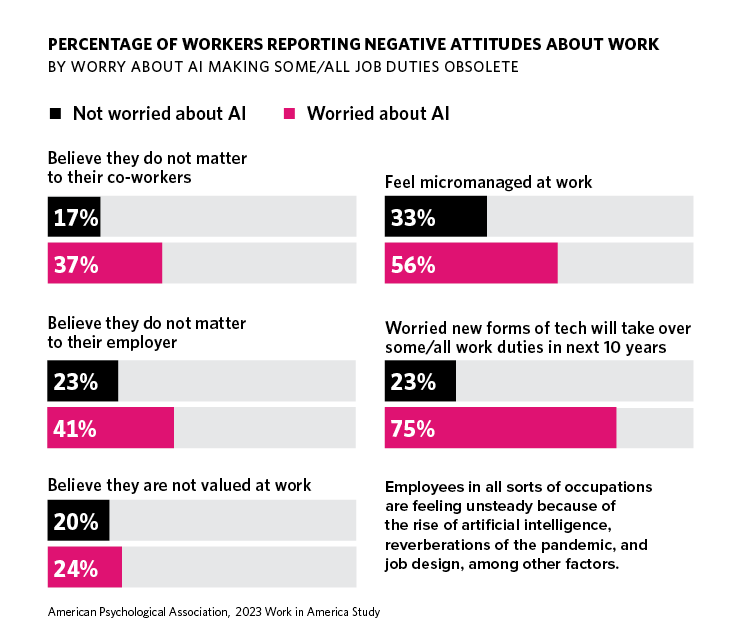
Finally, how artificial intelligence is and will affect people’s livelihoods is contributing to both practical and emotional instability among workers.
In a follow-up to APA’s 2023 Work in America survey specifically about AI, 38% of respondents reported worrying that AI might make some or all of their job duties obsolete, and 64% of those who were worried said they typically feel tense or stressed during the workday.
In one recent study, Wrzesniewski explored how 94 former or unemployed newspaper journalists have navigated not just job loss but also the decline of their whole industry, and often along with it, a sense of identity and purpose. She and collaborator Winnie Jiang, PhD, found that whether people had a “fixed” or “flexible” meaning in their work predicted whether they held out hope that their field would be restored—or they reinvented their careers.
Those with a more flexible mindset tended to recover more quickly from the sadness of their loss, and even found a sense of freedom along the way. Professionals of all stripes who may be impacted by AI should take note.
“There’s some pretty good evidence that AI is going to affect people in jobs that are more precarious to begin with, or jobs that are easily replaced by automation,” Blustein said. “So that’s a huge issue, and that’s going to add to the precariousness of work.”
Finding meaning amid uncertainty
Despite a social media trend of younger workers saying they want mindless work that allows them to clock in and out and live their lives, research suggests people of all ages largely crave a deeper purpose on the job.
In APA’s survey, 93% reported believing it’s very or somewhat important to have a job where they feel the work has meaning. Fortunately, most workers felt their jobs met the mark. Indeed, “mattering at work,” which is defined to include meaning and dignity, has been listed by the U.S. Surgeon Generalopens in new window as one of the “five essentials” for mental health and well-being in the workplace.
If you’re not seeking value from your work outside of a paycheck, Wrzesniewski asked, “then where is that sense of meaning or that sense of accomplishment or that sense of development and learning and pride coming from?”
“If there’s not an available other domain in life in which that’s happening,” she said, “then I think it becomes a pretty closed and unfulfilling loop ultimately.”
The search for meaning shouldn’t be a privilege limited to white-collar workers, Lambert said. “Everybody wants to have a job that uses their skills, that allows them to take pride in their work,” she said. “Think of the electrician, think of the plumber, think of the craftsmen who used to be able to make something and put their name on it. Those are incredibly rewarding jobs.”
But meaning is self-defined: For some, earning a paycheck is richly meaningful alone, Blustein said.
Meaningful work can also coexist with firm work-life demarcation, something employees increasingly say they want, but that the pandemic further blurred, according to Tammy Allen, PhD, a distinguished university professor in the University of South Florida’s Department of Psychology who studies work-life balance. Indeed, APA’s Work in America survey found only 40% said their time off is respected.
That’s problematic for all parties since, Allen said, “some detachment from work makes people be able to be better workers and to be able to bring their best selves to work, as opposed to being perpetually on and overworked, which can result in burnout.”
She’s found that simple so-called temporal boundary management tactics can help people set boundaries between work and home. Shutting down the computer at the end of the day and taking breaks during the day, for instance, can make a big difference in improving employee mental health.
[Related: 2023 Work in America Survey: Workplaces as engines of psychological health and well-being]
Wrzesniewski’s research on “job crafting,” meanwhile, demonstrates how employees can weave their own values and interests into their work to keep them more engaged. For example, an accountant may implement a new way to file taxes to make the job less repetitive or a teacher who moonlights as a musician may reframe their lectures as a performance. People who successfully job craft, other work has found, are more likely to have their needs for autonomy, competence, and relatedness at work met, and they also report better subjective and psychological well-being (Journal of Happiness Studies, Vol. 15, 2014).
“Try to start to build up and out from where you are to run these small experiments and make these small moves that may become bigger moves that get sustained and cemented into changes in your role over time,” she said.
Still, much of the onus is on employers to design roles, cultivate work environments, and support relationships that help staff find purpose, belonging, and ultimately, more security. Policymakers, governments, and health care providers also have a responsibility to support workers’ mental health through population-wide, not just individual, interventions a recent article in The Lancet argues (Rugulies, R., et al., Vol. 402, No. 10410, 2023opens in new window).
The good news, psychologists say, is that employers are waking up to this reality, which also supports their bottom line.
“Organizations are realizing they need to adapt to the needs of their workers,” Blustein said, “and that would be a very positive trajectory for the future.”