skip to main content
Conversation

Hirokazu Yoshikawa, PhD, studies interventions for young children in the Middle East

Community psychologist believes Sesame Workshop and International Rescue Committee programs could transform how early childhood education reaches youth in crisis all over the world

APA Style leaf logo Cite This Article in APA Style
Stringer, H. (2024, October 1). Hirokazu Yoshikawa, PhD, studies interventions for young children in the Middle East. Monitor on Psychology, 55(7). https://www.apa.org/monitor/2024/10/hirokazu-yoshikawa-middle-eastern-children

Hirokazu Yoshikawa, PhD

Decades of psychological and economic research have shown that development in the early childhood years affects school progress, well-being, future earnings, and a host of other outcomes later in life, yet governments in almost every country around the world underinvest in education for this age group. Aware of the risks of neglecting this critical window of child development, Hirokazu Yoshikawa, PhD, a professor at the New York University (NYU) Steinhardt School of Culture, Education, and Human Development and codirector of the school’s Global TIES for Children center, studies creative strategies to reach young children, particularly in the most volatile areas of the world.

He recently evaluated a remote learning program in Lebanon developed by Sesame Workshop—the global impact nonprofit behind Sesame Street—and the International Rescue Committee (IRC) that equips parents and caregivers to help their children learn numbers, letters, and social-emotional skills. The curriculum combined episodes from a new Arabic language version of Sesame Street called Ahlan Simsim (“Welcome Sesame” in Arabic) with at-home activities that caregivers could use to facilitate learning. Sesame produced Ahlan Simsim for Syrian refugee children whose families had been displaced by civil war and their host communities in Lebanon, Jordan, Iraq, and Syria. This collaborative project between Sesame Workshop and the IRC, a humanitarian organization that provides emergency aid and long-term support to families and refugees affected by conflict and persecution, received $100 million in grant funding from the MacArthur Foundation.

Yoshikawa told the Monitor that the findings from the evaluation study were even more robust than he and his collaborator, NYU community psychologist Kate Schwartz, PhD, expected (Journal of Research on Educational Effectiveness, advance online publication, 2024opens in new window). He believes the results could change assumptions globally about how countries can provide critical early childhood education that is affordable and scalable.

How and what did the children learn in this remote program?

At the start of the intervention, caregivers received worksheets, storybooks, crafts, and other materials that had been designed by preschool experts from the Middle East. For about 40 minutes three times a week for 11 weeks, caregivers used these materials and content from the Ahlan Simsim show to help their children learn colors, shapes, numbers, letters, and how to be aware of big feelings, verbalize them, and engage in coping strategies to process these emotions. The kids also learned from video segments how to ask for help, tell a friend about an emotion, and recognize an emotion in a friend, which are all foundational skills for later social development.

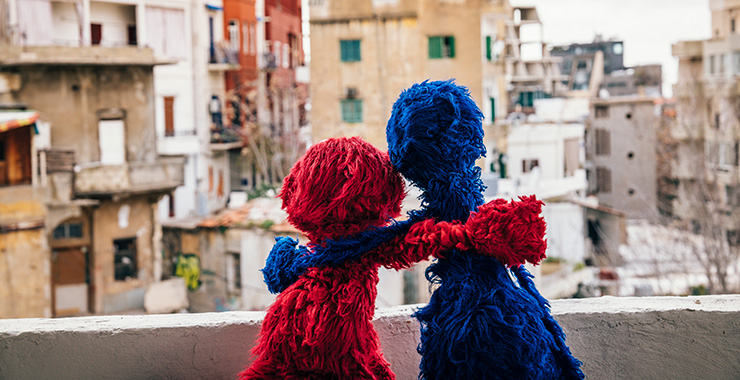
In one Sesame segment on the TV show, Jad, a yellow Muppet new to his neighborhood, is sad because he no longer has one of his favorite toys that he left in a prior home. He names the emotion and gets a hug from another character on the show. We all experience loss, and the ability to talk about it and support another child is especially important for kids who are affected by the stresses of war and forced displacement.

The caregivers turned on their video at the beginning of the WhatsApp calls on their mobile devices (Wi-Fi was very spotty during the economic crises going on in Lebanon). The kids would stay on the call for a few minutes to greet one another, and for the remaining 40 minutes a group of about six caregivers would share how their children were doing and receive coaching from a local teacher about different fun activities they could do at home to support learning.

two muppets arm in arm looking out at a neighborhood

What were your findings? Did the program make a difference with these children?

The combination of the at-home activities and Sesame video content produced spectacular effects on language, numeracy, and social-emotional and motor development. We found that the learning gains after 11 weeks were equivalent to those we usually expect from an entire year of preschool. The preschool teachers were initially skeptical about whether caregivers could deliver this type of education. This innovation showed that remote preschool is indeed possible.

The teachers reported getting to know families in ways that they rarely had in the past. Your average preschool teacher sees parents at drop-off and pickup, but during the WhatsApp calls, parents would share more personally about challenges they were facing related to power outages, difficulty buying food, and how their children were coping. The teachers also went out of their way if a caregiver could not attend a session by scheduling a separate call on the weekend or late in the evening. Another important finding was that the education and literacy levels of the caregivers did not affect their success in supporting learning among children. This really counters the stereotype that parents with low levels of education cannot teach their children at home.

What challenges did the research team face?

When the Sesame video content was initially being developed, sometimes the words for emotions were difficult to translate into another language. Basic emotions like sadness and anger were straightforward, but frustration can arise in circumstances and contexts that are more subtle and complex. The qualitative responses from caregivers also showed that faith-based coping strategies were very important in their lives, but this was not reflected in the curriculum.

What are the next steps to increasing access to preschool education?

The remote learning program we studied in Lebanon was recently piloted by the International Rescue Committee and the Ministry of Education of Iraq with 600 children in Iraq, and it was very successful. The children in Iraq advanced to the same degree as the treatment group in the initial study in Lebanon. I’m interested in studying whether this model could be applicable to mobile and migrant families in other parts of the world, such as Latin America.

Caregivers are often underestimated in terms of how they can support learning, and we need to innovate to reach more parents. Mass media channels throughout the Middle East are also broadcasting Ahlan Simsim, and 27 million children have seen the show in this region.

This is the single largest early childhood intervention in the history of humanitarian response. While this is encouraging, far too many young children in the world still do not have access to quality learning. That’s what keeps me up at night. Education systems worldwide are shutting down because of armed conflict, climate-related events, and political crises, and there is an urgent need to continue finding ways to support young children and their families.

Recommended Reading

Speaking of Psychology

Subscribe to APA’s audio podcast series highlighting some of the most important and relevant psychological research being conducted today.

Subscribe to Speaking of Psychology and download via:

Appleopens in new window
Apple podcast logo

Spotifyopens in new window
Spotify logo

You may also like