Key points
- As the U.S. fertility rate has declined, colleges and universities are facing a steep drop in enrollment that could impact the psychology workforce.
- Efforts to recruit and support underrepresented students could help address workforce shortages and improve diversity in the field.
- Initiatives to address declining enrollment include educating K–12 students about psychology, smoothing transitions from 2-year to 4-year colleges, and reducing financial barriers to pursuing psychology careers.
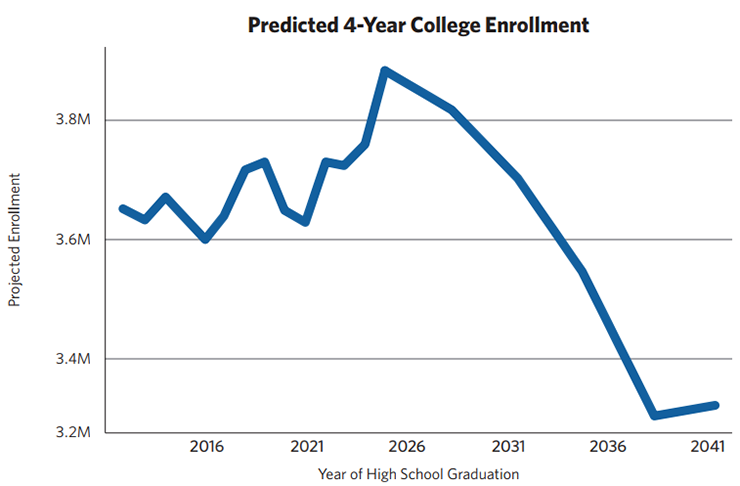
The U.S. fertility rate has been trending downward for decades, and colleges and universities find themselves on the edge of a precipice of declining enrollments—a situation that some institutions of higher education are ominously calling the “Great Cliff” or the “Enrollment Cliff.” In 2023, the nation’s fertility rate reached the lowest level ever recorded. The number of high school graduates is expected to peak in 2025 before dropping steadily at least through 2037 (Bransberger, P., et al. Knocking at the College Door [10th ed.], Western Interstate Commission for Higher Education, 2020opens in new window). Meanwhile, the price tag for higher education continues to soar, leading more young people to make the calculation not to pursue college or graduate degrees. It all adds up to a significant threat—not only for psychology programs that rely on incoming tuition dollars but for the future of the field itself.
As enrollments contract, schools may be forced to cancel classes, lay off instructors, and even consider mergers or closures. And the broader impact on society could be significant. Fewer psychology students translates to fewer mental health providers, fewer psychological scientists, and fewer educators to train the next generation of psychologists. “Psychology is beautiful because it applies to everything we do—it can make the world a better place. But we can’t do that unless we continue to have people trained in psychology,” said Karen Naufel, PhD, a professor of psychology at Georgia Southern University and 2024 chair of APA’s Board of Educational Affairs (BEA).
Prospective future psychologists are lost at multiple junctions on the pathway from high school graduation to psychology career. But APA and others are identifying opportunities to shore up the bumpy spots along that route, including efforts to clear financial barriers to graduate education and inspire a new generation of future psychologists. “Right now, psychology is fairly healthy as a major. There’s a lot of student interest, but there are financial and logistical barriers at all stages that need to be addressed,” said Karen Brakke, PhD, a professor of psychology and director of the Teaching Resource and Research Center at Spelman College in Atlanta, Georgia, and a member of the BEA. “It’s up to us to make sure the pathways are clear so those students can get to where they need to go.”
Recruiting a diverse psychology workforce
Psychology programs may not be feeling the pinch yet, but that could be shifting. “Psychology has long been a popular undergraduate major,” said Catherine Grus, PhD, APA’s former chief education officer. “But because that’s what we’ve enjoyed forever, there’s a risk that psychology faculty aren’t taking this seriously.”
Historically, enrollment numbers in undergraduate and graduate psychology programs have shown annual growth. “In the past few years, that growth has been smaller,” Grus said. “And so far, the trends for this academic year suggest we may actually be seeing a small decrease in enrollment.”
At the same time, there is growing recognition that the field of psychology must diversify to meet the needs of individuals and society. Efforts to recruit and support psychology students from wide-ranging backgrounds can help with both aims, ensuring a robust field of psychology professionals that reflects the rich diversity of the United States. “If we want to diversify the field and make sure we have adequate numbers of people in the workforce, we need to strengthen bridges across degree levels, through financial support, mentorship opportunities, and practical, hands-on opportunities to get people excited about psychology,” said Karen Stamm, PhD, senior director of APA’s Center for Workforce Studies, which collects, analyzes, and disseminates data about the psychology workforce and education system.
Those opportunities can start years before a student declares a major. To get young people excited about psychology careers, APA President Debra Kawahara, PhD, associate dean of academic affairs and distinguished professor at the California School of Professional Psychology at Alliant International University, is launching a presidential initiative called Engaging Psychology’s Future. With partners including APA’s Teachers of Psychology in Secondary Schools and Committee on Associate and Baccalaureate Education, she is planning a series of local events in as many as 100 communities across the United States. Through these informal events, high school and community college students can hear from psychologists about career options and connect with mentors in the field.
“Given my own lived experience as a first-generation college graduate, I know that if you’re not exposed to the people doing this work, you often can’t imagine yourself in that role. These events can provide that personal connection,” Kawahara said. “I’m hopeful that APA members will step up to participate. It’s a small lift, but it’s so important to engage young people to consider the array of things psychologists do that contribute to society’s well-being.”
Support for community college
Community colleges present another opportunity for growing the field. According to the 2019 National Survey of College Graduates, about half of graduates who hold bachelor’s or master’s degrees in psychology attended community college early on. Yet among psychology doctoral graduates, less than one third attended any community college. That suggests more can be done to strengthen the supports needed to help community college graduates transition into psychology graduate programs.
Research experience presents a significant obstacle in that transition, said Todd Joseph, MA, division chair for Public Safety, Social, and Behavioral Sciences at Hillsborough Community College in Tampa, Florida, and executive director of Psi Beta, the national honor society for psychology at 2-year colleges. Most 4-year colleges encourage students to take a research methods course soon after intro-level psychology. But many 4-year institutions will not accept research methods as a transfer equivalent from 2-year colleges. Since the credits will not transfer, most community colleges do not offer the course at all. That means community college transfer students cannot take the foundational class until their junior year. Without that prerequisite, they have fewer opportunities to enroll in higher-level psychology courses and are less likely to be selected to participate in hands-on research. Those limitations hurt their chances of being accepted into graduate programs.
The belief that community colleges are not equipped to teach research methods is as widespread as it is dubious, Joseph said. “As a 3rd-year grad student I taught a 200-person section of research methods. Now, with 20 years of experience, I can’t teach it [at Hillsborough Community College] because universities won’t accept it as a transfer equivalent.”
One way community colleges try to sidestep that obstacle is through organizations such as Psi Beta, which provide students with opportunities to participate in research projects and present at local and national conferences. Still, Joseph and other advocates urge universities to do more to ensure that students—and their transfer credits—can make the shift from 2-year to 4-year colleges. Improving those on-ramps would also benefit efforts to diversify the field. Data show that students from underrepresented backgrounds, including first-generation, low-income, and BIPOC students, are more likely to start their education in community colleges (“An Introduction to Community Colleges and Their Students,” Community College Research Center, 2021opens in new window).
“Community college students generally come from a lower SES [socioeconomic status] background, often have more responsibilities as caregivers, and almost always work outside of school. These aren’t just poor students who ended up at community college. They’re often excellent students who have had to persevere through more negative experiences than the average [4-year college] student,” Joseph said. “More universities need to develop a transfer-receptive culture and recognize that community college students can succeed because they’re transfers, not in spite of it.”
Clearing financial hurdles
Financial barriers also get in the way of a psychology career. Pursuing a doctorate is expensive—not only because of the cost of tuition and living expenses, but also because of the opportunity costs of not working during those long years of education and training. Yet the need for skilled mental health providers continues to grow. “We need to create more ways for people to enter the field,” Stamm said. “Not everyone wants or is able to pursue a doctorate. But given our mental health workforce shortages, we need everyone to contribute.”
To address that need, APA’s Commission on Accreditation (CoA) has been working since 2018 to develop an accreditation program for master’s programs in health service psychology, comprising clinical, counseling, and school psychology programs. In 2024, CoA approved the first such accreditation, for the clinical psychology master’s program at Capella University in Minneapolis. Several other master’s programs in health service psychology are now being evaluated for accreditation (see “Psychologists Are Seeking to Modernize the Profession”).
Other efforts are underway to clear financial hurdles for people pursuing psychology careers. In July 2024, the Accelerating the Development of Advanced Psychology Trainees (ADAPT) Act was introduced in the U.S. House of Representatives following advocacy from APA and others. The bipartisan legislation would support reimbursement in Medicare for supervised services provided by doctoral interns and postdoctoral residents—a policy that could make it more fiscally feasible for people to pursue clinical careers.
Individual institutions can also do more to support students, seeking out novel funding sources, for instance, and making programs more accessible to working students. “Nontraditional students who have been away from higher education for some time may be interested in joining the mental health workforce. But they often need flexible training programs that can fit into their existing jobs and caregiving commitments,” Brakke said. In other words, schools may have to rethink the status quo to find ways to help their students—and their departments—succeed.
Planning ahead
The challenges created by the enrollment crisis are likely to vary from institution to institution. Prestigious schools will probably continue to see a relatively steady stream of students (and tuition dollars). But other schools could pay the price as better-resourced universities with large endowments ramp up recruitment from the shrinking pool of prospective students. Still, all psychology programs should pay attention, Naufel said.
“Institutions and individual psychology departments need to look at this issue to understand the threats and opportunities to their program, and think about how they can address them,” she said. The BEA has begun collecting resources to assist programs as they prepare for the changes to come. A release date for those resources has not been set, but academic faculty should not wait to start thinking about ways to take action, Naufel said. “It’s important that we share ideas and work together to address this issue while preserving the quality of psychology education,” she added.
That last piece is critical. As the student body shrinks, Naufel said, some administrators may be tempted to take rash measures, such as lumping psychology, social work, and other programs together into a single “social sciences” program without giving enough thought to who will be teaching such programs and how well they will prepare students for graduate school. “We need to have a plan ahead of time to make sure psychology students continue to get the prerequisite knowledge they need to succeed in the field,” she said.
Psychologists across the discipline can act in ways small and large to protect the future of the field, through efforts like teaching young kids about psychology careers, mentoring community college students, or advocating for incentives to support students from diverse backgrounds in pursuing graduate degrees. “Faculty need to make sure they communicate with students all of the different ways they can enter the psychology workforce and contribute to addressing the issues we face as a society,” Brakke said. “Students are interested in making a difference. We need to get creative and find ways to give them the opportunities that will open those gates.”
Further reading
Psychology programs prep for steep drop in college students
Abrams, Z. Monitor on Psychology, March 2024
Building a robust mental health workforce
de las Fuentes, C. Monitor on Psychology, September 2024
Reducing barriers for community college students majoring in psychology
Stringer, H. Monitor on Psychology, September 2022
Psychology for kids: The science of the mind and behavior
Toner, J. B., & Freeland, C. A. B. Magination Press, 2021
Explore the wide range of psychological science careers (PDF, 1.7MB)opens in new window
APA, 2024