Today’s young children encounter more media claiming educational benefits than any generation before. Children can access content on mobile devices, tablets, computers, voice assistants powered by artificial intelligence (AI), and more.
Yet the learning and development benefits vary widely among the offerings. In one recent study of 124 commonly downloaded apps marketed as “educational to children,” researchers found that most of the apps scored in the lower range in key areas that are critical for learning (Meyer, M., et al., Journal of Children and Media, Vol. 15, No. 4, 2021opens in new window). Children learn most effectively when media facilitates meaningful interaction with characters, can be applied to everyday experiences, and does not include distracting visual and sound effects and advertisements.
Although some media may not be as “educational” as advertised, psychologists see the demand for digital learning content as an opportunity to positively influence millions of children. These tools have the potential to help kids learn valuable skills tied to outcomes later in life, such as educational attainment, future earnings, and well-being. “I am a firm believer in the science of learning,” said Kathy Hirsh-Pasek, PhD, a psychology professor at Temple University and a senior fellow at the Brookings Institution. “If we use psychological science as a basis to create media products that capitalize on how human brains learn, we can develop better products and kids will get more out of it.”
Using media to bridge gaps in education is more important than ever as evidence uncovers the depth of learning loss because of the COVID-19 pandemic. To study the effects of stay-at-home orders that closed preschools, playgrounds, and other settings for early learning, researchers investigated 672 children born between 2020 and 2021. The data showed that these children had significantly reduced verbal, motor, and overall cognitive performance compared with children born pre-pandemic. Children from lower socioeconomic families were most affected. According to neuroimaging data from the same study, children born during the pandemic also showed reduced brain white matter (Deoni, S., Biological Psychiatry, Vol. 91, No. 9, 2022opens in new window). Other evidence suggests that the pandemic has contributed to significant delays in social-emotional development for young children (Kuehn, L. M., et al., JAMA Pediatrics, Vol. 178, No. 2, 2024opens in new window).
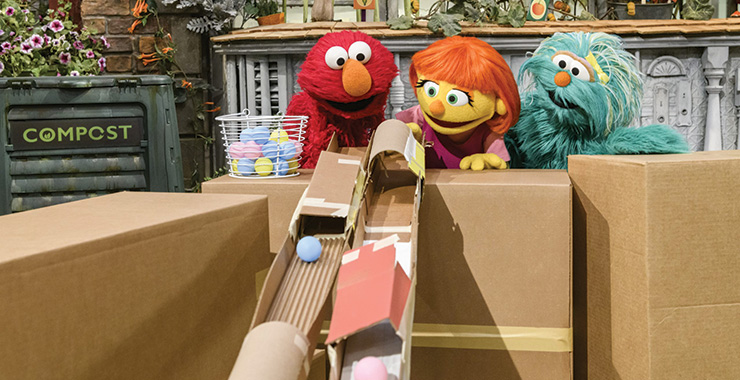
“Quality educational children’s media is not a substitute for preschool, but it has the power to mitigate learning loss in the midst of disruption,” said Kim Foulds, PhD, vice president of content research and evaluation at Sesame Workshop, a global educational media organization that has incorporated the science of learning into content development since the first season premiered in 1969. (APA is in its sixth year of partnering with Sesame Workshop on content related to children’s emotional well-being.) The latest studies reveal that television shows, apps, and interactive online games can teach numeracy and literacy, as well as social-emotional skills and thinking processes that help children become problem solvers rather than fear failure. Scientists are also discovering how media that allows viewers to converse with characters maximizes learning—and how AI is poised to create these interactive digital experiences.
[Related: Hirokazu Yoshikawa, PhD, studies interventions for young children in the Middle East]
“Clearly, we do not want our kids to be friends with AI at the expense of their friendships with real kids, but the use of interactive characters in AI could serve as an extra tool in the arsenal to help our kids learn,” said Sandra Calvert, PhD, professor emerita of psychology at Georgetown University and director of the Children’s Digital Media Center.