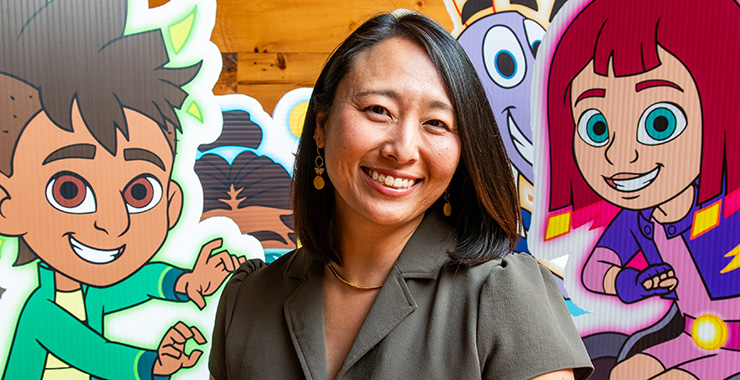
Sixty-five percent of youth now 15 years old and younger will work jobs that have not yet been invented, according to McCrindle, an Australian research firm. As technology and the workforce continue to evolve at rapid speed, today’s children may benefit from honing essential skills and competencies while also being exposed to potential careers. Momo Hayakawa, PhD, the managing director of child development and research at Twin Cities PBS in St. Paul, Minnesota, oversees the research for Skillsville, PBS’s latest animated offering designed to nurture essential skills for children ages 4 to 8 as they prepare for the world of work. She applies her training as a developmental psychologist to ensure the show is age appropriate and builds executive functioning and self-regulation skills. The television show is complemented by digital games as well as hands-on activities, live-action self-regulation strategy videos, ebooks, and virtual field trips that are free for after-school programs, libraries, and families.
How does Skillsville help young children build the skills needed for their future careers?
Skillsville supports early childhood learning and develops the foundational skills kids need. We decided early on that the three curricular pillars for our content are career exposure, executive functioning (EF) skills, and self-regulation strategies. Those form the foundation for every episode and our digital and analog content.
In every episode, the series presents a career, such as entrepreneur or game tester, and we make sure to showcase both common and uncommon careers. We want kids to explore different careers while learning how to manage everyday challenges that require EF skills. Every episode focuses on an EF skill, such as planning and prioritizing, feeling calm, or focusing.
The three main characters, Dev, Cora, and Rae, use a self-regulation strategy such as making a list or a stretching exercise. That enhances their executive functioning skills so they can overcome challenges that they experience both in the digital world of Skillsville and in their lives. By introducing these concepts of self-regulation strategies and EF to our young audience in ways that are relatable, Skillsville encourages kids to develop the foundation for workforce readiness.
What suggests that kids ages 4 to 8 need career readiness training?
With our research partners [Rockman et al Cooperative], we conducted a needs assessment with over 560 educators, families, and children to understand what areas they needed support in and what kinds of things the kids were into. We found that caregivers and educators were desperate for strategies to support children’s EF skills. Kids in kindergarten to second grade were easily distracted. They would quickly quit a task if it was challenging and they were having a tough time emotionally.
Children at this age don’t need to know what classes that they need to take to pursue a specific career. What they really need are strategies to help them to focus or think differently and to persist in a task. I wanted to expose them to different kinds of careers because that’s what kids can handle at this age.
For each episode, we conduct extensive formative research throughout every phase of development with kids ages 4 to 8 across the nation. Research covers character appeal, the names of the characters, and how they look—from the storyboard to the preliminary animated sequence and then to final animation. We make sure that the kids understand the content and find it engaging. We use methodology from experimental and developmental psychology to make sure we’re asking the right questions to get responses that will help us improve the content.
How do you blend science with storytelling in a way that makes learning exciting for young viewers?
We conduct extensive formative testing. It’s so important that we listen to these kindergartners through second graders and also observe, because sometimes it’s not just what they say. You’ll see a classroom of kids watching an episode, and they’re so into it that they physically stand up and move their bodies closer to the screen because they just want to be immersed in the world of Skillsville. That’s when you know we’re doing something right. I love when the kids turn to each other and start thinking of solutions [to a challenge in the episode] on their own. Like “I would do this,” or “Dev should really do this.” When they’re having that conversation, that means their wheels are spinning. They’re understanding the content. That’s gold.
You have expanded Skillsville into a gamified universe. How do you make that content fun, educational, and safe for young audiences?
Skillsville goes beyond academics, and we integrate creativity and emotional regulation and problem-solving into its storytelling and gameplay. Characters need to think creatively and collaborate to solve problems, whether they’re organizing a virtual city or managing a role-playing task. The characters’ varying personalities help kids see the value of using their unique strengths to overcome challenges. These are social skills that will serve them well in school and later in life. We also have analog activities like paper games and role-play activities so they can extend the learnings from the show and the digital games into their real-world lives, practicing these skills with their classmates or family and friends.
What do you hope the long-term outcomes of Skillsville will be?
Over the next 2 years, my focus is going to be on community engagement and understanding the impact that our content has on our viewers. We’ve planned a couple of quasiexperimental design studies to understand what aspects of our curriculum really stick with kids ages 4 to 8 and how the impacts or the takeaways might differ by grade level. With my background as a developmental psychologist, I’m always interested in “What did the kindergartners get out of it? How is that different from what the second graders got out of this?” We’ve done some pilot studies, and we’re building off of that data. It’s exciting to see more after-school programs use Skillsville and learn about the impact that it’s having on children and families. This is an area where practices from psychology can be even more integrated to create meaningful and entertaining experiences for kids.