Decades ago, dogs caught the interest of comparative psychologists after studies showed they could outperform apes on certain tasks. While apes could better use logic to find hidden food, dogs gained more from social and communicative cues, such as an experimenter pointing to the location of food (Bräuer, J., et al., Journal of Comparative Psychology, Vol. 120, No. 1, 2006; Hare, B., & Tomasello, M., Journal of Comparative Psychology, Vol. 113, No. 2, 1999). Early research on dog domestication led by Brian Hare, PhD, a professor of evolutionary anthropology and psychology and neuroscience at Duke University, also sparked interest in the humanlike social cognitive skills of dogs (Science, Vol. 298, No. 5598, 2002opens in new window; Trends in Cognitive Sciences, Vol. 9, No. 9, 2005opens in new window). Since then, peer-reviewed publications in the field have surged (Aria, M., et al., Animal Cognition, Vol. 24, No. 3, 2021opens in new window).
Initial efforts were met with some resistance. Many believed dogs operated solely on Pavlovian conditioning and were not worth studying. But pioneers such as Ádám Miklósi, PhD, who leads research on dog cognition at ELTE, began to uncover dogs’ unique social abilities—helping the subject gain scientific credibility.
Now, the highly collaborative field uses a clever suite of methods to explore the inner lives of dogs. In the lab, short problem-solving games allow researchers to quickly collect data from their subjects, who are typically volunteer pet dogs or service dogs in training.
“I often describe this type of research as a theatrical production for dogs,” said Zachary Silver, PhD, an assistant professor of psychology at Occidental College in Los Angeles. With a dog on one side of the room, humans on the other side interact, hide food, or perform other actions, while researchers observe how the dog responds.
Because pet dogs are so common, researchers increasingly rely on citizen science. Thousands of pet owners conduct simple experiments at home, adding further richness to the data on dog behavior.
“It’s an interesting research culture where studies don’t just happen quietly in a lab, but people can watch and participate directly,” said Evan MacLean, PhD, an associate professor of veterinary medicine and founder of the Arizona Canine Cognition Center at the University of Arizona.
Large-scale international research collaborations such as the ManyDogs projectopens in new window—an international consortium of researchers working in canine science—are also pooling data from labs around the world to answer the field’s most pressing questions, including why dogs follow the human pointing gesture.
The research boom has also offered the chance to reexamine some assumptions baked into the field. For example, virtually every early study of dog cognition used visual stimuli, with less than 2% focused on olfaction (Animal Cognition, Vol. 23, No. 1, 2020opens in new window). That comes down to a human bias toward examining the world with our strongest sense, said cognitive scientist Alexandra Horowitz, PhD, who runs the Horowitz Dog Cognition Lab at Barnard College, but it has long limited our understanding of how dogs think.
Horowitz has adapted visual techniques used with infants and other animals to study the sense of smell in dogs. For example, the mirror test checks for self-recognition in animals: While anesthetized, an animal is marked—typically on the forehead—then given access to a mirror when awake. If the animal investigates the mark, that is seen as a form of self-recognition. Horowitz designed an olfactory version of the test, which found that dogs can distinguish their own odor from that of other dogs and notice when their odor has been modified (Behavioural Processes, Vol. 143, 2017opens in new window).
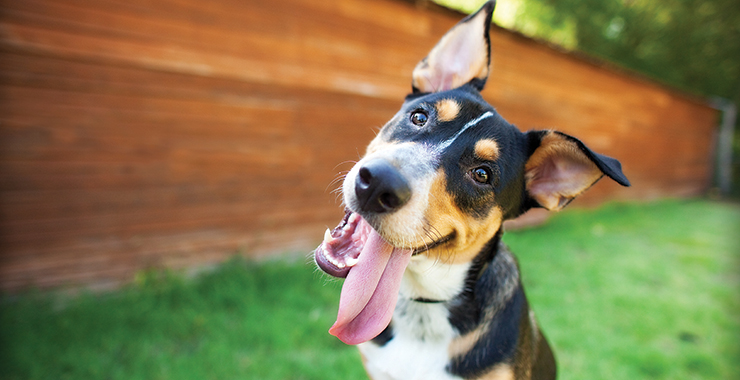
She also studied the full body “shake” behavior—the motion dogs use to shake off water. Horowitz found that it typically preceded a change in behavior, such as when two dogs walk away and stop interacting (Animals, Vol. 14, No. 22, 2024opens in new window). Other research has delved into the head-tilt, finding that it happens when dogs process meaningful external cues, such as the name of a toy they know (Sommese, A., et al., Animal Cognition, Vol. 25, No. 3, 2022opens in new window).
“The fact that straightforward behaviors like ‘shake’ and ‘head-tilt’ aren’t well understood means we may have gotten ahead of ourselves with dog cognition work and forgotten to ask what some basic things really mean,” Horowitz said.