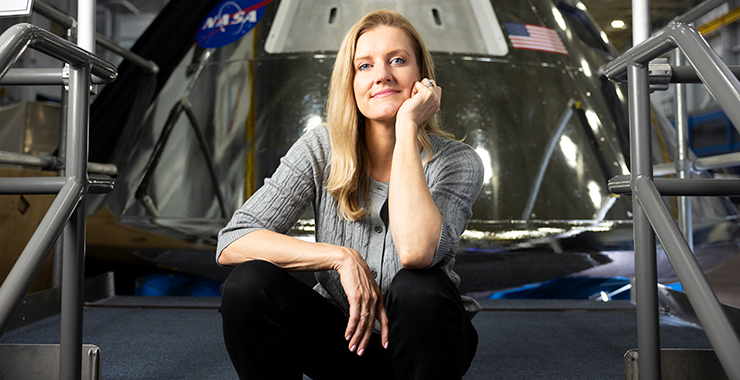
Suzanne Bell, PhD, is an organizational psychologist who leads the Behavioral Health and Performance Laboratory at NASA’s Johnson Space Center. Her team conducts cutting-edge research that mimics the conditions expected for future space exploration and develops evidence-based interventions and technologies that enable humans to survive and thrive—from the Artemis moon landings to future Mars exploration. Her work focuses on helping crews stay resilient, adaptable, and high performing in extreme environments marked by isolation, communication delays, and high-stress tasks.
How does your research inform astronaut training for space exploration, both for Artemis and the Mars mission?
For professional astronauts, NASA has a rigorous selection process and high standards for competencies needed to survive and thrive in space. We look at what they’ll be doing on the job and the behavioral health and team competencies needed to perform with different mission sets. For example, a 45-day moon mission versus a [much longer] Mars mission brings different stressors and challenges. We prioritize different skills and competencies needed for those circumstances, and whatever isn’t covered in selection is augmented with training. Training time for astronauts is always very in demand, and so we want to be as efficient as possible and prioritize what they need to know. We also train at the individual and team levels. Both the Artemis and Mars missions involve extensive teamwork; they survive as a team. When we don’t exactly know what the challenges will look like, we use analog research, or research circumstances that are designed to mimic what we expect for future missions, such as our CHAPEA [Crew Health and Performance Exploration Analog] research. For CHAPEA, four-person crews live and work together for 378 days in a Mars resource-restricted environment. For example, we mimic the expected 12–to–22–minute communication delay between the crew and mission control, as well as between the crew and family and friends. The crew has a restricted food supply and completes tasks such as spacewalks similar to what we might expect for Mars. We collect comprehensive human health and performance data pre-mission, in-mission, and post-mission, which will provide an invaluable dataset to help us understand how individuals and teams can thrive in a Mars resource-restricted environment. We look at pressure points and stressors in CHAPEA and other environments and use that to inform training and best position the crews of the future for a successful mission.
Which technologies do you find useful or essential in your research on the behavioral health of the astronauts?
We use artificial intelligence and machine learning to identify patterns of behavior in an isolated and confinement environment that can be early indicators that a team is not functioning well. Early detection will allow us to support and strengthen relationships before issues become severe. An interesting finding is that in long-term isolation, teams can become less cohesive, sometimes forming subgroups or isolates. When you’re only sending a crew of four to a place like Mars, every person and skill set is important. If team dynamics aren’t supportive of information sharing, team problem-solving, and being able to rely on one another for support, it could have detrimental effects with significant consequences.
How do you optimize behavioral health for working and living in confined spaces for long periods?
We optimize behavioral health through vehicle design, astronaut selection, training, and in-mission supports. For example, the psychologists in our Behavioral Health and Performance Operations group provide coaching on behavioral health and performance competencies, feedback on strengths and areas of focus for development, and suggestions for practicing new skills during the astronaut candidate training process. They continue to support developing astronauts’ resilience and behavioral health competencies as the astronauts await mission assignments. Living and working in confined spaces is complex, as astronauts have limited privacy. For example, in the Orion capsule, space is so limited that even basic activities require coordination. Astronauts are trained on group living skills, conflict management, relating to others, and debriefing so teams can become stronger over time and meet the evolving challenges of space exploration.
What lessons from your research can be applied to other careers and strengthening teams?
Much of the research we do has application for Earth teams as well. For example, any job where people live and work together, such as professional athletes, oil rig workers, or soldiers, can benefit from our research on group living skills. Some of our most important contributions are methodological, including measures of cognitive performance, innovations in AI, machine learning, and methodologies to better examine small sample data. We use novel methods to study not just individual adaptation but also how people work as a team and respond to each other over time, which is relevant to most jobs and everyday life.
How does your research help astronauts readjust to life back on Earth?
Future missions will be longer and more complex, with significant communication delays affecting relationships with friends and family. Our research explores how to help astronauts and their families’ stories evolve together, even with asynchronous communication and a significant communication delay. In our CHAPEA project that simulates Mars conditions, including communication delays, we research reintegration and are using that to develop and inform the supports needed for both crew and families.
What most excites you about the future of your research, and where do you go from here?
I love my job. Much of our work to date has focused on characterizing or understanding individual and team responses to the challenges expected of future space exploration missions. We’ve made significant progress, so now we’re shifting focus to developing training, in-mission monitoring and supports, and other interventions that help individuals and teams perform well under these extreme conditions, including significant communication delays with Earth. It’s a really exciting time, because each time we create an intervention or a countermeasure, we’re that much closer to being able to create a sustained presence on the moon and landing humans on Mars.