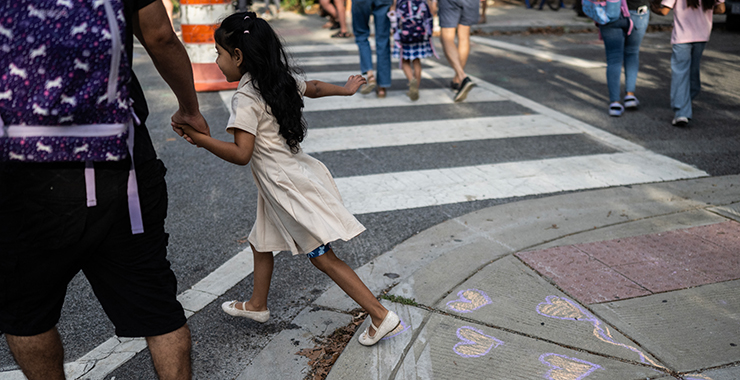
The Department of Homeland Security (DHS) rescinded its long-standing “sensitive locations” policy in January 2025, making schools no longer off-limits to Immigration and Customs Enforcement (ICE) arrests. While ICE requires a judicial warrant or authorization from school officials to enter private spaces, agents may now access public areas—such as parking lots or lobbies—to enforce immigration laws. For many students, families, and school personnel, this shift has eroded their sense of safety and belonging at school, making once-mundane activities like school pickup and drop-off fraught.
“These families fear that just engaging in their daily lives might be a danger to their children and lead to family separation,” said Amanda Venta, PhD, director of the Youth and Family Studies Lab at the University of Houston and cochair of the APA Presidential Task Force on Immigration and Health. “It is not possible to overstate how damaging this is from a mental health standpoint.”
A new push for tougher immigration enforcement is reshaping policies and communities nationwide. In July 2025, H.R. 1, or the One Big Beautiful Act, allocated $75 billion in additional funding opens in new windowto ICE over 4 years, increasing the agency’s operational capacity for arrests, surveillance, and detentions.
More than 1 in 4 U.S. children (26%), most of whom were born in the United States, live with at least one immigrant parent, while 10.3% are noncitizens (Haley, J. M., et al., Children of Immigrants in 2022–23, Urban Institute, 2025opens in new window). Millions grow up in mixed-status families, including an estimated 5.6 million U.S.-citizen children who live in households with at least one undocumented resident (What will deportations mean for the child welfare system?, The Brookings Institution, 2025opens in new window). Yet the impact of enforcement extends far beyond families with undocumented members. Recent ICE operations have swept up legal immigrantsopens in new window and U.S. citizensopens in new window, leaving many to feel unprotected regardless of their status.
School psychologists find themselves uniquely positioned on the front lines. Their traditional duties—delivering assessments, counseling, and coordination of Individualized Education Programs (IEPs)—now intersect with legal and forensic activities, as some provide documentation for immigration-related proceedings and consult on crisis response protocols. In addition, many schools lack institutional policies protecting affected students or have inconsistent local- and state-level protections.
In some states, political hostility or apathy toward immigration may leave school psychologists isolated, searching for trusted allies and information. This leads many to feel “like they’re spitting in the ocean during a tsunami,” said Carola Suárez-Orozco, PhD, director of the Immigration Initiative at Harvard. “There’s the danger of compassion fatigue and secondary trauma.”
The real risk of burnout in this new climate is a significant concern, making self-care and boundary setting essential for professionals. These strategies can take multiple forms. For example, limiting exposure to distressing news or incorporating mindfulness practices can help maintain calm and strengthen coping skills. Both APA and the National Association of School Psychologists (NASP) provide resources for managing secondary trauma. Professionals may also benefit from debriefing with a therapist. They may also turn to their professional support system and seek consultation from professional peer groups or request supervision from experienced colleagues.