

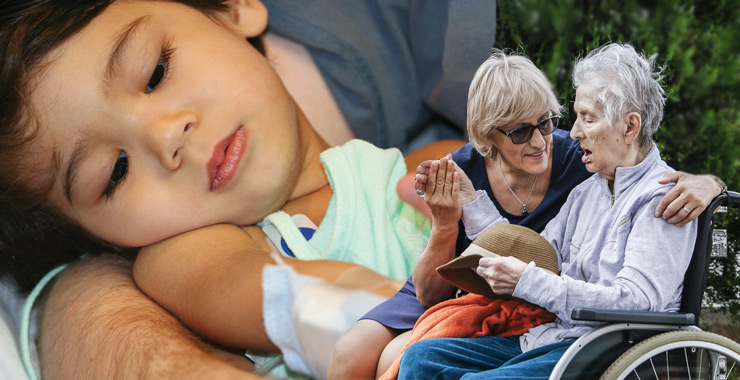

The research literature on family caregiving is vast and diverse. This section highlights some important areas of research on family caregiving, including:
- Descriptions of the prevalence of caregiving and assistance provided by caregivers.
- Studies of the psychological, social, health, and economic impact of caregiving.
- Studies of individual differences in response to caregiving.
- Studies of the effects of interventions and public policies on caregivers.
- Studies on issues faced by caregivers for specific conditions or disabilities and populations.
 The studies below provide information about the extent and variety of assistance provided by caregivers. They range from national samples that offer “big picture” snapshots and trends of caregiving activities (e.g., Wolff et al., 2016) to more focused projects that describe caregiving for individuals with a particular disease or disability of interest (e.g., Gaugler et al., 2005; Haley et al., 2009).
References
Gaugler, J. E., Hanna, N., Linder, J., Given, C. W., Tolbert, V., Kataria, R., & Regine, W. F. (2005). Cancer caregiving and subjective stress: A multi-site, multi-dimensional analysis. Psychooncology, 14, 771-785.
Haley, W. E., Allen, J. Y., Grant, J. S., Clay, O. J., Perkins, M., & Roth, D. L. (2009). Problems and benefits reported by stroke family caregivers: Results from a prospective epidemiological study. Stroke, 40, 2129-2133.
National Alliance for Caregiving & Caring Across America. (2019). Burning the candle at both ends: Sandwich generation caregiving in the U.S. https://www.caregiving.org/wp-content/uploads/2019/11/NAC-CAG_SandwichCaregiving_Report_Digital-Nov-26-2019.pdfopens in new window
Wolff, J. L., Spillman, B. C., Freedman, V. A., & Kasper, J. D. (2016). A national profile of family and unpaid caregivers who assist older adults with health care activities.
Wolff, J. L., Mulcahy, J., Huang, J., Roth, D. L., Covinsky, K., & Kasper, J. D. (2018). Family caregivers of older adults, 1999-2015: Trends in characteristics, circumstances, and role-related appraisal. The Gerontologist, 58(6), 1021-1032, doi: 10.1093/geront/gnx093
Studies of the psychological, social, health and economic impact of caregiving include topics such as:
- The impact of caregiving strain on immune system functioning (e.g., Lovell & Wetherell, 2011; Roth et al., 2019).
- The economic impact of caregiving (e.g., Reinhard, et al., 2019).
- The impact of caregiving strain on immune system functioning (e.g., Lovell & Wetherell, 2011).
- Effects of caregiver strain on caregiver mortality (e.g., Roth et al., 2015).
The literature on the impact of caregiving on inflammation or compromised immunity has also been summarized through meta-analysis (e.g., Roth et al., 2019).
References
Reinhard, S. C., Feinberg, L.,Houser, A., & Choula, R. , Evans, M (2019). Valuing the invaluable: 2019 update: Charting the Path Forward. Available at https://www.aarp.org/ppi/info-2015/valuing-the-invaluable-2015-update.htmlopens in new window
Lovell, B., & Wetherell, M. A. (2011). The cost of caregiving: Endocrine and immune implications in elderly and non-elderly caregivers. Neuroscience and Biobehavioral Reviews, 35(6), 1342-1352. doi:10.1016/j.neubiorev.2011.02.007
Pinquart, M. & Sörensen, S. (2003). Differences between caregivers and noncaregivers in psychological health and physical health: A meta-analysis. Psychology and Aging, 18, 250-267.
Roth, D. L., Fredman, L., & Haley, W. E. (2015). Informal caregiving and its impact on health: A reappraisal from population-based studies. The Gerontologist, 55(2), 309-319. doi: 10.1093/geront/gnu177
Roth, D. L., Sheehan, O. C., Haley, W. E., Jenny, N. S., Cushman, M., & Walston, J. D. (2019). Is family caregiving associated with inflammation or compromised immunity? A meta-analysis. The Gerontologist, doi:10.1093/geront/gnz015
Studies of individual differences in response to caregiving stress often utilize stress process models and categorize factors predictive of caregiver outcome. These studies have been essential for the development of translational research on caregiver interventions. Examples of such studies are:
- describing and evaluating stress and coping models of caregiving (e.g., Folkman, 1997; Pearlin et al., 1990; Vitaliano, 2003)
- the impact of a theoretically interesting construct—for example, women’s multiple roles-- on caregiver well-being (e.g., DePasquale et al., 2014, )
- particular individual difference variables, such as gender (e.g., Pinquart & Sorensen, 2006a), relationship type (e.g., Penning & Wu, 2016), or race (e.g., Badana, et al., 2019 )
- the empirical correlates of caregiver health (e.g., Kang & Marks, 2016, Pinquart & Sorensen, 2007).
 References
Badana, A, Marino V., & Haley, W.E. (2019). Racial Differences in Caregiving: Variation by Relationship Type and Dementia Care Status. Journal of Aging and Health, 31(6), 925-946. doi: 10.1177/0898264317743611
DePasquale, N., Davis, K. D., Zarit, S. H., Moen, P., Hammer, L. B., & Almeida, D. M. (2014). Combining formal and informal caregiving roles: The psychosocial implications of double-and triple-duty care. Journals of Gerontology Series B: Psychological Sciences and Social Sciences, 71(2), 201-211.
Kang, S., & Marks, N. F. (2016). Marital strain exacerbates health risks of filial caregiving: Evidence from the 2005 National Survey of Midlife in the US. Journal of Family Issues, 37(8), 1123-1150. doi:10.1177/0192513X14526392
Pearlin, L. I., Mullin, J. T., Semple, S. J., & Skaff, M. M. (1990). Caregiving and the stress process: An overview of concepts and their measures. The Gerontologist, 30, 583–594
Pinquart, M., & Sörensen,S. (2007). Correlates of physical health of informal caregivers: a meta- analysis. Journals of Gerontology Series B-Psychological Sciences & Social Sciences, 62, P126-37.
Penning, M. J., & Wu, Z. (2016). Caregiving stress and mental health: Impact of caregiving relationship and gender. The Gerontologist, 56(6), 1102-1113. doi:10.1093/geront/gnv038
Pinquart, M., & Sorensen, S. (2006a). Gender differences in caregiver stressors, social resources, and health: An updated meta-analysis. Journal of Gerontology: Psychological Sciences, 61B, P33-P45.
Studies of the effects of interventions and public policies on caregivers include:
- randomized trials of caregiver interventions (e.g., Pinquart & Sorensen, 2006b;) • studies using quasi-experimental designs to evaluate interventions such as adult day care (e.g., Zarit et al., 1998)
- translational research studies demonstrating the impact of caregiver interventions in community settings (e.g., Gitlin et al., 2010)
- reviews that describe existing policies for family caregivers, outline unmet needs to address through future policy change, and provide clinical recommendations for promoting awareness of available benefits (e.g., Bell, 2019)
A comparative effectiveness trial, using a pragmatic RCT design, found that two caregiver intervention programs: REACH OUT and Mary Mittelman’s NYUCI, were equally effective in reducing burden and stress in Hispanic caregivers of persons with dementia. Both programs were more effective in reducing burden and stress for caregivers of spouses than for caregivers of parents. View abstractopens in new window or final reportopens in new window.
References
Bell, J. F., Whitney, R. L., & Young, H. M. (2019). Family caregiving in serious illness in the United States: Recommendations to support an invisible workforce. Journal of the American Geriatrics Society, 67, S451-S456, doi:10.1111/jgs.15820
Gitlin, L. N., Jacobs, M., & Earland, T. V. (2010). Translation of a dementia caregiver intervention for delivery in homecare as a reimbursable Medicare service: Outcomes and lessons learned. The Gerontologist, 43, 532-546.
Pinquart, M., & Sörensen, S. (2006b). Helping caregivers of persons with dementia: Which interventions work and how large are their effects? International Psychogeriatrics, 18, 577-595.
Zarit, S. H., et al. 1998. Stress reduction for family caregivers: Effects of adult day care use. Journal of Gerontology, 53B(5): S267-77.
Within these major areas, researchers have been interested in caregiving for specific conditions or disabilities (e.g. AIDS, mental health disorders, stroke, cancer, traumatic brain injuries, multiple sclerosis, prematurity, asthma, sickle cell disease, intellectual disability) and populations (e.g. children, older adults, individuals of specific cultural and racial backgrounds)
- As many once life-threatening diseases of childhood can now be managed as chronic conditions, the burdens of caregiving on parents have become more broadly delineated and understood. There is considerable research on the social, economic, and psychological impact of caring for an ill child on parents and siblings. A few evidence-based interventions for parents of ill children are also available (Askins et al., 2009; Stehl et al, 2009.)
- The bulk of caregiver research to date has been conducted with older individuals living with conditions that are often associated with older age (e.g., Alzheimer’s Disease, stroke).
 Although caregivers of varying ages and backgrounds may need to perform similar activities, cultural differences may influence the way caregivers perceive and respond to their responsibilities. These factors will become progressively more important as a result of increased diversity in United States—ethnic/racial, but also SES, linguistic, sexual orientation, and religious affiliation. Caregiver reactions, coping strategies, distress levels, acceptance of symptoms, and attitudes toward clinicians and outside help may vary considerably across different cultures (Roth et al., 2015). Research has demonstrated differing beliefs, levels of support, and physical and emotional outcomes among caregivers from diverse cultural backgrounds.
References
Cheng, H. Y., Ying, S., & Chau, J. P. (2014). The effectiveness of psychosocial interventions for stroke family caregivers and stroke survivors: A systematic review and meta-analysis. Patient Education and Counseling, 95, 30-44. doi: 10.1016/j.pec.2014.01.005
Henderson, J. N. (1992). The power of support: Alzheimer's disease support groups for minority families. Aging, 363-364, 24-28.
Poritz, J. M. P., Elliott, T., & Pfeiffer, K. (2015). Family caregivers of stroke survivors. In L. Burgio, J. Gaugler, & D. Algase (Eds.), The spectrum of family caregiving for adults and elders with chronic Conditions. New York: Oxford University Press
Roth, D. L., Dilworth-Anderson, P., Huang, J., Gross, A. L., & Gitlin, L. N. (2015). Positive aspects of family caregiving for dementia: Differential item functioning by race. The Journals of Gerontology: Series B, 70(6), 813-819, doi: 10.1093/geronb/gbv034