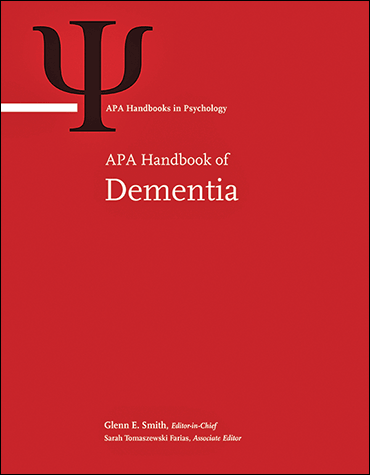
APA Handbook of Dementia
ISBN: 978-1-4338-2879-9Part of the landmark APA Handbooks in Psychology® Series from APA
The APA Handbook of Dementia addresses assessment, comorbidity, evaluation, and treatment of various forms of dementia. The handbook reviews common dementias including Alzheimer’s disease, Lewy body disease, vascular dementia, frontotemporal dementia, and other less common dementias. It is organized into sections discussing diagnosis, epidemiology, and neurobiology (including neuropathology and neuroimaging); assessment, including cultural issues, methodology, and neuropsychology; and primary, secondary, and tertiary intervention strategies. The handbook is intended as a resource for all psychologists and other health professionals that serve persons and families impacted by neurodegenerative disease.
Editorial Board
About the Editor-in-Chief
Contributors
A Note from the Publisher
Introduction
I. Foundations: Diagnosis, Epidemiology, and Neurobiology
- Contemporary Research Criteria for Dementia
Marilyn S. Albert - Epidemiology of Dementia and Mild Cognitive Impairment
Brenda L. Plassman and Guy G. Potter - The Neuropathology of Dementia
Melissa E. Murray and Michael DeTure - Traumatic Brain Injury and Repetitive Brain Trauma: Chronic Traumatic Encephalopathy and Dementia Syndromes
Breton M. Asken and Russell M. Bauer - Brain Imaging in Dementia and Antecedent Conditions
Sterling C. Johnson
II. Assessment: Cultural Issues, Methodology, and Neuropsychology
- Assessment of Cognition in African American Older Adults
David Freedman and Jennifer J. Manly - Assessment of Age-Related Cognitive Changes and Dementia in Chinese and Chinese-American Older Adults
June Yu Paltzer - Neuropsychological Assessment of Spanish-Speaking Older Adults
Otto Pedraza - Widely Disseminated Tools for the Assessment of Populations at Risk for Dementia
Sandra Weintraub and Stephanie Kielb - Aging and Everyday Functioning: Measurement, Correlates, and Future Directions
Maureen Schmitter-Edgecombe and Sarah Tomaszewski Farias - Financial and Medical Decision-Making Capacity in Mild Cognitive Impairment and Dementia
Kristen L. Triebel, Adam Gerstenecker, and Daniel C. Marson - Quality of Life in Dementia: Conceptualization, Measurement, and Psychosocial Treatment Implications
Rebecca G. Logsdon and Linda Teri - Clinical Assessment of Alzheimer's Disease
Emily C. Edmonds, David P. Salmon, and Mark W. Bondi - Clinical Neuropsychological Assessment in Older Adults With Lewy Body Disease and Parkinson's Disease
Julie A. Fields - Clinical Neuropsychology of Frontotemporal Dementia
Christa L. Watson, Jessica M. Foley, and Joel H. Kramer - Neuropsychological Evaluation for Vascular Dementia
David J. Libon, Melissa Lamar, Catherine C. Price, Angela L. Jefferson, Rodney Swenson, and Rhoda Au - Neuropsychology of HIV-Associated Neurocognitive Disorders
Lisa L. Barnes and S. Duke Han
III. Intervention: Primary, Secondary, and Tertiary Prevention Strategies
- Cognitive Reserve: Theory, Measurement, and Evidence
Daniel Barulli and Yaakov Stern - Social and Behavioral Factors Associated With Risk of Developing Dementia
Robert S. Wilson and Patricia A. Boyle - The Effects of Physical Activity on Cognition, Dementia Risk, and Brain Health
Sasha N. Skinner, Matthew P. Ellis, and Judy Pa - Cognitive Remediation Approaches and Dementia Prevention: Findings From the ACTIVE Trial and Related Research
Sherry L. Willis - Does Cognitive Training Reduce Risk for Dementia?
Elizabeth M. Zelinski - Evidence Supporting Common Cognitive Rehabilitation Techniques in Cognitively Symptomatic Older Adults
Benjamin M. Hampstead, Emily M. Briceño, and Sarah Garcia - Memory Compensation in Mild Cognitive Impairment and Dementia
Melanie J. Chandler and Anne L. Shandera-Ochsner - Multicomponent Approaches to Secondary Prevention of Dementia
Kelly J. Murphy - Disclosing a Neurodegenerative Diagnosis: The Complexities of Telling and Hearing
Brian D. Carpenter and Jonathan Gooblar - Treating Comorbidities in Dementia: Depression
Vonetta M. Dotson, Sarah M. Szymkowicz, and Molly E. McLaren - Sleep in Mild Cognitive Impairment and Dementia
Jennifer Rose V. Molano - Assessment and Pharmacological Management of Behavioral and Psychological Symptoms in Dementia
Maria M. Reyes and Bruce Sutor - Support Groups and Dementia
Tai L. Sims and Joseph E. Gaugler - Education Programs for Informal Dementia Caregivers
Kenneth Hepburn, Mariya Kovaleva, and Carolyn Clevenger - Risks for Elder Abuse Among Persons With Dementia
Karen A. Roberto and Kirby Deater-Deckard - Person-Centered Care as Treatment for Dementia
Cameron J. Camp, Michelle S. Bourgeois, and Jérôme Erkes - Palliative and End-of-Life Care in the Context of Dementia
Rebecca S. Allen, Fei Sun, Hillary R. Dorman, and Amy E. Albright
Index
Glenn E. Smith, PhD, is Elizabeth Faulk Professor and chair of the Department of Clinical and Health Psychology at the University of Florida and emeritus professor of psychology at Mayo Clinic College of Medicine.
Dr. Smith is a board-certified clinical neuropsychologist. He received his PhD in clinical psychology from the University of Nebraska and completed his internship in neuropsychology and geropsychology at the University of California, Los Angeles, and his fellowship in clinical neuropsychology at the Mayo Clinic.
He has authored or coauthored more than 200 original articles and 16 book chapters in the area of cognitive aging and dementia.
During his 25 years at Mayo, he, his trainees, and his collaborators created the Healthy Action to Benefit Independence and Thinking (HABIT®) program for persons with mild cognitive impairment.
He is currently the principal investigator of the Comparative Effectiveness of Behavioral Interventions to Prevent or Delay Dementia study and co-principal investigator for the National Alzheimer's & Dementia Patient & Caregiver-Powered Research Network; both projects were funded by the Patient Centered Outcomes Research Institute.
He is past president of the American Board of Clinical Neuropsychology and of APA Division 40 (Society for Clinical Neuropsychology) and past chair of the APA Committee on Aging.
In 2016, he received the American Academy of Clinical Neuropsychology's Distinguished Clinical Neuropsychologist Award.
Essential.
—Choice