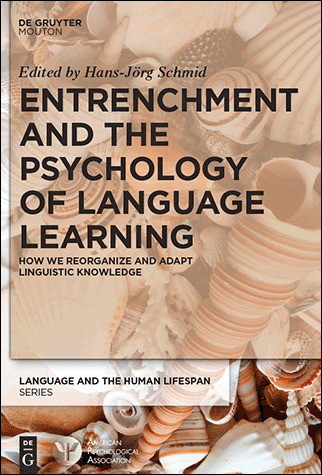
Entrenchment and the Psychology of Language Learning
In recent years, linguists have increasingly turned to the cognitive sciences to broaden their investigation into the roots and development of language. With the advent of cognitive–linguistic, usage-based and complex–adaptive models of language, linguists today are utilizing approaches and insights from cognitive psychology, neuropsychology, social psychology and other related fields.
A key result of this interdisciplinary approach is the concept of entrenchment — the ongoing reorganization and adaptation of communicative knowledge. Entrenchment posits that our linguistic knowledge is continuously refreshed and reorganized under the influence of social interactions. It is part of a larger, ongoing process of lifelong cognitive reorganization whose course and quality are conditioned by exposure to and use of language and by the application of cognitive abilities and processes to language.
This volume enlists more than two dozen experts in the fields of linguistics, psycholinguistics, neurology, and cognitive psychology in providing a realistic picture of the psychological and linguistic foundations of language. Contributors examine the psychological foundations of linguistic entrenchment processes, and the role of entrenchment in first-language acquisition, second-language learning, and language attrition.
Critical views of entrenchment and some of its premises and implications are discussed from the perspectives of dynamic complexity theory and radical embodied cognitive science.
Contributors
Introduction
Hans-Jörg Schmid
I. Setting the Scene
- A Framework for Understanding Linguistic Entrenchment and Its Psychological Foundations
Hans-Jörg Schmid
II. Linguistic Perspectives on Entrenchment
- Entrenchment in Cognitive Grammar
Ronald W. Langacker - Entrenchment in Construction Grammar
Martin Hilpert and Holger Diessel - Entrenchment Effects in Language Change
Hendrik De Smet - The Corpus-Based Perspective on Entrenchment
Anatol Stefanowitsch and Susanne Flach - Entrenchment From a Psycholinguistic and Neurolinguistic Perspective
Alice Blumenthal-Dramé - Entrenchment as Onomasiological Salience
Dirk Geeraerts
III. Cognitive Foundations of Linguistic Entrenchment Processes
- Memory Consolidation
Atsuko Takashima and Iske Bakker - On the Automaticity of Language Processing
Robert J. Hartsuiker and Agnes Moors - Statistical Learning as a Domain-General Mechanism of Entrenchment
Ethan Jost and Morten H. Christiansen - Entrenchment, Gestalt Formation, and Chunking
Fernand Gobet - The Roles of Analogy, Categorization, and Generalization in Entrenchment
Anne-Kristin Cordes - Salience, Attention, and Perception
Franziska Günther, Hermann J. Müller, and Thomas Geyer
IV. Entrenchment in Language Learning and Language Attrition
- Entrenchment in First Language Learning
Anna L. Theakston - Entrenchment in Second-Language Learning
Brian MacWhinney - Entrenchment and Language Attrition
Rasmus Steinkrauss and Monika S. Schmid
V. Deconstructing Entrenchment
- Entrenchment, Embeddedness, and Entanglement: A Dynamic Complexity View
Philip Herdina - Entrenchment: A View From Radical Embodied Cognitive Science
Stephen J. Cowley
VI. Synopsis
- Linguistic Entrenchment and Its Psychological Foundations
Hans-Jörg Schmid
Index
About the Editor
Hans-Jörg Schmid, DrPhil, holds the Chair of Modern English Linguistics at Ludwig-Maximilians-Universität München (LMU Munich). He obtained his doctorate and Habilitation from the same university and taught for many years at the Universities of Dresden, Bochum, and Bayreuth, before returning to Munich in 2005.
Dr. Schmid's research interests lie in the fields of cognitive linguistics, lexical semantics, word formation, pragmatics, construction grammar, and corpus linguistics. He developed a linguistic framework known as the entrenchment-and-conventionalization model.
Will benefit graduate students in cognitive psychology, cognitive researchers, and faculty teaching courses in cognitive psychology or psycholinguistics.
—PsycCRITIQUES
Highlighting new ties between psycholinguistics and cognitive linguistics, this volume covers a range of perspectives on linguistic entrenchment and the cognitive processes that interact with entrenchment to form and re-form linguistic units and constructions. As a guide to both theory and method, it will excite and engage a range of audiences, especially psychologists interested in how cognitive phenomena play out in language learning, processing and change, and linguists seeking to understand the cognitive underpinnings of linguistic phenomena.
— Joan Bybee, PhD
Distinguished Professor Emerita, University of New Mexico, Albuquerque
This important volume brings together experts from the psychology of learning and from cognitive linguistics to understand the ways that patterns of language experience sum to language knowledge and processing fluency. It is a model for interdisciplinary collaboration in the language sciences. In bringing together the state-of-the-art from both areas of research, this synthesis will serve as the foundation for the next generation of usage-based research.
—Nick C. Ellis, PhD
Professor of Psychology, Professor of Linguistics, University of Michigan, Ann Arbor