Living on Death Row
Available formats
Also available from
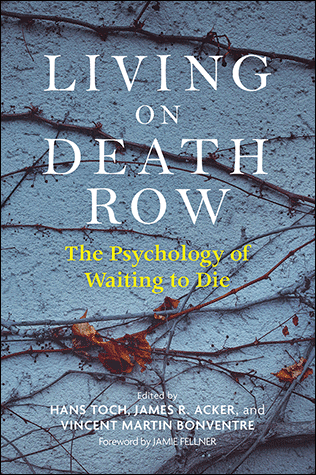
Prisoners on death row spend 22 or more hours a day alone in cramped, barren cells. They have little to do except wait to die — without knowing if it will happen in days, or decades. This extreme isolation combined with the omnipresent fear of death takes a severe psychological toll that is unnecessary, inhumane, and — in the eyes of many — unconstitutional.
In this book Hans Toch, James R. Acker and Vincent Martin Bonventre present wide-ranging, scholarly perspectives from psychologists, legal professionals, and criminologists along with compelling personal accounts from prison administrators and actual death row inmates. Together, they reveal the systemic, physical, and moral conditions that define and underlie death row, as well as the humanity of death row inmates who struggle to find meaning amid a lack of human contact, physical activity, and mental stimulation.
This book represents an urgent call to action for researchers, policymakers, and all those who seek criminal justice reform.
Contributors
Foreword
Jamie Fellner
Acknowledgments
Introduction
Hans Toch, James R. Acker, and Vincent Martin Bonventre
I. Overview of Death Row Conditions
- Rethinking Classification, Programming, and Housing for Death Row Inmates
Jeanne Woodford - Waiting Alone to Die
Terry A. Kupers - Lessons in Living and Dying in the Shadow of the Death House: A Review of Ethnographic Research on Death Row Confinement
Robert Johnson and Gabe Whitbread
II. Legal and Policy Issues
- Death Row Solitary Confinement and Constitutional Considerations
Fred Cohen - The Failure of a Security Rationale for Death Row
Mark D. Cunningham, Thomas J. Reidy, and Jonathan R. Sorensen - Execution "Volunteers": Psychological and Legal Issues
Meredith Martin Rountree
III. Concepts of Time on Death Row
- Psychological Survival in Isolation: Tussling With Time on Death Row
Ian O'Donnell - Time on Death Row
Bruce Jackson and Diane Christian - Spending Time on Death Row: A Case Study
Gareth Evans, Eleanor Price, Amy Ludlow, Ruth Armstrong, and Shadd Maruna, with Jonathan Reed
IV. Stories of Surviving Death Row and Postexoneration Trauma
- Once Numbered Among the Dead, Now I Live!
Joe D'Ambrosio with Rev. Neil Kookoothe - "Dreaming That I'm Swimming in the Beautiful Caribbean Sea": One Man's Story on Surviving Death Row
Charles S. Lanier - Continuing Trauma and Aftermath for Exonerated Death Row Survivors
Saundra D. Westervelt and Kimberly J. Cook
Appendix. Rethinking Death Row: Variations in the Housing of Individuals Sentenced to Death
The Arthur Liman Public Interest Program, Yale Law School
Index
About the Editors
Hans Toch, PhD, is distinguished professor emeritus at the University of Albany at the State University of New York, where he is affiliated with the School of Criminal Justice. He obtained his PhD in social psychology at Princeton University, has taught at Michigan State University and at Harvard University, and in 1996, served as the Walker-Ames Professor at the University of Washington.
Dr. Toch is a fellow of both APA and the American Society of Criminology. In 1996, he acted as president of the American Association of Correctional Psychology. He is a recipient of the Hadley Cantril Memorial Award (for Men in Crisis), the August Vollmer Award of the American Society of Criminology for outstanding contributions to applied criminology, the Prix deGreff from the International Society of Criminology for Distinction in Clinical Criminology, and the Research Award of the International Corrections and Prison Association.
Dr. Toch's research interests range from mental health problems and the psychology of violence to issues of organizational reform and planned change. His books include The Social Psychology of Social Movements (1965, 2013), Reforming Human Services: Change Through Participation (with J. D. Grant, 1982), Violent Men (1992), Living in Prison (1992), Mosaic of Despair (1992), The Disturbed Violent Offender (with Kenneth Adams, 1994), Police Violence (with William Geller, 1996), Corrections: A Humanistic Approach (1997), Crime and Punishment (with Robert Johnson, 2000), Acting Out (with Kenneth Adams, 2002), Stress in Policing (2002), Police as Problem Solvers (2005), Cop Watch: Spectators, Social Media, and Police Reform (2012), Organizational Change Through Individual Empowerment: Applying Social Psychology in Prisons and Policing (2014), and Violent Men, 25th Anniversary Edition (2017).
James R. Acker, JD, PhD, is a Distinguished Teaching Professor at the School of Criminal Justice, University at Albany. He earned his JD at Duke Law School and his PhD at the University at Albany.
He is the author of Questioning Capital Punishment: Law, Policy, and Practice (2014), and coeditor of America's Experiment With Capital Punishment: Reflections on the Past, Present, and Future of the Ultimate Penal Sanction (3rd ed., 2014). He has written numerous scholarly articles addressing the death penalty, wrongful convictions, criminal law, and related subjects.
Vincent Martin Bonventre, JD, PhD, is the Justice Robert H. Jackson Distinguished Professor of Law at Albany Law School. He received his PhD in government, specializing in public law, at the University of Virginia; a JD from Brooklyn Law School; and a BS from Union College. He was a law clerk to Judges Matthew J. Jasen and Stewart F. Hancock, Jr., of the New York Court of Appeals. Between those clerkships, he was selected by Chief Justice Warren Burger to serve as a United States Supreme Court Judicial Fellow.
He teaches, comments, advises, and has authored numerous works on courts, judges, and various areas of public law. Those areas include the judicial process, the Supreme Court and state high courts, criminal law, and civil liberties.
- PROSE Award Finalist for Psychology
Living on Death Row explores a timely and profoundly important topic through multiple layers of analysis and different theoretical perspectives. It contains insightful and compelling contributions from top scholars as well as moving firsthand accounts. This is the essential, definitive work on the topic and will be for many years to come.
— Craig Haney, JD, PhD
Distinguished Professor of Psychology and Codirector of the UC Criminal Justice & Health Consortium, University of California, Santa Cruz
This is a powerful and important book. It provides hope, despite its painful content. One of the key messages is that the death penalty is in decline. I recommend it wholeheartedly.
—Alison Liebling, PhD
Institute of Criminology, University of Cambridge, Cambridge, England