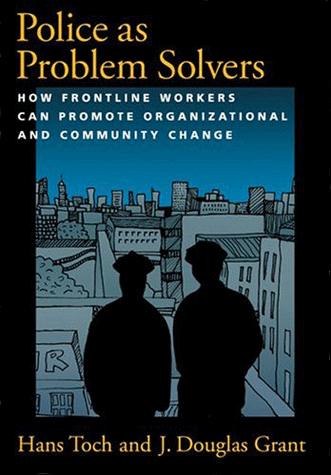
Police as Problem Solvers
Faced with the crime associated with grinding poverty and a no-win drug war, police departments are adapting and changing. Foot patrol officers again walk the streets and talk to citizens, and neighborhood crime watches are valued as the eyes and ears of enforcers. Most seminal is the "quiet revolution" which has been called problem-oriented policing. This revolution makes police officers pioneering professionals who systematically study and address social problems in their localities. Cops become social scientists who work with other agents in the community to address root causes of crime.
Police as Problem Solvers is a lively yet scholarly book written by a pioneer of the approach. The author conducted the legendary first experiment in which police officers became researchers and "agents of change." Of special interest to psychologists will be verbatim material in the book about an innovative program designed to reduce police use of force. The authors describe the origin of this peer group approach to problems of violence, in which violence-involved individuals are engaged in systematic study of their own behavior. This revolution not only has implications for social policy and criminal justice, but also for work reform, because it expands the jobs of frontline workers (police officers), showing that authoritarian management is obsolete.
This book is a gem that will be prized by social psychologists, criminologists, organizational consultants, and community activists.
Foreword
Preface
Acknowledgements
- The Idea of Problem-Oriented Policing
- Policing in the United States Before the Advent of the Problem-Oriented Approach
- Pioneering Efforts
- Organizational Change Issues
- The Oakland Project
- Defining a Problem: First-Generation Change Agents
- Addressing the Problem: Inventing the Peer Review Panel
- Documenting the Solution
- A Decentralized Problem-Oriented Activity
- Top-Down Problem Solving: The Compstat Paradigm
- Community Policing and Problem-Oriented Policing
- Commitment and Community in Problem-Oriented Interventions
- Extending the Approach to Inter-Agency Problem Solving
Postscript
Appendix: Session Rating Form
References
Index
About the Authors