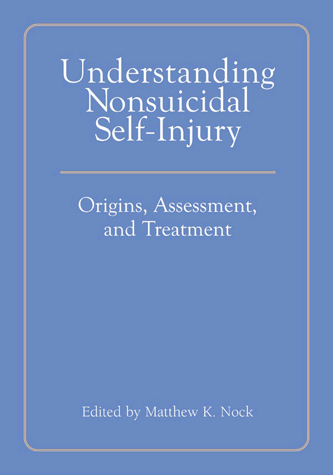
Understanding Nonsuicidal Self-Injury
Nonsuicidal self-injury (NSSI) is the deliberate damaging of one's own body tissue in the absence of any intent to die. Although reports of this behavior span centuries, reported instances of NSSI have increased dramatically over the last 20 years. Until now, there has been no authoritative book on the topic that evaluates why this behavior occurs and what evidence-based assessment and treatments are available.
Editor Matthew K. Nock has compiled the first comprehensive overview of NSSI written by leading theorists, researchers, and clinicians in the field. Drawing upon the historical, biological, cognitive, behavioral, and interpersonal literature, the contributors help to provide answers to some key questions: How prevalent is NSSI? What is its history? Does it occur more frequently among youth? Among females? What influences its occurrence? And, most importantly, how can mental health professionals help those who self-injure? The book's contributors have created a monumental and accessible study of NSSI.
Understanding Nonsuicidal Self-Injury is a must-have for both researchers and clinicians, including psychologists, psychiatrists, social workers, nurses, and all who wish to help those who struggle with this disturbing behavior.
Contributors
Acknowledgements
Introduction
—Matthew K. Nock
I. What Is Nonsuicidal Self-Injury?
Nonsuicidal Self-Injury: Definition and Classification
—Matthew K. Nock and Armando R. FavazzaA Cultural Understanding of Nonsuicidal Self-Injury
—Armando R. FavazzaEpidemiology and Phenomenology of Nonsuicidal Self-Injury
—Karen Rodham and Keith Hawton
II. Why Do People Engage in Nonsuicidal Self-Injury?
Psychological Models of Nonsuicidal Self-Injury
—Matthew K. Nock and Christine B. ChaInterpersonal Models of Nonsuicidal Self-Injury
—Mitchell J. Prinstein, John D. Guerry, Caroline B. Browne, and Diana RancourtBiological Models of Nonsuicidal Self-Injury
—Leo Sher and Barbara StanleyDevelopmental Pathways From Child Maltreatment to Nonsuicidal Self-Injury
—Tuppett M. YatesMedia, the Internet, and Nonsuicidal Self-Injury
—Janis Whitlock, Amanda Purington, and Marina GershkovichNonsuicidal Self-Injury Among People With Developmental Disabilities
—James K. Luiselli
III. What Are the Most Effective Ways to Assess and Treat Nonsuicidal Self-Injury?
Assessment of Nonsuicidal Self-Injury
—E. David Klonsky and Anna WeinbergCognitive Therapy for Nonsuicidal Self-Injury
—Cory F. NewmanBehavior Therapy for Nonsuicidal Self-Injury
—Thomas R. Lynch and Caroline CozzaSpecial Issues in Treating Adolescent Nonsuicidal Self-Injury
—Alec L. Miller, Jennifer J. Muehlenkamp, and Colleen M. JacobsonResidential Treatment of Nonsuicidal Self-Injury
—Barent W. Walsh and Leonard A. DoerflerPsychopharmacologic Treatment of Nonsuicidal Self-Injury
—Curt A. Sandman
Afterword
—Matthew K. Nock
Index
About the Editor
Matthew K. Nock, PhD, is the John L. Loeb Associate Professor of the Social Sciences and director of the Laboratory for Clinical and Developmental Research in the Department of Psychology at Harvard University in Cambridge, Massachusetts. Dr. Nock received his doctorate in psychology from Yale University and completed his clinical internship at the New York University Child Study Center—Bellevue Hospital Center. His research focuses primarily on the etiology, assessment, and treatment of nonsuicidal self-injury, suicidal behaviors, and aggressive behaviors.
Dr. Nock has authored more than 75 scientific articles on these topics, and his research is funded by the National Institute of Mental Health, the American Foundation for Suicide Prevention, and the Talley and Clark Funds at Harvard University. In addition to his research and clinical work, Dr. Nock teaches courses at Harvard on self-destructive behaviors, statistics, research methodology, developmental psychopathology, and cultural diversity.