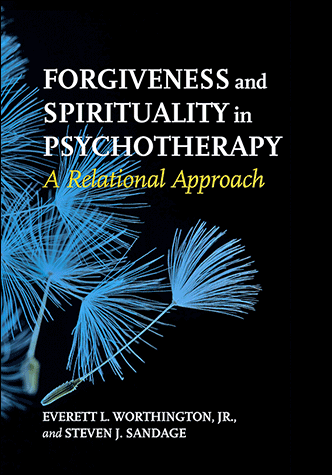
Forgiveness and Spirituality in Psychotherapy
Forgiveness is a frequent challenge in life and a common concern of clients in psychotherapy. While it is easy to see the emotional benefits of forgiveness, actually forgiving a transgressor can be difficult. And the process may be either helped or hindered by the way one relates to the sacred. In some cases, spiritual transformation may be needed before one is able to forgive.
This book presents a model of forgiveness and relational spirituality based on clinical practice and supported by empirical research. Worthington and Sandage bring together decades of experience as both researchers and clinicians to show the differing ways in which spiritual and religious experiences can shape concerns, values, and practices that may facilitate or hinder forgiveness among clients.
Their model highlights relational factors (attachment and differentiation) and action-oriented interventions for emotion regulation. Applications are described for short-term therapy, long-term therapy, couple and family therapy, and group therapy.
Preface
Acknowledgments
Introduction
I. Theory and Evidence
- How Forgiveness Helps People Cope With Transgressions
- How Spiritual Transformation Occurs
- How Attachment Affects Spirituality and Why Spiritual Transformation May Be Needed to Forgive
- Evidence Supporting the Models
II. Promoting Forgiveness
- Helping People Forgive
- Forgiveness in Brief Psychotherapy
- Case Study of Forgiveness in Brief Psychotherapy
- Forgiveness in Long-Term Psychotherapy
- Case Study of Forgiveness in Long-Term Psychotherapy
- Forgiveness in Couples and Family Therapy
- Forgiveness in Group Interventions
Afterword
Appendix: Measures to Assess Aspects of the Victim–Sacred and (Victim's Perception of) the Offender–Sacred Relationship
References
Index
About the Authors
Everett L. Worthington, Jr., PhD, is Commonwealth Professor of Psychology at Virginia Commonwealth University (VCU). He is a licensed clinical psychologist in Virginia and has had an active private practice, directed a counseling service, and been clinical supervisor for other agencies. As a professor, he has done teaching and research at VCU since 1978. He has studied forgiveness since the 1980s, and he makes many practical resources available on his websiteopens in new window (without cost).
In his career, he has written or edited 35 books and almost 400 articles or chapters. Dr. Worthington is regularly interviewed in media and is a frequent speaker throughout the world.
Steven J. Sandage, PhD, is the Albert and Jessie Danielsen Professor of Psychology of Religion and Theology at Boston University and the research director and senior staff psychologist at the Danielsen Institute. He is a licensed psychologist with clinical specialization in couples and family therapy.
Dr. Sandage has academic appointments at Boston University in the School of Theology, the Department of Psychological and Brain Sciences, and the Graduate Division of Religious Studies and has been training clinicians for 18 years. He has previously published four books and numerous articles and chapters in the areas of positive psychology, spirituality, psychopathology, psychotherapy, and intercultural competence.
This is a useful read for time-strapped practitioners who want to understand this approach and improve their clinical efficacy by integrating the religious and psycho-spiritual approach into their work, as I believe that this is a key aspect of therapy that is missing.
—New England Psychologist