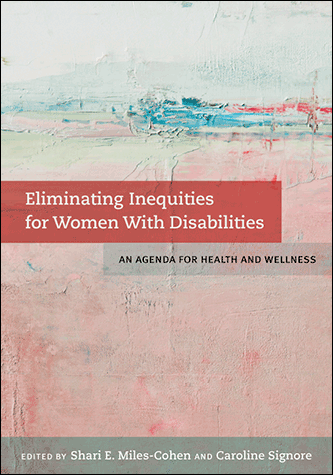
Eliminating Inequities for Women With Disabilities
More than 20 million American women and girls have some form of disability, and this number will only increase in the years to come. At the same time, women with disabilities often have difficulty accessing health care services, and the quality of the health care they do receive is often worse than the care received by women without disabilities and men with disabilities. The consequences of these disparities include increased prevalence of secondary complications, diminished quality of life, and even premature death.
In this book, the editors and colleagues investigate the causes and consequences of these health care disparities. Representing various relevant disciplines, the authors offer action plans to improve wellness, health promotion, and disease prevention among this broad yet consistently underserved population.
Using an integrated care framework as a foundation, the authors tackle the structural, environmental, and social barriers that prevent women with disabilities from accessing effective and culturally competent care and services. The many urgent issues discussed include psychosocial health, interpersonal violence, health care policy, health promotion, disease prevention programs, telehealth, reproductive and sexual health, and dental care.
Contributors
Foreword
Wanda K. Jones
Acknowledgments
Introduction
Shari E. Miles-Cohen and Caroline Signore
I. The Big Picture
- Health Disparities and Equity: The Intersection of Disability, Health, and Sociodemographic Characteristics Among Women
Margaret A. Nosek - Access to Care: The Heart of Equity in Health Care
Marsha Saxton - Health Promotion and Disease Prevention for Women With Disabilities
Susan Parish, Monika Mitra, and Lisa Iezzoni
II. Delivery of Care
- Achieving Equity in the Health of Women With Disabilities Through Telehealth: Challenges and Benefits
Anju Khubchandani and Denise Thew - Reproductive and Sexual Health for Women With Disabilities
Caroline Signore - Oral Health of Women With Disabilities
H. Barry Waldman and Steven P. Perlman
III. Specific Populations
- Across the Lifecourse: Youth and Aging With Disability
Judy Simms-Cendan and Adam Golden - Integrated Health Care for Women of Color With Disabilities
Rosaly Correa-de-Araujo - "We Exist": The Health and Well-Being of Sexual Minority Women and Trans People With Disabilities
Lesley A. Tarasoff - Parenting With Disability: Experiences of Disabled Women
Erin E. Andrews and Kara Ayers - Integrated Primary Behavioral Health Care for Women Veterans With Disabilities
Colleen Clemency Cordes, Linda R. Mona, and LaDonna C. Saxon - Coming Together to End Violence Against Women and Girls With Disabilities
Julie Williams and Lyndsay Colvin
IV. Recommendations
- An Agenda to Eliminate Inequities
Shari E. Miles-Cohen and Caroline Signore
Afterword
Gloria L. Krahn
Index
About the Editors
Shari E. Miles-Cohen, PhD, is senior director of the Women's Programs Office at APA.
Dr. Miles-Cohen has received funding from the National Science Foundation and the U.S. Department of Health and Human Services, Office of Women's Health, to explore the educational needs and health care needs of women with disabilities. Prior to joining APA, she served in leadership positions with university-based and independent nonprofit organizations working to improve the lives of women and girls, including the African American Women's Institute, the Society for the Psychological Study of Social Issues, and the Women's Research and Education Institute.
Dr. Miles-Cohen holds a bachelor of arts from the University of Colorado at Boulder, and a master of science and a doctorate of philosophy in personality psychology from Howard University. She is a fellow of APA.
Her first edited book focused on the status of African American women in the United States and was published while she was a graduate student. Since that time, she has worked to promote an intersectional analysis of women's lives, especially related to women's health and wellness. She lives in Washington, DC, with her husband and son.
Caroline Signore, MD, MPH, is a board-certified obstetrician-gynecologist, and a fellow of the American College of Obstetricians and Gynecologists (ACOG).
Her interest in the reproductive health care needs of women with disabilities arose in 1996, when, shortly after completing her residency training, she sustained a traumatic cervical spinal cord injury. Since then, she has delivered a number of presentations on reproductive health and wellness in women with disabilities, served as a guest reviewer for a handbook on health for women with disabilities in developing countries, and authored chapters for women's health textbooks.
From 2004 to 2009, Dr. Signore served as an advisory board member to an ACOG committee to produce resources to assist ACOG members with providing quality reproductive health care to women with disabilities. Her special interest is increasing awareness among clinicians of the barriers to reproductive health care faced by women with disabilities and how care providers can address these barriers to deliver more comprehensive, competent, and sensitive care for all women.
Miles-Cohen and Signore have edited an excellent resource that manages to capture the current status of women with disabilities and health care, including health provision, social economic, and cultural inequities that impact independent living and well-being.
—PsycCRITIQUES