Secrets and Lies in Psychotherapy
ISBN: 978-1-4338-3052-5Available formats
Also available from
Honest disclosure is central to the work of all psychotherapy. Clients, however, are not always honest with their therapists. They keep secrets, avoid or minimize discussion of personally salient topics, and sometimes tell outright lies.
This book examines the nature of lies and concealment in everyday life and in therapy.
Using the results of two studies involving more than 1,000 clients, Barry A. Farber, Matt Blanchard, and Melanie Love discuss common lies told in therapy about a wide range of issues, including sex, substance abuse, suicidal ideation, trauma, and feelings about the therapist and the progress of therapy.
The lies therapists tell to their patients are also examined.
Throughout, the authors emphasize ways therapists can prevent or at least minimize client concealment and how to honestly and respectfully wrestle with the natural reluctance we all have toward disclosing the truth about our experiences.
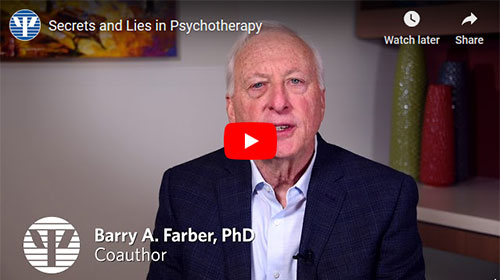
Watch a video with the author
Acknowledgments
Introduction
- Telling Lies and Keeping Secrets in Psychotherapy
- The Nature, Prevalence, and Functions of Lying and Secret Keeping: Why Do We Do These Things?
- Clinical and Empirical Perspectives on Secrets and Lies in Psychotherapy
- Factors Underlying the Likelihood, Process, and Consequences of Client Disclosure and Concealment: "It's Complicated"
- Therapist Deception
- The Columbia Project on Lying in Psychotherapy: What Did 1,345 Psychotherapy Clients Tell Us?
- Common Clinical Lies: Suicidal Thoughts, Self-Harm, and Emotional Distress
- Common Clinical Lies: All Things Sexual
- Common Clinical Lies: Substance Use and Abuse
- Common Clinical Lies: Trauma
- Common Clinical Lies: Clinical Progress and Feelings About One's Therapist
- Secrets and Lies in Psychotherapy: Summary and Clinical Implications
References
Index
About the Authors
Barry A. Farber, PhD, received his doctorate from Yale University in 1978. The following year he became a member of the clinical psychology faculty at Teachers College, Columbia University, where he's been ever since. He was director of clinical training there for 24 years and also served two stints as department chair.
He has varied interests within the area of psychotherapy research, including the nature and consequences of therapists' provision of positive regard, the role of informal supervision in psychotherapy training, and the extent to which patients, therapists, supervisors and supervisees do and don't honestly disclose to each other.
He is the author of several previous books, including Self-Disclosure in Psychotherapy (2006), The Psychotherapy of Carl Rogers: Cases and Commentary (1998), and Rock 'n Roll Wisdom: What Psychologically Astute Lyrics Can Teach About Life and Love (2007).
He served 6 years on the Executive Council of APA Division 29 (Society for the Advancement of Psychotherapy), maintains a small private practice of psychotherapy, and currently serves as editor of the Journal of Clinical Psychology: In Session.
Matt Blanchard, PhD, is a Phi Beta Kappa graduate of the University of Pennsylvania and received his doctorate from Columbia University in 2017. Previously a reporter for the Philadelphia Inquirer and editor-in-chief of the Graduate Student Journal of Psychology, he is now in clinical practice as a staff psychologist at New York University's Gallatin School of Individualized Study.
Melanie Love, MA, graduated with honors from Johns Hopkins University and will receive her doctorate in clinical psychology from Columbia University in 2019. Her research focusing on factors affecting disclosure of sexual content in psychotherapy has been published in Psychotherapy Research and the Journal of Clinical Psychology: In Session, and her master's thesis was the recipient of APA Division 29's Donald K. Freedheim award in 2017.
She was previously the editor-in-chief of the Graduate Student Journal of Psychology.
Melanie is currently in clinical practice as a doctoral intern at Temple University's Counseling Center.
This is an important book for new clinicians and a reminder for experienced clinicians of the complexity of disclosure issues and the importance of tending to the therapeutic relationship.
—Choice
Secrets and Lies in Psychotherapy is a ground-breaking book. It will be the definitive source on the topic for many years to come.
—PsychCentral
This book is full of clinical wisdom and scientific evidence, and also draws from literature, philosophy, and current events. It clearly indicates that we cannot just rely on what we hear in psychotherapy sessions, we have to probe deeper.
—Clara E. Hill, PhD
Department of Psychology, University of Maryland, College Park
A landmark book on a crucial topic "hiding in plain sight." Based on careful research and a deep understanding of the clinical dynamics of therapy, a must-read for clinicians and researchers!
—Adam O. Horvath, EdD
Faculty of Education, Simon Fraser University, Burnaby, British Columbia, Canada
Psychotherapists need to know how often and how much their clients don't tell them. In this illuminating book, Farber, Blanchard, and Love provide just that knowledge — drawing from their original research, presented in rich clinical detail in a highly literate style, and offering wise practical guidelines.
—David E. Orlinsky, PhD
Department of Comparative Human Development, University of Chicago, Chicago, IL