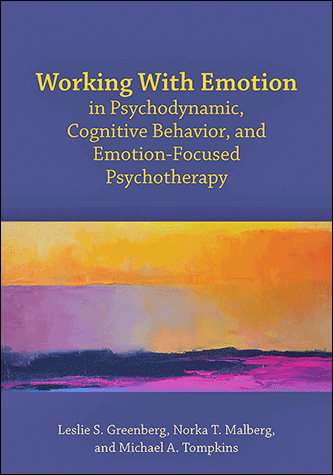
Working With Emotion in Psychodynamic, Cognitive Behavior, and Emotion-Focused Psychotherapy
ISBN: 978-1-4338-3034-1Available formats
Also available from
In this volume, Leslie S. Greenberg, Norka T. Malberg, and Michael A. Tompkins investigate the role of emotion in the development and maintenance of psychological problems, and in effecting psychological change. They examine emotion as it is conceptualized and used in three of the most widely practiced approaches today — psychodynamic, cognitive behavior, and emotion-focused psychotherapy.
The authors discuss the impact of emotion on child development and learning, the relationship between emotion and motivation, and the ways in which emotion can be harnessed in treatment to improve psychological functioning and strengthen interpersonal relationships.
Clinical vignettes show readers how to arouse, identify, and channel emotions in therapy, while also utilizing emotion to develop and maintain an effective therapeutic alliance.
- Introduction
Leslie S. Greenberg, Norka T. Malberg, and Michael A. Tompkins - Psychodynamic Psychotherapy and Emotion
Norka T. Malberg - Cognitive Behavior Psychotherapy and Emotion
Michael A. Tompkins - Emotion-Focused Psychotherapy
Leslie S. Greenberg - Comparing Approaches
Leslie S. Greenberg, Norka T. Malberg, and Michael A. Tompkins
Index
About the Authors
Leslie Greenberg, PhD, is Distinguished Research Professor Emeritus of Psychology at York University in Toronto.
He has authored key texts on emotion-focused psychotherapy, from its inception in the 1980s through today. He has received the Distinguished Research Career award of the International Society for Psychotherapy Research as well as the Carl Rogers and the Distinguished Professional Contribution to Applied Research of the APA.
He conducts a private practice for individuals and couples and trains people in emotion–focused approaches.
Visit Emotion-Focused Therapy Clinicopens in new window.
Norka T. Malberg, PsyD, is an assistant clinical professor at the Yale Child Study Center, School of Medicine in New Haven, Connecticut where she is also in private practice.
She is a Child, Adolescent and Adult Psychoanalyst and a member of the Western New England Psychoanalytic Society and the Contemporary Freudian Society.
Dr. Malberg is coeditor of the Lines of Development Book Series by Karnac Books for which she coedited the first book: The Anna Freudian Tradition in 2010. She is on the editorial board for the Psychoanalytic Study of the Child and the Journal of Infant, Child And Adolescent Psychotherapy.
Visit Norka Malbergopens in new window and follow @freudian1969.
Michael A. Tompkins, PhD, ABPP, is codirector of the San Francisco Bay Area Center for Cognitive Therapy, assistant clinical professor at the University of California at Berkeley, and board certified in Behavioral and Cognitive Psychology.
He is a Diplomate of the Academy of Cognitive Therapy and an adjunct faculty member of the Beck Institute of Cognitive Behavior Therapy.
Dr. Tompkins is the author or coauthor of articles and chapters on cognitive-behavior therapy and related topics, as well as nine books. He provides evidence-based treatments for adults, adolescents, and children.
Visit San Francisco Bay Area Center for Cognitive Therapyopens in new window.
It is all too common in academia for differences to be expressed vociferously, where the worthy aim of genuine dialogue becomes displaced or abandoned. In contrast, this volume places three psychotherapy orientations in conversation, exploring differences clearly, thoughtfully, and with no rancor. Graduate students and early career professionals will find that this book challenges the inevitable biases of their education. Even the most seasoned practitioner will be stimulated to transcend facile ways of characterizing these psychotherapeutic approaches.
—Elliot Jurist, PhD
Professor of Psychology and Philosophy, The City College of New York and the Graduate Center of The City University of New York, New York
This book fills two gaps in the literature. First, it offers a rich and nuanced account of the role of emotions in the psychological therapies, showing how central they are to the way we work. Second, it offers a rare example of dialogue between different therapy traditions. With intriguing clinical examples, the authors highlight what the traditions share, as well as what is specific to each.
—Nick Midgley
Associate Professor and Codirector of the Child Attachment and Psychological Therapies Research Unit, University College London, England
At the cutting edge of the psychotherapy integration movement, this book summarizes psychodynamic, cognitive behavior, and emotion-focused work in historical context; the authors' comparisons and contrasts are incisive, original, and thought-provoking. Students and new clinicians will appreciate the verbatim clinical material, while experienced therapists will benefit from the theoretical clarity and comprehensiveness.
—Nancy McWilliams, PhD, ABPP
Rutgers Graduate School of Applied and Professional Psychology, Piscataway, NJ