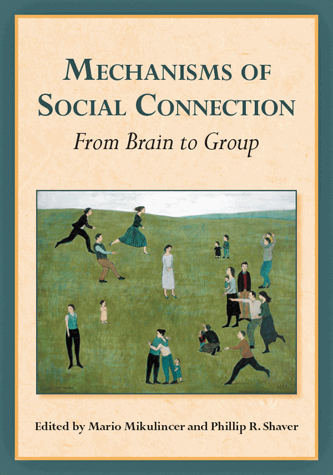
Mechanisms of Social Connection
Available formats
Also available from
Human beings the world over are eager to form social bonds, and suffer grievously when these bonds are disrupted. Social connections contribute to our sense of meaning and feelings of vitality, on the one hand, and — at times — to our anguish and despair on the other.
It is not surprising that the mechanisms underlying human connections have long interested researchers from diverse disciplines including social psychology, developmental psychology, communication studies, sociology, and neuroscience. Yet there is too little dialogue among these disciplines and too little integration of insights and findings.
This fifth book in the Herzliya Series on Personality and Social Psychology aims to rectify that situation by providing a comprehensive survey of cutting-edge theory and research on social connections. The volume contains 21 chapters organized into four main sections:
- Brain (focusing on the neural underpinnings of social connections and the hormonal processes that contribute to forming connections)
- Infancy and Development (focusing especially on child–parent relationships)
- Dyadic Relationship (focusing especially on romantic and marital relationships)
- Group (considering both evolutionary and physiological bases of group processes)
The integrative perspectives presented here are thought-provoking reading for anyone interested in the social nature of the human mind.
Contributors
Preface
Introduction
Mario Mikulincer and Phillip R. Shaver
I. Brain
- Comparative and Developmental Perspectives on Oxytocin and Vasopressin
Karen L. Bales - Primary-Process Separation-Distress (PANIC/GRIEF) and Reward Eagerness (SEEKING) Processes in the Ancestral Genesis of Depressive Affect and Addictions
Jaak Panksepp, Mark Solms, Thomas E. Schläpfer, and Volker A. Coenen - Romantic Love, Pair-Bonding, and the Dopaminergic Reward System
Bianca P. Acevedo and Arthur P. Aron - The Vicarious Brain
Christian Keysers and Valeria Gazzola - Our Social Baseline: The Role of Social Proximity in Economy of Action
James A. Coan, Casey L. Brown, and Lane Beckes - Emotion, Morality, and the Developing Brain
Jean Decety and Lauren H. Howard
II. Infancy and Development
- Child–Parent Attachment and Response to Threat: A Move From the Level of Representation
Jude Cassidy, Katherine B. Ehrlich, and Laura J. Sherman - Synchrony and the Neurobiological Basis of Social Affiliation
Ruth Feldman - Gaze Following: A Mechanism for Building Social Connections Between Infants and Adults
Rechele Brooks and Andrew N. Meltzoff - Beyond Words: Parental Embodied Mentalizing and the Parent–Infant Dance
Dana Shai and Peter Fonagy - Parental Insightfulness and Child–Parent Emotion Dialogues: Their Importance for Children's Development
David Oppenheim and Nina Koren-Karie - The Impact of Early Interpersonal Experience on Adult Romantic Relationship Functioning
Jeffry A. Simpson, W. Andrew Collins, Jessica E. Salvatore, and Sooyeon Sung
III. Adult Close Relationships
- Risk Regulation in Close Relationships
Justin V. Cavallo, Sandra L. Murray, and John G. Holmes - Responsiveness: Affective Interdependence in Close Relationships
Harry T. Reis - Attachment Bonds in Romantic Relationships
Phillip R. Shaver and Mario Mikulincer - A Theoretical Perspective on the Importance of Social Connections for Thriving
Brooke C. Feeney and Nancy L. Collins - Sexy Building Blocks: The Contribution of the Sexual System to Attachment Formation and Maintenance
Gurit E. Birnbaum
IV. Group
- Evolution of the Social Brain: Psychological Adaptations for Group Living
Mark van Vugt and Tatsuya Kameda - Social Defense Theory: How a Mixture of Personality Traits in Group Contexts May Promote Our Survival
Tsachi Ein-Dor - It's All in the Mind: How Social Identification Processes Affect Neurobiological Responses
Naomi Ellemers, Félice van Nunspeet, and Daan Scheepers - Oxytocinergic Circuitry Motivates Group Loyalty
Carsten K. W. De Dreu
Index
About the Editors
Mario Mikulincer, PhD, is a professor of psychology and dean of the New School of Psychology at the Interdisciplinary Center in Herzliya, Israel. He has published five books and more than 280 scholarly journal articles and book chapters.
Dr. Mikulincer's main research interests are attachment theory, terror management theory, personality processes in interpersonal relationships, coping with stress and trauma, grief-related processes, and prosocial motives and behavior.
He is a member of the editorial boards of several scientific journals, including the Journal of Personality and Social Psychology, Psychological Inquiry, and Personality and Social Psychology Review, and he has served as associate editor of two journals, the Journal of Personality and Social Psychology and Personal Relationships. Recently, he was elected to serve as chief editor of the Journal of Social and Personal Relationships.
He received the EMET Prize in Social Science for his contributions to psychology and the Berscheid-Hatfield Award for Distinguished Mid-Career Achievement from the International Association for Relationship Research.
Phillip R. Shaver, PhD, a social and personality psychologist, is Distinguished Professor of Psychology at the University of California, Davis. Before moving there, he served on the faculties of Columbia University, New York University, University of Denver, and State University of New York at Buffalo. He has coauthored and coedited numerous books and has published more than 250 scholarly articles and book chapters.
Dr. Shaver's research focuses on attachment, human motivation and emotion, close relationships, personality development, and the effects of meditation on behavior and the brain.
He is a member of the editorial boards of Attachment and Human Development, Personal Relationships, the Journal of Personality and Social Psychology, and Emotion, and he has served on grant review panels for the National Institutes of Health and the National Science Foundation. He has been executive officer of the Society of Experimental Social Psychology (SESP) and president of the International Association for Relationship Research (IARR).
He has received a Distinguished Career Award and a Mentoring Award from the IARR, a Scientific Influence Award from SESP, and a Career Contribution award from the Society for Personality and Social Psychology.
This edited volume takes what might appear to be disparate topics and creates a narrative of the human social experience that is highly informative and coherent…Each of the chapters is skillfully edited so that there is relatively little repetition of information across chapters. The result is one of the very few edited books I have encountered in which the chapters flow seamlessly, as if written by one very good author.
—PsycCRITIQUES
The diversity of perspectives presented in the current volume makes it a must for scholars interested in the physiological and psychological mechanisms of social bonds.
—Choice