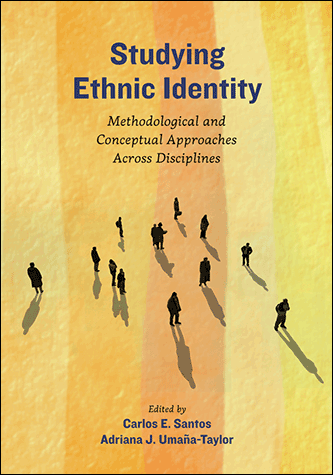
Studying Ethnic Identity
Humans are a fundamentally social species. As individuals, we construct our identity through our affiliation, interaction, and identification with larger groups. And in diverse and multiethnic societies like ours, ethnic identity takes on an especially profound importance. In recent years, social scientists have been increasingly studying the meaning, process, and content of ethnic identity, but these efforts have been piecemeal, and the field as a whole has suffered from a lack of conceptual clarity and methodological rigor.
In this book, editors Carlos Santos and Adriana Umaña-Taylor bring together a diverse group of social and applied scientists from a wide range of fields including educational anthropology, developmental, community and social psychology, and sociology. Together, they investigate the process by which ethnic identity is formed and maintained throughout the lifespan.
Authors present qualitative and quantitative approaches to conceptualizing and measuring ethnic identity, including narrative psychology and ethnographic approaches, cognitive schemas and semi-structured interviews, as well as analyses of social networks. Throughout, authors present contextually-rich accounts of ethnic identity that keep the focus where it belongs, on the lived experience of real people.
Contributors
Foreword
Stephen M. Quintana
Introduction: Ethnic Identity Research Across Diverse Perspectives
Carlos E. Santos and Adriana J. Umaña-Taylor
- Ethnic Identity Research: How Far Have We Come?
Adriana J. Umaña-Taylor - Theoretical and Methodological Contributions of Narrative Psychology to Ethnic Identity Research
Moin Syed - A Critical Ethnographic Approach to the Study of Ethnic Identity: Chilean Mapuche Intercultural Bilingual Education
Patricio Ortiz, Guillermo Williamson, and Annette Hemmings - Studying Ethnic Schemas: Integrating Cognitive Schemas Into Ethnicity Research Through Photo Elicitation
Wendy D. Roth - Understanding the Association Between Phenotype and Ethnic Identity
Irene López, Lovey H. M. Walker, and Melek Yildiz Spinel - Using Semistructured Interviews to Examine Adolescent Racial–Ethnic Identity Development
Leoandra Onnie Rogers and Niobe Way - Friendship Networks and Ethnic–Racial Identity Development: Contributions of Social Network Analysis
Olga Kornienko, Carlos E. Santos, and Kimberly A. Updegraff - Adolescent Ethnic Identity in Context: Integrating Daily Diaries, Biannual Surveys, and School-Level Data
Sara Douglass and Tiffany Yip - Current and Future Directions in Ethnic–Racial Identity Theory and Research
Carlos E. Santos
Index
About the Editors
Carlos E. Santos, PhD, is an assistant professor at Arizona State University in the Counseling and Counseling Psychology program. Prior to his current appointment, Dr. Santos was a Research Fellow at Harvard University's Malcolm Wiener Center for Social Policy and a Mainzer Junior Fellow at the University of Cambridge's Centre for Gender Studies. He received his undergraduate degree and doctoral degree in developmental psychology from New York University and a master's degree in education from Harvard University.
Drawing on ecological theories of development, Dr. Santos's research explores how ethnic and gender identities intersect and form within the individual; how these social identities are influenced by peers as well as cultural stereotypes; and how these processes predict psychological adjustment among adolescents, particularly Latino and immigrant youth. He draws on a variety of disciplines including developmental, social, and cultural psychology; family studies; anthropology; and sociology. His research has been funded by the National Science Foundation and has been published in a variety of outlets.
Dr. Santos was a member of the governing council of the Society for Research in Child Development and was selected as a Faculty Fellow by the Ford Foundation and the American Association of Hispanics in Higher Education. He is a consulting editor of the Journal of Counseling Psychology and Cultural Diversity and Ethnic Minority Psychology, and he is a member of the College of Reviewers at the National Science Foundation.
Adriana J. Umaña-Taylor, PhD, is a Foundation Professor at Arizona State University in the T. Denny Sanford School of Social and Family Dynamics. She received her PhD in human development and family studies from the University of Missouri–Columbia.
Dr. Umaña-Taylor's research focuses on ethnic identity formation, familial socialization processes, and culturally informed risk and protective factors. Her expertise lies primarily in the developmental period of adolescence, and her work is largely influenced by an ecological framework, with an emphasis on understanding how individual and contextual factors interact to inform adolescent development and adjustment. A large body of her work has focused on the development and psychosocial adjustment of Latino youth and families living in the United States.
Dr. Umaña-Taylor approaches her research from an interdisciplinary perspective, drawing largely from developmental psychology, social psychology, cultural psychology, family studies, and sociology. Her work, funded by the National Institutes of Health, has been featured in notable journals in the family, cultural, and developmental sciences.
Dr. Umaña-Taylor currently serves on multiple editorial boards and a Study Section for the National Institutes of Health. She has served as a member of the executive council of the Society for Research on Adolescence and as a member of the board of directors for the National Council on Family Relations.
This book provides great examples of qualitative and alternative methods for examining ethnic identity developmental processing. Seasoned researchers and undergraduate students in psychology, education, social work, and sociology will benefit and gain greater understanding of the research, research methodology, and the stories of the lives presented in each chapter.
—PsycCRITIQUES®