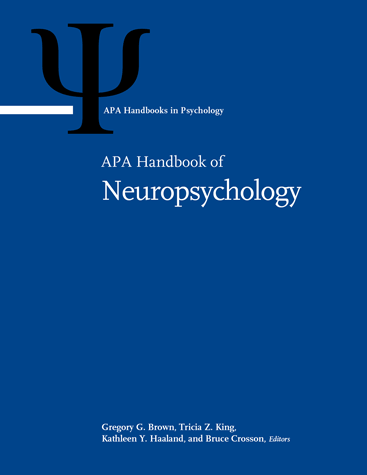
APA Handbook of Neuropsychology
Available formats
Part of the landmark APA Handbooks in Psychology® Series from APA
A comprehensive two-volume set, the APA Handbook of Neuropsychology provides foundational information on neuropsychology, identifies pressing research questions related to neuropsychological disorders and conditions, offers updates on methods to investigate these issues, and aims to shape the field’s future development.
Volume 1, Neurobehavioral Disorders and Conditions: Accepted Science and Open Questions, aids clinicians and researchers in updating their understanding of disordered brain function and addresses questions regarding neurobehavioral disorders, such as amnesia, and clinical conditions, such as Alzheimer’s disease. Taking a lifespan approach, chapters in Volume 1 include a section on accepted neuropsychological science and a section on important issues for future research.
Volume 2, Neuroscience and Neuromethods, focuses on neuroscience, brain imaging methods, and advanced statistical models needed to investigate the questions raised in Volume 1, as well as treatment paradigms to guide future interventions. Chapters aim to stimulate innovative assessment and intervention methods.
The chapters serve as an invaluable resource for the expanding field of neuropsychology. Clinicians, researchers, students, and scholars can use this handbook to gain a foundational understanding of neuropsychology and to further advance the field themselves.
Volume 1: Neurobehavioral Disorders and Conditions: Accepted Science and Open Questions
Editorial Board
About the Editors
Contributors
A Note From the Publisher
Introduction
- Chapter 1. Clinical Neuropsychology: Foundational History and Future Prospects
Gregory G. Brown and Kenneth M. Adams
Part I. Neurobehavioral Disorders
- Chapter 2. Word-Finding and Lexical–Semantic Disorders
Anastasia M. Raymer - Chapter 3. Discourse and Communicative Pragmatics
Seana Coulson, Jacob Momsen, and Crystal R. Poole - Chapter 4. The Neuropsychology of Mathematical Cognition
Konstantinos Priftis - Chapter 5. Specific Reading Disabilities
Jeremy Miciak and Jack M. Fletcher - Chapter 6. Body Representation Disorders
Liana Palermo and Antonella Di Vita - Chapter 7. Higher Order Visual Disorders
Ransom W. Campbell and Daniel Tranel - Chapter 8. Syndromes of Limb Apraxia: Developmental and Acquired Disorders of Skilled Movements
Jennifer Randerath - Chapter 9. Disorders of Executive Functioning
Yana Suchy - Chapter 10. Memory Disorders
Mieke Verfaellie and Margaret M. Keane
Part II. Clinical Conditions
- Chapter 11. Spina Bifida and Other Neural Tube Defects
Victoria J. Williams, Amery Treble-Barna, Ashley L. Ware, and Jack M. Fletcher - Chapter 12. Very Preterm Birth
Alice C. Burnett - Chapter 13. Cerebral Palsy
Seth Warschausky - Chapter 14. Pediatric Brain Tumors
Michelle E. Fox and Tricia Z. King - Chapter 15. Neuropsychological Outcomes in Phenylketonuria
Cristina Romani, Lucie Thomas, and Stephan Huijbregts - Chapter 16. Neuropsychology of Attention-Deficit/Hyperactivity Disorder
Erik G. Willcutt - Chapter 17. Epilepsy and Neuropsychology
Bruce P. Hermann, David W. Loring, Stephen C. Bowden, and Rani Sarkis - Chapter 18. Traumatic Brain Injury
Andrew R. Mayer, Lindsay D. Nelson, and Erin D. Bigler - Chapter 19. Leukemia and Sickle Cell Disease
Kristina K. Hardy, Christina M. Sharkey, Hannah Weisman, and Steven J. Hardy - Chapter 20. Vascular Disease, Including Vascular Dementia
Daniel A. Nation - Chapter 21. Infectious Disorders: HIV, Hepatitis C, and COVID-19 Pandemics
Mariana Cherner, Rowan Saloner, Erin Sundermann, and David Moore - Chapter 22. Frontotemporal Dementia
Molly Memel, Joel H. Kramer, and Doris Chen - Chapter 23. Alzheimer’s Disease
Katherine J. Bangen, Lisa V. Graves, Emily C. Edmonds, Kelsey R. Thomas, and Mark W. Bondi - Chapter 24. Parkinson’s Disease and Parkinsonism
Alexander I. Tröster - Chapter 25. Huntington’s Disease Across the Lifespan
Julie C. Stout - Chapter 26. Multiple Sclerosis
Michelle H. Chen, Ralph H. B. Benedict, and John DeLuca - Chapter 27. Alcohol Drinking and Alcohol Use Disorder Across the Ages: Dynamic Effects on the Brain and Function
Edith V. Sullivan, Séverine Lannoy, Anne-Pascale Le Berre, Rosemary Fama, and Adolf Pfefferbaum - Chapter 28. Neurocognitive Correlates of Psychostimulant Use
Gillinder Bedi, Candice Basterfield, Alexandre A. Guerin, Edward Mullen, Robert Hester, and Stephen C. Bowden - Chapter 29. Cannabis and Neuropsychology
Natania A. Crane and Natasha E. Wade - Chapter 30. Prenatal Exposure to Opioids
Egil Nygaard and Jannike Mørch Andersen - Chapter 31. Environmental Toxicities, Including Lead
Roberta F. White and Aaron S. Reuben - Chapter 32. Sleep and Circadian Rhythm Disorders
Sean P. A. Drummond, Melinda L. Jackson, and Jade M. Murray - Chapter 33. Autism Spectrum Disorder
Rebecca P. Thomas, Kirsty L. Coulter, and Deborah A. Fein - Chapter 34. Schizophrenia
Amy M. Jimenez and Michael F. Green - Chapter 35. The Neuropsychology of Mood Disorders
Federica Klaus and Lisa T. Eyler - Chapter 36. The Neuropsychology of Anxiety: An Approach–Avoidance Decision-Making Framework
Robin L. Aupperle, Timothy J. McDermott, Evan White, and Namik Kirlic - Chapter 37. Eating Disorders: Anorexia Nervosa, Bulimia Nervosa, and Binge-Eating Disorder
Christina E. Wierenga
Index
Volume 2: Neuroscience and Neuromethods
Editorial Board
Contributors
Part I. Neuroscience
- Chapter 1. Brain Organization: From Cells and Circuits to Systems and Networks
Alex Fornito - Chapter 2. Brain Development
Clare E. Palmer and Terry L. Jernigan - Chapter 3. Behavior Genetics in Neuropsychology
William S. Kremen, Eero Vuoksimaa, and Chandra A. Reynolds - Chapter 4. Learning and Memory
Alexander J. Barnett and Charan Ranganath - Chapter 5. Movement and Neuropsychology
Brian P. Johnson and Leonardo G. Cohen - Chapter 6. Higher Order Visual Object Representations: A Functional Analysis of Their Role in Perception and Action
Bradford Z. Mahon - Chapter 7. The Neuroscience of Language and Aphasia
Nina F. Dronkers and Maria V. Ivanova - Chapter 8. Neuroscience of Executive Functioning
Yana Suchy - Chapter 9. Social Neuroscience
Marie-Pier B. Tremblay, Carola Tuerk, Philip L. Jackson, and Miriam H. Beauchamp
Part II. Assessment: Emerging Methods
- Chapter 10. Centering Social Forces and Cultural Experiences in Neuropsychological Assessment
Miguel Arce Rentería, Justina F. Avila, Jet M. J. Vonk, and Jennifer J. Manly - Chapter 11. Automated Neuropsychological Testing
Russell M. Bauer and Robert M. Bilder - Chapter 12. Wearable and Digital Technology Tools: Neuropsychological Assessment, Monitoring, and Diagnosis in the Digital Era
Rhoda Au, Honghuang Lin, Kieffer Christianson, and Daniela Brunner - Chapter 13. Assessing and Predicting Everyday Function
Tania Giovannetti, Katherine Hackett, Molly B. Tassoni, Rachel Mis, and Stephanie M. Simone - Chapter 14. Evaluating Social Cognition
Skye McDonald and Michelle Kelly - Chapter 15. Videoconference Teleneuropsychology
Travis H. Turner and Timothy W. Brearly
Part III. Interventions
- Chapter 16. Rehabilitation of Neuropsychological Deficits: The Role of Restorative Approaches
Thomas F. Bergquist, Molly J. Sullan, and Eva C. Alden - Chapter 17. Rehabilitation of Neuropsychological Deficits: Compensatory Approaches
Alyssa Weakley and Sarah Tomaszewski Farias - Chapter 18. Pediatric Rehabilitation
Shari L. Wade, Lisa M. Gies, Anna-Lynne R. Adlam, Alessandra Bardoni, Claudia Corti, Kelly M. Jones, Jennifer Limond, and Tricia Williams - Chapter 19. Aphasia Treatment: Lessons for Clinically Oriented Neuroscientists
Bruce Crosson - Chapter 20. Interventions for Psychosocial and Emotional Sequelae of Brain Injury and Disease
Skye McDonald, Tamara Ownsworth, and Dana Wong - Chapter 21. From Virtual Reality to Augmentative Apps: The Future of Cognitive Rehabilitation Therapeutics
Anthony Y. Stringer and Anastacia Nichols - Chapter 22. Noninvasive Brain Stimulation as a Rehabilitation Tool for Cognitive Impairment
Benjamin M. Hampstead, Ketrin Lengu, Elana R. Goldenkoff, and Michael Vesia - Chapter 23. Clinical Virtual Reality: The State of the Science
Albert Rizzo, Sebastian Koenig, Belinda Lange - Chapter 24. Lifestyle Interventions
Joe R. Nocera, Keith M. McGregor, and Monica C. Serra - Chapter 25. Implementation Science
Christopher J. Miller and Julianne E. Brady
Part IV. Neuroimaging Methods: Tutorial Presentations
- Chapter 26. Structural Magnetic Resonance Imaging
Amanda Bischoff-Grethe and Christine Fennema-Notestine - Chapter 27. Functional and Physiological Magnetic Resonance Imaging
Frank Haist, Divya S. Bolar, and Richard B. Buxton - Chapter 28. Diffusion Imaging and Fiber Mapping
Erin D. Bigler and Naomi J. Goodrich-Hunsaker - Chapter 29. Electroencephalography in Infants and Children
Michelle Downes, Joe Bathelt, and Wanze Xie - Chapter 30. Magnetoencephalography
Carly Demopoulos - Chapter 31. PET Neuroimaging of Neurologic Disease: Methods and Clinical and Research Applications
Keenan A. Walker and Murat Bilgel
Part V. Statistical and Probabilistic Models for Neuropsychologists
- Chapter 32. Formal Models of Cognition and Behavior
Gregory G. Brown - Chapter 33. Advances in Psychometric Theory: Item Response Theory, Generalizability Theory, and Cognitive Psychometrics
Michael L. Thomas and John R. Duffy - Chapter 34. Structural Equation Modeling in Neuropsychology Research
Rex B. Kline - Chapter 35. Multilevel Modeling in Neuropsychological Research
Ronald H. Heck and Tingting Reid - Chapter 36. Machine Learning
Daoqiang Zhang, Mingxia Liu, Wei Shao, Jiashuang Huang, Mingliang Wang, Liang Sun, and Meiling Wang
Index
Gregory G. Brown, PhD, ABPP-CN, is emeritus professor, Department of Psychiatry, University of California, San Diego School of Medicine. Dr. Brown earned a PhD in psychology from Wayne State University in 1977.
He worked as a clinical neuropsychologist at Henry Ford Hospital in Detroit, Michigan for 17 years and at The New York Hospital/Cornell University Medical College for a year. In 1995, he joined the Department of Psychiatry at University of California, San Diego, and the Psychology Department at the VA San Diego Healthcare System.
Throughout his career he has taught courses on clinical neuropsychology and mentored trainees. Dr. Brown has 170 papers listed in ResearchGate; his neuropsychological research has been wide-ranging, involving studies of the neuropsychological functioning of patients with neurological or neuromedical disorders and studies of these patients using functional and structural brain imaging.
He has a board certification from the American Board of Professional Psychology with a specialty in clinical neuropsychology, and is a fellow of Division 40 of the American Psychological Association (Society for Clinical Neuropsychology).
He was the editor of APA’s journal Neuropsychology from 2014 to 2019.
Tricia Z. King, PhD, is a tenured professor in the Department of Psychology, Georgia State University (GSU). She is a fellow of Division 40 of APA (Society for Clinical Neuropsychology).
Dr. King earned her PhD in clinical psychology with a neuropsychology specialization at the University of Florida. Dr. King continues to investigate the interacting biopsychosocial factors that contribute to optimal outcomes following neurodevelopmental disruption.
The overarching goal of her work is to contribute to advancements in precision medicine, resulting in greater prognostic abilities and enhanced interventions to mitigate neurotoxicity and enable individuals to thrive. She has published more than 100 peer reviewed papers and chapters.
Dr. King is committed to diversifying the trainee pipeline and has enjoyed mentoring and training at the undergraduate and graduate level. She sponsors a chapter of the Association of Students and Trainees at GSU (SCN ANST) and was awarded the GSU Outstanding Undergraduate Mentoring Award.
She has served as the chair of the SCN Scientific Advisory Board, member of the SCN Fellows Committee, and was elected Treasurer of SCN. Dr. King serves on the editorial board for Child Neuropsychology and is an associate editor of The Clinical Neuropsychologist.
Kathleen (Kathy) Y. Haaland, PhD, ABPP-CN, is a tenured professor of psychiatry and behavioral sciences at the University of New Mexico Health Sciences Center. She is board certified by the American Board of Professional Psychology and the American Board of Clinical Neuropsychology (ABPP-CN) where she continues to participate in board certification exams.
She has published more than 100 papers and chapters largely focused on the cognitive and neuroanatomical correlates of action in stroke, Parkinson’s disease, and Huntington’s disease. Her research was continuously funded from 1981 to 2014, and in addition to serving as the director of neuropsychology at the New Mexico VA Healthcare System for many years, she was a VA research career scientist from 2004 to 2014.
She has been recognized locally for her research, is a fellow of APA, and received lifetime career contribution awards from the International Neuropsychological Society and the National Academy of Neuropsychology. She has also served in leadership roles in the International Neuropsychological Society, APA, and the American Board of Clinical Neuropsychology.
She was the symposium editor and then editor in chief of the Journal of the International Neuropsychological Society. Since 2017 she has been an associate editor for the neuroscience section of Frontiers for Young Minds.
Bruce Crosson, PhD, ABPP-CN, has published more than 150 refereed journal articles during a career of over 40 years, and mentored 26 faculty, fellows, and graduate students. Most recently, Dr. Crosson’s primary faculty affiliations have included professor of clinical and health psychology at the University of Florida (1989–2012) and professor of neurology and of radiology and imaging sciences at Emory University (2012–2021).
He held an honorary professorship in health and rehabilitation sciences at the University of Queensland in Brisbane, Australia for 18 years (2004–2021). Dr. Crosson was the recipient of a Senior Research Career Scientist Award from the VA Rehabilitation Research and Development Service (2009-2021).
He is considered one of the world’s leading experts on subcortical functions in language and is also recognized for his expertise in functional neuroimaging. Dr. Crosson has held a diplomate in clinical neuropsychology from the American Board of Professional Psychology since 1986, and he is a fellow of APA.
He was one of the organizers of the 1997 Houston Conference on Specialty Education and Training in Clinical Neuropsychology, which has guided the training of clinical neuropsychologists for more than 20 years.
Included here is the supplemental material for the APA Handbook of Neuropsychology. The materials on this page were provided by handbook chapter authors to aid in understanding the ideas presented in their chapters.
The page is organized by chapter. Note that not all chapters in the handbook have associated supplemental material. The material provided varies depending on topic, including items such as additional data and readings and brain images.
These documents are offered for your personal use. If you reprint or adapt them for publication, permission is required from the copyright holder. All material is ©2023 by the American Psychological Association unless otherwise noted and in the case of software input, output, and syntax. The opinions and statements presented in these documents are the responsibility of the authors, and such opinions do not necessarily represent the policies of the American Psychological Association.
Volume 1
Chapter 2. Word-Finding and Lexical–Semantic Disorders
Chapter 8. Syndromes of Limb Apraxia: Developmental and Acquired Disorders of Skilled Movements
Chapter 20. Vascular Disease, Including Vascular Dementia
- Figure 1. Brain structural MRI images show brain slices through the horizontal plane that display various signatures of cerebral small vessel disease (PDF, 94KB)opens in new window
- Figure 2. Investigational brain perfusion MRI images from pseudocontinuous arterial spin-labeling (pCASL) scans show slices through the horizontal plane that display aspects of cerebrovascular function that may represent early preclinical markers of cerebrovascular disease risk (PDF, 133KB)opens in new window
Chapter 29. Cannabis and Neuropsychology
Volume 2
Chapter 14. Evaluating Social Cognition
Chapter 15. Videoconference Teleneuropsychology
- Figure. Broadband coverage in the United States (from U.S. Census Bureau) (PDF, 140KB)opens in new window
- Table 1. Summary of tests validated in VTC studies with clinical populations (PDF, 97KB)opens in new window
- Table 2. Comparisons of intercorrelations for related measures across modality. Pearson product-moment correlations with sample size provided below in parentheses (PDF, 36KB)opens in new window
- Table 3. Comparison of intratest correlations from a sample of patients with Parkinson’s disease seen via teleneuropsychology and in person (PDF, 11KB)opens in new window
Chapter 23. Clinical Virtual Reality: The State of the Science
Chapter 26. Structural Magnetic Resonance Imaging
Chapter 29. Electroencephalography in Infants and Children
Chapter 30. Magnetoencephalography
Chapter 32. Formal Models of Cognition and Behavior
Chapter 33. Advances in Psychometric Theory: Item Response Theory, Generalizability Theory, and Cognitive Psychometrics
Chapter 34. Structural Equation Modeling in Neuropsychology Research
Chapter 35. Multilevel Modeling in Neuropsychological Research