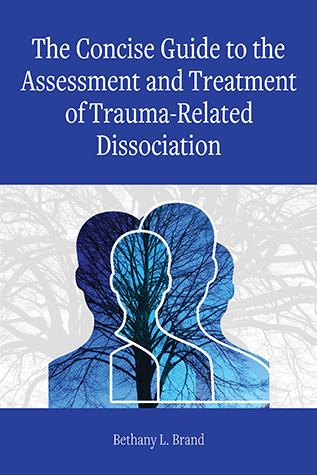
The Concise Guide to the Assessment and Treatment of Trauma-Related Dissociation
ISBN: 978-1-4338-3771-5Dissociation is one of the common sequelae of trauma, yet few clinicians have received training in evidence-based assessment and treatment of trauma-related dissociation (TRD). This book provides a concise overview of trauma-related dissociation, issues around misdiagnosis, methods for assessment, and guidance on treatment planning.
Trauma-related symptoms and disorders are often overlooked or misconceptualized by mental health professionals. Failure to correctly diagnose and treat trauma-related dissociation can lead to prolonged suffering and a range of costs to individual clients and their loved ones, as well as to the health care system and society at large. Trauma-related dissociation is a symptom in a range of psychiatric disorders and is often associated with severe symptomatology and dysfunction, yet it can be successfully resolved if recognized and appropriately treated.
This book addresses the lack of adequate training and knowledge about TRD by providing a systematic overview of methods for assessing it and a discussion of using assessment results to guide treatment planning. It provides a concise overview of conceptualizations of TRD and the reasons it is often overlooked or misdiagnosed, psychological disorders in which TRD is a key symptom, etiological theories of dissociation, the application of assessment data in treatment planning, issues specific to treatment of children and adolescents, and more topics that are imperative to understanding trauma-related dissociation.
Series Foreword
Anne P. DePrince and Ann T. Chu
Foreword: The History and Complexity of Trauma-Related Dissociation
John Briere
Foreword: An Overview of The Concise Guide to the Assessment and Treatment of Trauma-Related Dissociation
Frank W. Putnam
Preface
- Chapter 1. An Introduction to Trauma-Related Dissociation
- Chapter 2. The Etiology of Dissociation
- Chapter 3. Therapeutic Approach to Assessing Trauma Exposure and Trauma-Related Dissociation
- Chapter 4. Self-Report Measures and Interviews for Assessing Dissociation
- Chapter 5. Assessing Dissociation in Forensic and Other Contexts in Which Malingering is Considered
- Chapter 6. Assessing Child and Adolescent Dissociative Disorders and Why It Matters
Amie Myrick and Joyanna Silberg - Chapter 7. Tailoring Treatment for Trauma-Related Dissociation
Appendix A. Diagnostic Interview Outline
Bethany L. Brand and Nicholas A. Pierorazio
Appendix B. Assessment Measures: PITQ-t and PITQ-p
Hugo Schielke and Bethany L. Brand
Appendix C. Resources, Training, and Suggested Readings
References
Index
About the Author
Bethany L. Brand, PhD, specializes in the assessment and treatment of trauma-related disorders including posttraumatic stress disorder (PTSD) and dissociative disorders. She has over 30 years of clinical experience stemming from training at Johns Hopkins Hospital and George Washington University Hospital, a postdoctoral fellowship at Sheppard Pratt Health System's Trauma Disorders program, and a private practice in Towson, Maryland.
Dr. Brand has been awarded many clinical, research, writing, and teaching awards. As a professor of psychology at Towson University, she is sought after for media interviews including by National Public Radio's show Science Friday. Dr. Brand has served on three national task forces that developed guidelines for the assessment and treatment of trauma-related disorders.
Dr. Brand conducts research on the assessment and treatment of trauma-related disorders, including the assessment of feigned dissociative disorders. Dr. Brand is the principal investigator on five lines of trauma-related research, including a series of large, prospective, longitudinal treatment outcome studies called the "Treatment of Patients with Dissociative Disorders" (TOP DD) study.
As a result of her expertise, she frequently serves as an expert witness in state, federal, and international forensic cases, including a Supreme Court case in Australia.
Scholarly, comprehensive, but also beautifully written and readable, Bethany L. Brand has truly given us the landmark book on the important but often overlooked topic of dissociation. A must-read for all clinicians working with trauma.
—Janina Fisher, PhD, author of Healing the Fragmented Selves of Trauma Survivors and Transforming the Living Legacy of Trauma
Dr. Bethany L. Brand has provided a wealth of contemporary information about dissociation and its assessment and treatment in a concise format. She is known for her deep expertise on these topics and her ability to communicate complicated information in a straightforward and accessible way. I highly recommend it as a must-have reference for all mental health professionals.
—Christine A. Courtois, PhD, ABPP, author of Healing the Incest Wound: Adult Survivors in Therapy and coeditor of Sexual Boundary Violations in Psychotherapy
In this state-of-the art book, Bethany L. Brand eloquently guides the reader through the assessment and treatment of trauma-related dissociation in children and adults, as well as its critical importance in forensic settings. A must-read for all clinicians working with clients who experience dissociation and trauma-related disorders!
—Ruth Lanius, MD, PhD, Professor of Psychiatry, University of Western Ontario, London, Ontario, Canada
The Diagnostic Interview Outline, also available as Appendix A in the print and electronic editions of The Concise Guide to the Assessment and Treatment of Trauma-Related Dissociation, is provided as supplemental content for clinicians, students, trainees, and other health care professionals working with patients with potential trauma exposure and/or trauma-related symptoms. When trauma and/or dissociation are identified in the interview, further assessment is recommended. See Chapter 3 for further discussion of the process of diagnostic interviewing and assessment.
This document is offered for your personal use. If you reprint or adapt it for publication, permission is required from the publisher. ©2024 American Psychological Association.