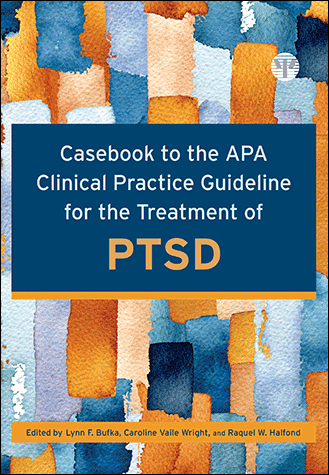
Casebook to the APA Clinical Practice Guideline for the Treatment of PTSD
ISBN: 978-1-4338-3219-2This casebook offers detailed guidance to help practitioners understand and implement the treatments recommended in APA’s Clinical Practice Guideline for the Treatment of Posttraumatic Stress Disorder in Adults.
The authors describe the unique factors involved in PTSD treatment, and core competencies necessary for providers. Chapters then describe each treatment described in the guideline, summarize the empirical evidence for their effectiveness, and offer rich, detailed case examples that demonstrate how readers can use these interventions with real clients.
Treatments described include cognitive behavior therapy, cognitive processing therapy, cognitive therapy and prolonged exposure, brief eclectic psychotherapy, eye movement desensitization and reprocessing, and narrative exposure therapy. Medications including fluoxetine, paroxetine, sertraline, and venlafaxine are discussed as well.
Intended for use with the Guideline, this book combines the best available research with expert clinical recommendations, to help readers make the clinical decisions that are best for their patients.
- Introduction to this Casebook
- Foundations of PTSD Treatment
- Cognitive-Behavioral Treatment for PTSD
- Cognitive Processing Therapy for PTSD
- Cognitive Therapy for PTSD
- Prolonged Exposure for PTSD
- Brief Eclectic Therapy for PTSD
- Eye Movement Desensitization and Reprocessing Therapy for PTSD
- Narrative Exposure Therapy for PTSD
- Pharmacotherapy for PTSD
- Conclusion: Treatment Themes, Shared Components, and Future Research Directions
Lynne F. Bufka, PhD, is the associate executive director of practice research and policy at APA in Washington, DC.
Before coming to APA, Lynn earned her PhD degree in clinical psychology from Boston University in 1996, where she taught such courses as cross-cultural psychology, case management, and adult psychological assessment.
Her areas of professional interest include health care policy, practice patterns and trends, professional development, adult anxiety disorders and cross-cultural issues in psychology. She frequently serves as a media spokesperson for APA on these topics and other policy matters relevant to professional practice.
Follow @drbufka.
C. Vaile Wright, PhD, is director of research and special projects at APA, where she focuses on the development and implementation of programs and policies related to expanding opportunities for professional psychology. Her training and career in mental and behavioral health has been dedicated to the integration of practice and research in the area of professional psychology.
Dr. Wright has clinical, research, management, training, and teaching experience in hospital (both inpatient and outpatient), government, non-profit and academic settings. Her research has included peer-reviewed articles in Law and Human Behavior, Journal of Traumatic Stress, Professional Psychology: Research and Practice, among others.
Follow @drvailewright.
Raquel W. Halfond, PhD, is the director of clinical practice guidelines for APA, overseeing all the day-to-day activities of the initiative. She is also a clinical psychologist.
Dr. Halfond received her doctorate in clinical psychology from Virginia Commonwealth University. She completed her APA approved clinical internship at Children’s Hospital Los Angeles and was a postdoctoral fellow at Harbor-UCLA Medical Center.
This casebook complements the work of the APA Guideline Development Panel for the Treatment of PTSD in Adults and its completed product of APA’s first ever clinical practice guideline. Members of the guideline development panel volunteered their expertise and time as they implemented a development process, studied detailed systematic reviews of the evidence, debated the limitations of the research, identified efficacious treatments and formulated recommendations.
The panel read and responded to hundreds of comments and modified its work as appropriate. Ultimately, the guideline met rigorous development standards and was adopted as policy by APA and added to national guideline databases. The efforts of the members of the panel made the guideline possible.
We wish to thank each member of the panel for their significant contributions to the guideline: Christine A. Courtois (chair), Bethany Beach, Delaware; Jeffrey H. Sonis (vice-chair), Department of Social Medicine, University of North Carolina at Chapel Hill; Laura S. Brown, Seattle, Washington; Joan M. Cook, Department of Psychiatry, Yale School of Medicine; John A. Fairbank, Department of Psychology and Neuroscience, Duke University; Matthew J. Friedman, Department of Psychiatry, Dartmouth Geisel School of Medicine; Joseph P. Gone, Department of Global Health and Social Medicine, Harvard Medical School; Russell T. Jones, Department of Psychology, Virginia Polytechnic Institute and State University; Annette M. La Greca, Department of Psychology, University of Miami; Thomas A. Mellman, Department of Psychiatry and Behavioral Sciences, Howard University Hospital; John Roberts, Jacksonville, Florida; and Priscilla Schulz, Seattle, Washington.
Additionally, we would like to acknowledge the contributions to the guideline of former panel member, Ms. Sharon Wise, for her valuable information on patient values and preferences. The APA Advisory Steering Committee for Clinical Practice Guideline Development, Board of Professional Affairs, Board of Scientific Affairs, Council of Representatives, and Board of Directors all supported the development of the guideline.
We appreciate the work of the late Dr. Daniel Galper in supporting the work of this panel and the ongoing work of Dr. Howard Kurtzman in APA’s clinical practice guideline initiative.
In completion of this volume, we also extend our appreciation to our colleagues Ms. Sarah Rose and Mr. Jacob Marzalik as well as our colleagues in the APA Publishing Office. This was our first opportunity to edit a book together and we are grateful for the many people who supported us in this effort.
We particularly thank those who have experienced trauma as they always inspire us to do more, work harder, and improve care.