Pathological Lying
Available formats
Also available from
This book analyzes the science behind pathological lying, and offers important lessons for research and clinical practice.
Curtis and Hart expertly synthesize and unify historical and contemporary writings and research on pathological lying, into a functional and cohesive resource for researchers and clinicians. By offering a succinct, theory‑driven, and empirically corroborated account of this disorder, the authors aim to provide clinicians with the tools they need to more accurately identify and effectively treat patients.
For a hundred years, research on pathological lying has been fragmented and diffuse; as a result, the disorder has been called by different names and characterized in innumerable ways, with no formal definition or diagnosis. Recently, there has been a re‑emergence of research examining pathological lying, which has helped establish research markers, categorical distinctions, assessment profiles, and clinical
- Chapter 1: Pathological Lying: An Overview
- Chapter 2: Normative Aspects of Lying
- Chapter 3: Characteristics of People Who Lie a Lot
- Chapter 4: Case Studies of Pathological Liars
- Chapter 5: Pathological Aspects of Lying
- Chapter 6: Pathological Lying on the Couch
- Chapter 7: Assessment
- Chapter 8: Diagnosis
- Chapter 9: Treatment, Clinical Applications, and the Future
- Chapter 10: References
Drew A. Curtis, PhD is a Texas licensed psychologist, Rodgers Distinguished Faculty, and the director of the PsyD and MS counseling psychology programs at Angelo State University (ASU).
His research has specifically focused on pathological lying and deception: in the context of therapy, within healthcare professions, intimate relationships, and parental relationships.
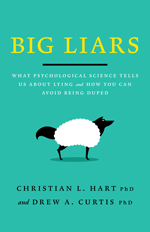
He has published an abnormal psychology textbook, a book about psychopathology, several papers on deception, and received various research grants and awards for his research. He is also coauthor for another book with Dr. Hart, titled Big Liars: What Psychological Science Tells Us About Lying, and How You Can Avoid Being Duped.
Follow Dr. Curtis on Twitteropens in new window.
Christian L. Hart, PhD, is a professor of psychology and director of the psychological science graduate program at Texas Woman’s University. He holds an MS and PhD in experimental psychology and has been a professor for almost 20 years. He teaches courses in deception and forensic psychology and conducts research primarily on lying and deception.
He is also the former president and current executive director of the Southwestern Psychological Association. Prior to becoming a professor, Dr. Hart held the rank of lieutenant commander in the United States Navy, where he served as an aerospace experimental psychologist and taught at the Navy Test Pilot School.
He is an author of the forthcoming book, Big Liars: What Psychological Science Tells Us About Lying, and How You Can Avoid Being Duped.
This book is the gold standard; in its contribution to our understanding of pathological lying, nothing else compares. Curtis and Hart have brought order to a confused, disorganized, but deeply significant topic. Their research is cutting-edge, and their recommendations for the assessment and diagnosis of pathological lying are impressively justified and badly needed.
—Bella DePaulo, PhD, Academic Affiliate, Department of Psychological and Brain Sciences, University of California, Santa Barbara, Santa Barbara, CA, United States
The most frequent question we deception researchers are asked is, “What about pathological liars?” Now we can answer, “Buy this book.” It fills a gap in the literature by providing a comprehensive overview of theory, research, and clinical practice related to pathological lying, and is written in a very accessible style.
—Aldert Vrij, PhD, Professor of Applied Social Psychology, Department of Psychology, University of Portsmouth, Portsmouth, Hants, England
By parsing pathological lying from everyday normative and prolific lying, Curtis and Hart make a valuable contribution to both clinical psychology and the study of deception. Not only do they build the case for pathological lying as a distinct diagnosis that is more than just the symptom of other pathologies, but they also help us to understand that not everyone who tells a lot of lies is suffering from a mental disorder. This book will go a long way toward correcting the frequent and casual misuse of the term “pathological liar.”
—Kim Serota, PhD, Deception Scholar and Lecturer, Department of Management and Marketing, Oakland University, Rochester, MI, United States
Curtis and Hart provide the much-needed definitive treatise on pathological lying. They have changed how I understand pathological lying. I recommend their book to everyone interested in the topic.
—Timothy R. Levine, PhD, author of Duped: Truth-Default Theory and the Social Science of Lying and Deception
Following an outstanding review of the literature, the authors use case histories and examples, historical and current, to bring the concept of pathological lying to life. This scholarly but easy-to-read work extends the forceful argument for recognizing pathological lying as a diagnostic entity in the DSM.
—Charles C. Dike, MD, MPH, Distinguished Fellow, American Psychiatric Association; Fellow, Royal College of Psychiatrists of England; Associate Professor of Psychiatry and Co-Director, Law and Psychiatry Division, Yale University School of Medicine, New Haven, CT, United States
Until now, our understanding of the pathological liar has been fragmented, confusing, and obscured by stigma. Finally, the picture is clearer! Curtis and Hart bring all the pieces of the puzzle together to provide an engaging book that draws on scientific evidence to help us understand the pathological liar—what makes them lie and approaches to reducing their lying and the negative impact on close personal relationships.
—Victoria Talwar, PhD, Author of “The Truth About Lying: Teaching Honesty to Children at Every Age and Stage”; Professor and Chair, Department of Educational and Counselling Psychology, McGill University, Montreal, QC, Canada