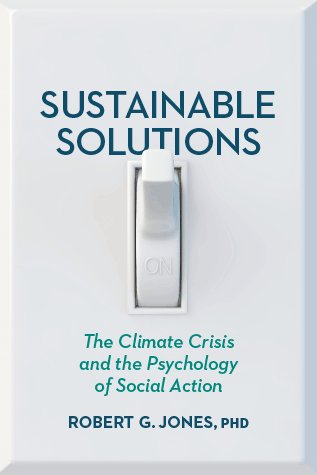
Sustainable Solutions
Available formats
Also available from
A sustainable future requires more than just technological innovation. We must change the way we think and behave to avoid environmental catastrophe. The lessons of applied psychology are crucial in this endeavor.
In this book, Robert G. Jones combines insights from biological adaptation with a psychological analysis of the ways in which we identify problems, consider solutions, and take action.
He examines the complicated web of behaviors and motivations that underlie our sustainability problem, and identifies concrete actions social scientists, policymakers, and individuals can take to help transform ourselves, and our planet, for the better.
For centuries, human beings have transformed our physical environment to service our needs and desires. But today, thanks to the waste and depletion of natural resources and the looming threats of climate change, we must learn to adapt ourselves in order to create a sustainable planet for our children and grandchildren.
This book is written for scholars and students in environmental, applied, and evolutionary psychology, as well as a scholarly and advocacy audience in conservation, sustainability, and environmental studies.
- Chapter 1: Introduction
- Chapter 2: Beyond Deep Adaptation
- Chapter 3: Human Exceptionalism
- Chapter 4: Psychological Factors Required for Social Speciation
- Chapter 5: Social Margins, Conflict, and Developmental Change
- Chapter 6: Making and Managing Social Ecotones
- Chapter 7: Using Social Speciation on Purpose
- Chapter 8: Defining Successful Social Speciation
- Chapter 9: Taking Action
- Chapter 10: Solutions
Robert G. Jones, PhD is a professor of psychology at Missouri State University. His research and professional interests are in industrial and organizational psychology, and relate to management, prejudice, and ethical decision making.
He is author of the textbook Psychology of Sustainability: An Applied Perspective (Routledge, 2015; second edition in progress).
Dr. Jones teaches statistics and environmental psychology courses at the undergraduate level and performance assessment, selection, and internship and thesis supervision at the graduate level.
His affiliations include Academy of Management, Personnel Psychology: Book review editor, Springfield City Council: Member, and Society for I-O Psychology. Dr. Jones's research and professional interests lie in assessment centers, construct validation, emotive perception, feedback responses, job analysis, nepotism, prejudice, and rating and decision biases.