Treatment of Posttraumatic Stress Disorder in Serious Mental Illness
Available formats
Also available from
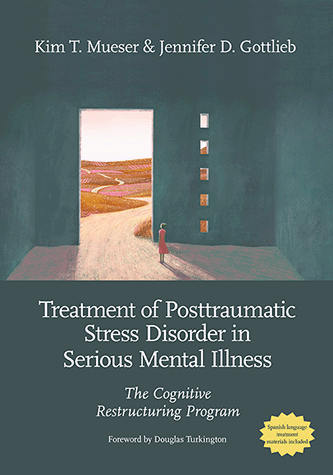
This book is a practical guide to the evidence-based Cognitive Restructuring (CR) for PTSD program, which has been specifically designed to meet the unique needs of people with serious mental illness.
Posttraumatic stress disorder (PTSD) is very common among persons with serious mental illness (SMI). Unfortunately, it often leads to more severe psychiatric symptoms, greater impairment in psychosocial functioning, poorer physical health, and a higher use of acute care services among people with SMI. Yet despite major advances in the treatment of PTSD in the general population, PTSD has remained underdiagnosed and underaddressed among people with SMI, and treatments for this population have been relatively neglected.
This practical, hands-on guide gives clinicians the tools they need for screening, detecting, and treating PTSD in their clients with SMI, including schizophrenia, bipolar disorder, major depression, and borderline personality disorder. Chapters summarize research and theory regarding the interaction between PTSD and SMI, provide nuts and bolts strategies for implementing the authors' Cognitive Restructuring for PTSD program, and offer guidance for overcoming clinical challenges to trauma treatment such as psychotic symptoms, low distress tolerance, emotion dysregulation, hopelessness, and cognitive impairment. Chapters also feature in-session dialogues with case vignettes that follow three unique clients as they participate in the CR for PTSD program.
Handouts and worksheets for delivering the CR for PTSD program are available in the Appendix of the book as well as in printable versions online under the resources tab. These online resources also include the educational handouts and worksheets translated into Spanish, a supplemental chapter on The BREATHE Program: A Brief PTSD Intervention for Persons with SMI in Special Settings, and the BREATHE Treatment Program.
Foreword
Preface
Part I: Background and Overview of Trauma and PTSD in Serious Mental Illness
- Chapter 1. Trauma and PTSD in Serious Mental Illness
- Chapter 2. Treatment of PTSD in People With Serious Mental Illness: The Cognitive Restructuring Program
- Chapter 3. Understanding and Assessing Trauma and PTSD
Part II: The Cognitive Restructuring for PTSD Program
- Chapter 4. Logistics of Implementing the CR for PTSD Program
- Chapter 5. Beginning Treatment: Engagement, Orientation, Wellness Planning, and Breathing Retraining
- Chapter 6. Psychoeducation and Goal-Setting
- Chapter 7. Cognitive Restructuring I: The Thought-Feeling Model and Common Styles of Thinking
- Chapter 8. Cognitive Restructuring II: The 5 Steps of Cognitive Restructuring and Action Plans
- Chapter 9. Cognitive Restructuring III: Working With Trauma-Related Thoughts, Core Beliefs, and Persistent PTSD Symptoms
- Chapter 10. Solutions to Common Challenges
- Chapter 11. Skill Generalization and Termination
Part III: Special Clinical Challenges and Populations
- Chapter 12. Working With People With Psychosis
- Chapter 13. Working With People With Borderline Personality Disorder
Part IV: Conclusion
- Chapter 14: The Role of the CR for PTSD Program in a Comprehensive System of Mental Health Care
Appendix: Clinician Tools and Handouts
References
Kim T. Mueser, PhD is a professor in the Departments of Occupational Therapy and Psychological and Brain Sciences at Boston University. He has published over 400 peer-reviewed articles, 100 book chapters, and 15 books primarily on psychosocial treatments for serious mental illness (SMI), and has given numerous conference presentations, workshops, and invited lectures in the U.S. and abroad.
Dr. Mueser began adapting empirically supported treatment methods for PTSD in the general population to the SMI population in the late 1990s, which resulted in the first standardization and feasibility testing of the CR for PTSD program in the early 2000s, followed by randomized controlled trials evaluating the program.
Jennifer D. Gottlieb, PhD is a diplomate in the Academy of Cognitive and Behavioral Therapies whose work has been dedicated to the development, evaluation, and implementation of effective psychotherapeutic interventions for persons with severe psychiatric conditions. She is a founding member and former president of the North America CBT for Psychosis Network (NACBTpN) and is affiliated with the Cambridge Health Alliance/Harvard Medical School.
In addition to numerous publications and presentations related to cognitive behavioral therapies for psychosis and other serious mental illness, Dr. Gottlieb has focused on the Cognitive Restructuring for PTSD intervention for over 18 years, as both a coinvestigator and a program development consultant. She has provided extensive workshop training, clinical supervision, and treatment fidelity evaluation to hundreds of clinicians and has worked with multiple mental health agencies, nationally and internationally to implement and sustain this intervention (https://www.jennifergottliebphd.com).
To learn more, please visit her websiteopens in new window.
A groundbreaking exploration into PTSD and severe mental illness, encompassing psychotic, severe mood, and borderline personality disorders. This exceptional book equips readers with a meticulous, hands-on guide to assessing and treating these complex conditions. From comprehensive etiological knowledge to evidence-based cognitive restructuring treatment, this book is rich with empirical support. Authored by distinguished clinical researchers in PTSD and psychosis, this work stands as a testament to their expertise. An indispensable resource for clinicians, this is a definitive must-have for anyone working with people with severe mental illness.
—Tania Lecomte, PhD, Professor of Psychology, University of Montreal, Montreal, Quebec, Canada; Director of The Canadian Network for Research in Schizophrenia and Psychoses
In this important volume, Drs. Mueser and Gottlieb provide us with a sensitive and skillful guide to assessing and treating PTSD in individuals with serious mental illness. Their years of clinical experience, combined with their considerable research, shine through in every chapter. Thank you for this important resource and for so ably helping some of the most vulnerable trauma survivors in our care systems.
—J. Gayle Beck, PhD, Emerita Professor of Psychology and former Chair of Excellence, University of Memphis, Memphis, TN, United States
Welcome to the resource library for the Treatment of Posttraumatic Stress Disorder in Serious Mental Illness: The Cognitive Restructuring Program book by Kim T. Mueser and Jennifer D. Gottlieb. The contents of this resource library are copyrighted and are for the personal use of owners of the book, with the expectation that they will be used in accordance with the treatment guidelines provided therein.
This page provides the full range of downloadable educational handouts and worksheets in both English and translated into Spanish to facilitate using this intervention with Spanish-speaking individuals with Serious Mental Illness (SMI), an underserved population with very high rates of trauma and PTSD. This page also includes a supplemental chapter and a practical manual that outline a three-session intervention for PTSD which can be implemented in settings or situations where use of the full Cognitive Restructuring (CR) for PTSD program may not be appropriate. We hope you will find both the book and these valuable online resources helpful when treating PTSD in the SMI population.
Note: When using these documents, please ensure proper credit to the book’s authors, Kim T. Mueser and Jennifer D. Gottlieb.
If you reprint or adapt any of these resources for publication, permission is required from the publisher. ©2025 American Psychological Association.
Download the entire resource library. (ZIP 3,437KB)opens in new window
Contents:
Clinician Tools and Handouts (in English)
- Features the handouts, worksheets, and clinician tools in the appendix of the published book on the CR for PTSD program. Clinicians can easily download these materials and print and use them as needed. As described in the volume, suggested usage of these materials includes completing and sharing designated handouts and worksheets with clients during treatment sessions, and using the clinician tools to track clients’ progress throughout the CR program.
Clinician Tools and Handouts (in Spanish)
- Includes client handouts, worksheets and clinician tools for the CR for PTSD program professionally translated into Spanish. Clinicians can easily download these materials and print and use them as needed. As described in the book, suggested usage of these materials includes completing and sharing designated handouts and worksheets with Spanish-speaking clients during treatment sessions. Clinicians have the option to use either the English or the Spanish versions of the clinician tools to track clients’ progress throughout the CR program.
Supplemental Chapter 15: The BREATHE Program: A Brief PTSD Intervention For Persons With SMI In Special Settings
- Offers a supplemental chapter to the CR for PTSD book that describes a brief (3-session) program for treating PTSD in people with serious mental illness: The Brief, Relaxation, Education and Trauma Healing (BREATHE) program. The chapter summarizes research on the BREATHE program and provides recommendations of treatment settings where it is not practical or feasible to implement the full CR program but where BREATHE can serve as an alternative program.
BREATHE:A Brief Intervention for Persons with PTSD and Co-Occurring Serious Mental Health Conditions: Treatment Program Manual
- Provides the manual for the BREATHE (Brief, Relaxation, Education and Trauma Healing) program, a brief (3-session) treatment program for PTSD in people with serious mental illness, which provides a practical alternative that can be used in treatment settings where it is not feasible to implement the full CR for PTSD program. More information about the BREATHE program is provided in the online resource, “Supplemental Chapter 15: The BREATHE Program.”