Principles of Emotion Change
Available formats
Also available from
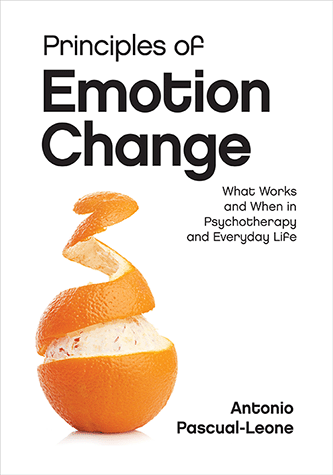
This book of theory and practice offers an unprecedented exploration of the nature of emotion and the process by which it changes.
Written for mental health providers and psychotherapy researchers, this innovative and unique volume offers an extraordinary synthesis of psychotherapy research, neuroscience, and practical observations to propose a new paradigm of emotion change. The book presents a general theory of how a difficult emotional state changes. Integrating findings across treatment approaches, it resolves contradictions found in different lines of research and reconciles existing theories that have seemed at odds. It explains the different kinds of emotional change, the hypothesized mechanisms driving that change, and when each type of change is most applicable.
Dr. Pascual-Leone demonstrates that having a clearer understanding of how emotion change happens enables clinicians to apply more impactful and effective interventions. Chapters explore everything from moment-by-moment work (through engagement, labeling, and expression) to broader process formulations (such as narrative, re-framing, and purpose in life). Extensive clinical examples help therapists get a better grip on what each kind of processing really means.
Introduction
- Chapter 1: A General Theory of Emotional Change
Part I – Reduce Intensity
- Chapter 2: Down-Regulating Emotional Intensity
- Chapter 3: Avoidance, Desensitization, and Behavioral Coping
Part II: Notice the Feeling
- Chapter 4: Emotional Awareness: From Engagement to Symbolization
- Chapter 5: Emotional Engagement: Getting in Touch With What’s There
- Chapter 6: Labeling Emotion: Finding Just the Right Words
- Chapter 7: Deepening Emotion Through Symbolization
Part III: Feel More, Express More
- Chapter 8: Heightening Arousal, Vividness, Expression, and Enactments
- Chapter 9: Getting Physical: Working From the Outside In
- Chapter 10: Enactments: Working From the Inside Out
- Chapter 11: Proclamation of Self: “I Felt It, I Said It, I Did It!”
Part IV: Order the Sequence of Emotions
- Chapter 12: Sequential Transformation: The Pattern in Emotion Makes the Change
- Chapter 13: Changing Emotion With Emotion: The Process in Action
- Chapter 14: Adult Emotional Development: Expanding One’s Repertoire
- Chapter 15: The Sequential Model: “The Only Way Out is Through”
- Chapter 16: Tracking Sequences: The Roller Coaster to Resolution
Part V: Put the Feeling in Context
- Chapter 17: Using Context and Narrative: “The Big Picture”
- Chapter 18: Psychological Elaboration: Telling More of the Story
- Chapter 19: We Have Relationship With Our Memories: Revising the “Meta-Data”
- Chapter 20: Stepping Out of the Frame: “I Am Myself and My Circumstances”
- Chapter 21: Life Narrative and Identity: The Story Itself Is an Agent of Change
- Chapter 22: Storying the Self: “It’s a Matter of Perspective . . ."
- Chapter 23: Having Purpose and Making Choices
Part VI: Conclusions: A New Paradigm
- Chapter 24: A General Theory of Emotion Change
References
Index
About the Author
Antonio Pascual-Leone, PhD, CPsych, is a professor in psychology at the University of Windsor, Canada and is an honorary professor of psychiatry at the University of Lausanne, Switzerland. Dr. Pascual-Leone runs the Emotion Change Lab at the University of Windsor and supervises research on the processes of emotional change as they occur in psychotherapy and in everyday life.
Dr. Pascual-Leone usually teaches courses on psychotherapy interventions and has co-authored a book on Emotion-Focused Therapy with Dr. Sandra C. Paivio. He has published seminal contributions to the theory and research of emotion-focused therapy and is regarded as a world expert in emotional processing. His work is recognized by career awards from international societies as well as distinguished publication awards.
This outstanding book is a must-read for clinicians of all orientations, offering a comprehensive and insightful synthesis for those who want to improve their skill in working with emotion. Twelve years in the making, this work combines clinical process with empirical findings in brilliant fashion, illuminating the how and why of emotional change in psychotherapy. A visionary work, this will be a main reference for clinicians and academics alike.
—Leslie S. Greenberg, PhD, Distinguished Research Professor Emeritus, Department of Psychology, York University, Toronto, ON, Canada
This book is an integrative masterpiece. Emotional change in psychotherapy is a jungle of theories, contradictions, and messy findings—but Antonio Pascual-Leone has expertly cleared a path to reveal what emotions to focus on, when, for what purpose, and how. This amazing synthesis will become a leading light in the field, a guiding force for psychotherapy practice, training, and research.
—Louis G. Castonguay, PhD, Liberal Arts Professor of Psychology, Pennsylvania State University, University Park, PA, United States
Serious EFT therapists and practitioners of related emotion-based approaches will want to read this book because it provides a solid, clearly stated scientific foundation for five key kinds of emotion change processes. The author has produced a tour de force based on a rigorous, decade-long systematic review of a wide range of applied emotion research that provides a fresh look at the key therapeutic tasks such as empty chair work, grounding them historically and in the wider field of applied emotion research.
—Robert Elliott, PhD, Professor Emeritus, University of Strathclyde, Glasgow, Scotland
With clarity, elegance, and precision, Antonio Pascual-Leone offers a generative new synthesis in the emotion-focused tradition. Grounded in empirical rigor and richly illustrated through clinical examples, this principle-based framework will help a new generation of therapists understand not just that emotion matters—but how it changes. At once nuanced and practical!
—J. Christopher Muran, PhD, Dean and Professor, Gordon F. Derner School of Psychology, Adelphi University, Garden City, NY, United States; Mount Sinai Beth Israel Psychotherapy Research Program, New York, NY; NYU Postdoctoral Program in Psychotherapy and Psychoanalysis, New York, NY