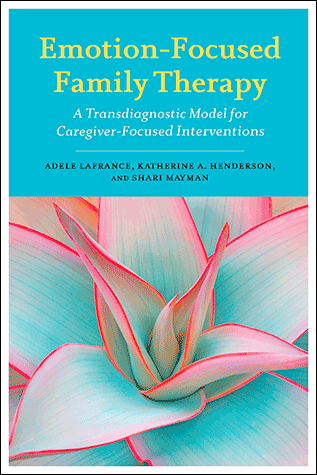
Emotion-Focused Family Therapy
Available formats
Also available from
In this treatment manual, Adele Lafrance, Katherine A. Henderson, and Shari Mayman provide mental health professionals with guidelines for implementing emotion-focused family therapy (EFFT), an exciting new intervention in which caregivers are the primary healing agents in their loved one’s treatment.
EFFT was initially created to treat eating disorders, and then developed into a transdiagnostic approach that can be applied to any emotion- or behavior-based disorder with various relationship dynamics across the lifespan, including parent–child relationships (even if the child is an adult) and romantic partnerships.
The authors describe how to teach caregivers advanced skills for supporting their loved ones through emotion and behavior coaching. Therapists will also learn collaborative strategies for strengthening healing bonds between the caregiver and the loved one and healing relational ruptures.
Techniques for processing caregivers’ emotional blocks are also explored, as are methods for clinicians to work through their own blocks via supervision.
Vivid case examples illustrate the implementation of EFFT in a wide variety of realistic scenarios. Clinical handouts are included in the appendices, which are also available under clinician and practitioner resources.
Acknowledgments
Introduction
- Emotion-Focused Family Therapy Explained
- Emotion Coaching
- Behavior Coaching
- Therapeutic Apologies
- Working Through Caregiver Blocks
- Working Through Clinician Blocks
- Emotion-Focused Family Therapy for Eating Disorders
- Frequently Asked Questions and Future Directions
Epilogue: Lessons Learned
- Appendix A: The Super-Feeler Explained
- Appendix B: Emotion Coaching Cheat Sheet
- Appendix C: Behavior Coaching for Cooperation and Collaboration
- Appendix D: Healing Family Wounds via Therapeutic Apology
- Appendix E: Caregiver Styles Self-Reflection Tool
- Appendix F: Caregiver Traps Scale
- Appendix G: Behavior Coaching: Family Safety Plan for Self-Harm and Suicidality
- Appendix H: Relationship Dimensions Scale
- Appendix I: Connecting in Relationships: Validating Silence
- Appendix J: Processing Caregiver Blocks Using Chair Work
- Appendix K: Clinician Traps Scale
- Appendix L: Self-Directed Block Worksheet for Clinicians
- Appendix M: Processing Clinician Blocks Using Chair Work — Caregiver Involvement
- Appendix N: Helpful Resources When Caring for a Loved One With an Eating Disorder
References
Index
About the Authors
Adele Lafrance, PhD, is an associate professor at Laurentian University and codeveloper of emotion-focused family therapy (EFFT). She is a founding member of the International Institute for EFFTopens in new window.
She is a licensed clinical psychologist with a practice of short-term clinical care and supervision. Over the years, she has taught numerous courses on developmental and clinical psychology with a focus on family-oriented mental health care across the life span.
Dr. Lafrance provides EFFT training for clinicians, school boards, and mental health agencies worldwide. She has published extensively in the field and currently supports the research base for EFFT.
Dr. Lafrance is regularly interviewed in the media and is a frequent speaker throughout the world. She also develops many practical resources for parents, caregivers, and clinicians that are available on her website free of costopens in new window.
Katherine A. Henderson, PhD, is a licensed clinical psychologist and codirector of Anchor Psychological Servicesopens in new window. She is also an adjunct research professor in the Department of Psychology at Carleton University, Ottawa, Canada.
Dr. Henderson is recognized internationally for her expertise and research in the treatment of pediatric eating disorders. She codeveloped the 2-day EFFT caregiver workshop and Concurrent-CARE (C-CARE), an extension of EFFT for the treatment of concurrent eating and substance use disorders. She provides EFFT and C-CARE training to clinicians and community agencies worldwide and is a frequent speaker within her community on mental health issues.
Dr. Henderson lives in Ottawa, Ontario, Canada.
Shari Mayman, PhD, is a licensed clinical psychologist and the codirector of Anchor Psychological Servicesopens in new window, a private practice in Ottawa. She is an expert in the assessment and treatment of eating disorders, as well as mood and anxiety disorders. She has significant experience in hospital-based eating disorder programs.
Dr. Mayman codeveloped the 2-day EFFT caregiver workshop and Concurrent-CARE (C-CARE), a treatment model for concurrent eating and substance use disorders that is an extension of EFFT. She provides EFFT and C-CARE training to clinicians and community agencies internationally and speaks frequently on topics related to mental health.
Dr. Mayman lives in Ottawa, Ontario, Canada.
Emotions are key processes for social beings. This book describes how to augment social support through emotional coaching using a clear, concise framework and should become an important part of the tool kit for all therapists.
—Janet Treasure, PhD, FRCP, FRCPsych, IOPPN
Kings College London, England
Clearly and accessibly written, this volume will inspire hope for clinicians working within even the most challenging family therapy scenarios. The authors provide concrete strategies to support loved ones, caregivers, and clinicians in transforming emotional pain, behavioral responses, and blocks to therapy progress. Whether used alone or integrated into other family therapy approaches, the tools offered in this book will strengthen any clinician’s practice.
—Sarah Thompson, CPsych
Clinical Psychologist, Toronto, Ontario, Canada
Welcome to the clinician and practitioner resources for Emotion-Focused Family Therapy: A Transdiagnostic Model for Caregiver-Focused Interventions. The materials on this site are clinical handouts that can be used in emotion-focused family therapy (EFFT). The handouts related to client interventions require training in EFFT.
Appendices A–J and N are handouts that mental health practitioners can distribute to clients during sessions. They contain educational material as well as tips and exercises for improving emotion and behavior coaching skills, strengthening relationships between caregivers and their loved ones, and processing emotional blocks, among other areas of foci. Appendix N provides a list of recommended resources that caregivers can consult when supporting a loved one who is struggling with an eating disorder.
Appendices D and J are reserved for psychotherapists with training in the application of these interventions.
Appendices K, L, and M are handouts that can used by clinicians and their supervisors to identify and process clinicians’ concerns and emotional blocks.
These documents are available for clinical use only. If you reprint or adapt them for publication, permission is required from the publisher. All material is ©2020 by the APA unless otherwise noted. The opinions and statements presented in these documents are the responsibility of the authors, and such opinions do not necessarily represent the policies of the APA.
- Appendix A: The Super-Feeler Explained (PDF: 164KB)opens in new window
- Appendix B: Emotion-Coaching Cheat Sheet (PDF: 35KB)opens in new window
- Appendix C: Behavior Coaching for Cooperation and Collaboration (PDF: 37KB)opens in new window
- Appendix D: Healing Family Wounds via Therapeutic Apology (PDF: 55KB)opens in new window
- Appendix E: Caregiver Styles Self-Reflection Tool (PDF: 426KB)opens in new window
- Appendix F: Caregiver Traps Scale (PDF: 49KB)opens in new window
- Appendix G: Behavior Coaching: Family Safety Plan for Self-Harm and Suicidality (PDF: 46KB)opens in new window
- Appendix H: Relationship Dimensions Scale (PDF: 42KB)opens in new window
- Appendix I: Connecting in Relationships: Validating Silence (PDF: 44KB)opens in new window
- Appendix J: Processing Caregiver Blocks Using Chair Work (PDF: 45KB)opens in new window
- Appendix K: Clinician Traps Scale (PDF: 45KB)opens in new window
- Appendix L: Self-Directed Block Worksheet for Clinicians (PDF: 42KB)opens in new window
- Appendix M: Processing Clinician Blocks Using Chair Work—Caregiver Involvement (PDF: 44KB)opens in new window
- Appendix N: Helpful Resources When Caring for a Loved One With an Eating Disorder (PDF: 41KB)opens in new window