Adults in the U.S. overwhelmingly say they feel comfortable talking about their mental health, yet younger adults may still be struggling to ask for help when they need it, according to the results of a survey conducted by The Harris Pollopens in new window in partnership with APA.
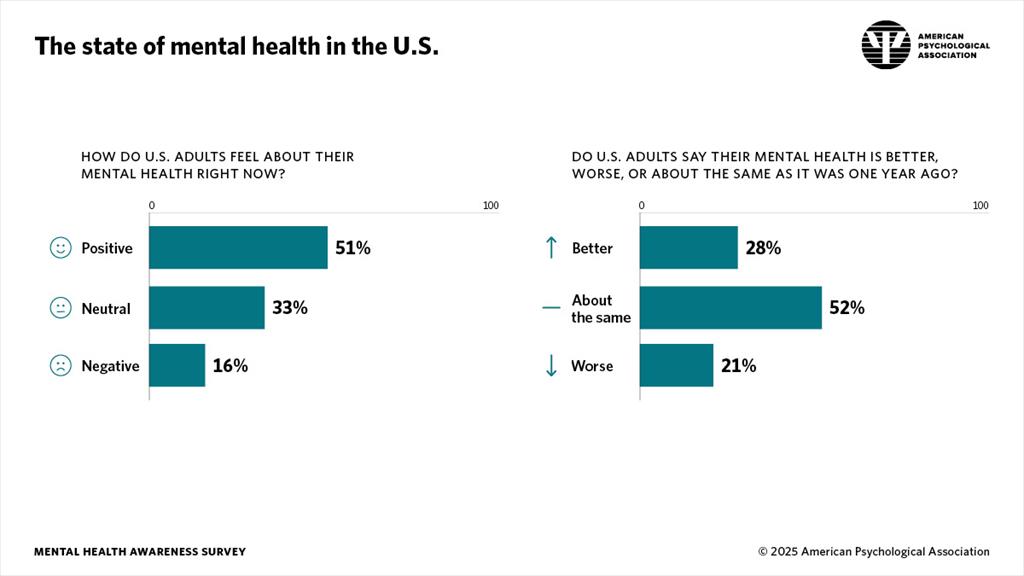
A majority of U.S. adults (51%) said they feel positive about their mental health right now, and more than 4 in 5 adults (83%) said they are comfortable talking about their mental health.
Health care providers appear to be a widely trusted source on mental health, as 84% of adults said they would be comfortable talking with a doctor or therapist about their mental health. But most adults also felt comfortable opening up to the people in their daily lives, including friends (81%) and family (81%).
However, younger adults were both more likely to feel negative about their mental health and less likely to talk about it. Nearly a quarter of younger adults said they were not comfortable talking about their mental health—more than any other age group (23% ages 18–34 vs. 14% ages 35–54 and 14% ages 55+). More than half of younger adults (52%) also said they have withheld information about their mental health from friends or a health care provider before, compared with 42% of adults ages 35–54 and 25% of adults ages 55 and older.
And while 83% said they would be comfortable opening up to their friends about their mental health, younger adults were much less likely to feel comfortable than adults 35 and older to broach these conversations with their family (71% ages 18–34 vs. 79% ages 35–54 and 89% ages 55+) or health care providers (76% ages 18–34 vs. 86% ages 35–54 and 89% ages 55+).
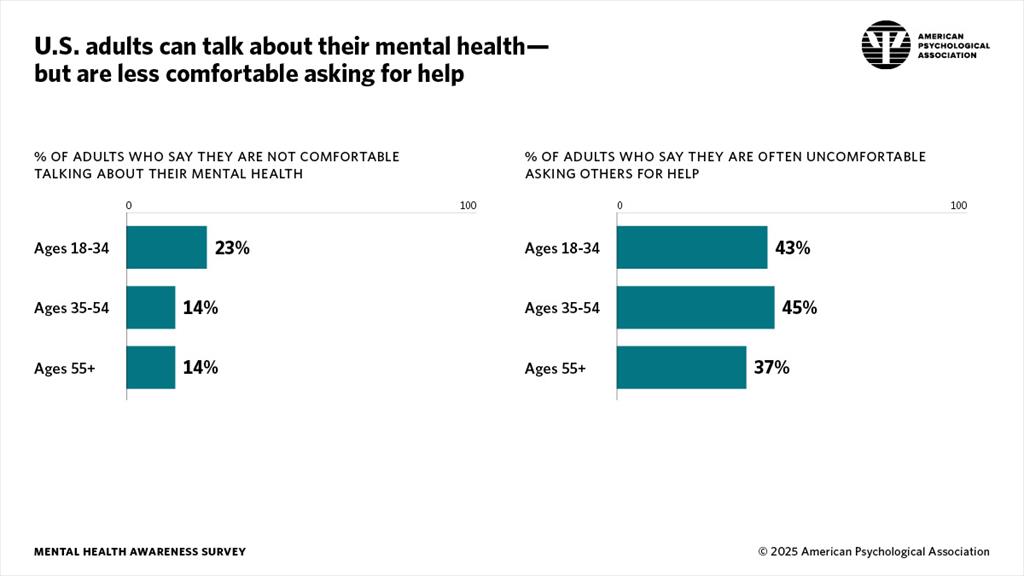
A significant number of U.S. adults showed a reluctance to reach out for help, as 41% said they are often uncomfortable asking others for aid. This may especially be the case for people who are struggling with mental health issues, as more adults said they would be uncomfortable asking for an accommodation at work or school for their mental health (29%) than they would for their physical health (21%).
Still, young adults appear to be seeking ways to open up on their own terms. About half of adults ages 18–34 (52%) and 35–54 (54%) said they would feel comfortable discussing their mental health with an artificial intelligence chatbot, compared with just 26% of older adults.
In addition, 3 in 10 young adults (30%) would rather talk about mental health anonymously than with someone they know. These findings suggest younger generations may feel safer engaging in conversations about mental health when they can maintain distance or anonymity.
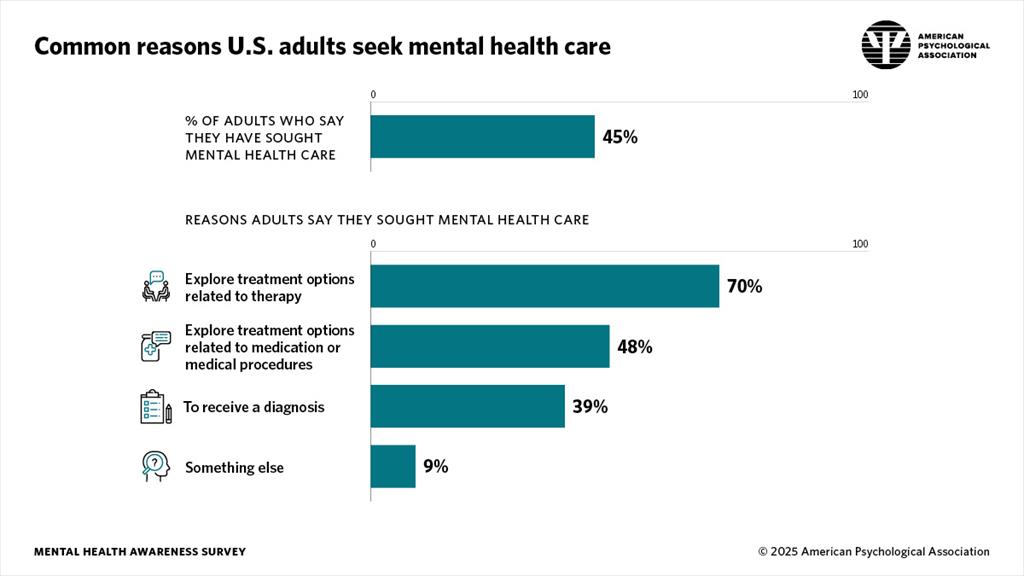
Seeking professional mental health care may also be increasingly common, as only one-third of adults (34%) said they had never sought professional mental health care and do not want to. More adults said they have sought mental health care in the past (45%), and close to 1 in 5 said they want to in the future (17%). Most adults who sought professional mental health care said they were interested in exploring treatment options related to therapy (70%), including close to 3 in 4 adults ages 18–34 (76%) and 35–54 (73%).
Close to 3 in 5 younger adults (59%) said they have sought out professional mental health care, but only 43% said they were actually able to receive care. This may be because more younger adults said they had issues finding a provider who meets their treatment needs (34% ages 18–34, 26% ages 35–54, and 23% ages 55+) or a provider accepting new clients (20% ages 18–34 and 20% ages 35–54 vs. 9% ages 55+).
Overall, nearly 1 in 10 adults (9%) said they have sought, but not received, professional mental health care as access and affordability continue to be barriers to treatment.
When it comes to paying for treatment, 25% of adults said they had issues finding a provider in their insurance network—including 30% of adults ages 18–34, 24% ages 35–54, and 17% ages 55+. A similar percentage of adults (29%) said they were worried about the cost of treatment, and adults ages 18–54 were more likely than adults ages 55 and older to say they had issues with insurance such as a rejected claim or a change in coverage (21% adults 18–34 and 15% ages 35–54 vs. 7% ages 55+).
Methodology
This survey was conducted online in the United States by The Harris Poll from April 18–21, 2025, among 1,076 U.S. adults ages 18+. Figures were weighted where necessary to bring them into line with their actual proportions within the U.S. population. Respondents for this survey were selected from a pool of potential respondents who have agreed to participate in The Harris Poll’s online research.
Six Things Psychologists are Talking About

Speaking of Psychology
Subscribe to APA’s audio podcast series highlighting some of the most important and relevant psychological research being conducted today.
Subscribe to Speaking of Psychology and download via:


Related books