


Psychologists continue to face capacity issues, such as longer waitlists, patients with increasingly severe symptoms, increases in treatment course length, and a sense that they are unable to meet the demand for treatment, according to the 2024 Practitioner Pulse Survey by APA and its companion organization, APA Services.
About half (53%) of psychologists did not have openings for new patients. And despite improvements in stress levels, work-life balance, and self-care practices, a third of psychologists still reported feeling burned out—a trend that seems to be disproportionately affecting early career psychologists. Early career psychologists reported higher levels of stress and burnout than psychologists later in their careers, which may have implications for the future of the mental health workforce.
Intensifying these capacity issues were psychologists’ low participation rates in insurance plans—especially public insurance plans like Medicare and Medicaid. While a majority of psychologists (66%) reported they currently accept some form of insurance, about one-third (34%) said they do not accept insurance.
Meanwhile, the practice of psychology is changing. Telehealth has been broadly adopted by psychologists, opening new avenues for treatment. And while most psychologists had never used artificial intelligence (AI) tools in their practices (71%), approximately 1 in 10 psychologists (11%) used AI at least monthly for tasks such as note-taking or reducing administrative burdens. More than a quarter of psychologists (27%) were worried that AI may make some or all of their job duties obsolete in the future.
Workload and capacity
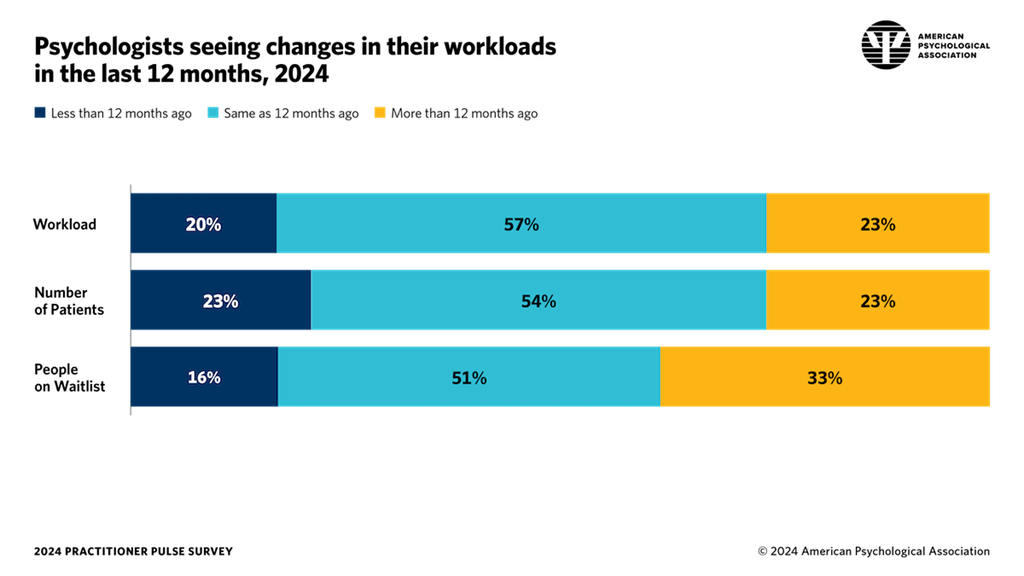
Compared with previous years, more psychologists reported treating fewer patients and working fewer hours now than they did 12 months ago. This trend may be driven by psychologists in later career stages who, on average, reported reducing their patient caseloads and work hours. All other career stages overwhelmingly worked at the same level or higher than they did 12 months ago.
More than half of psychologists (53%) did not have openings for new patients, suggesting prospective patients may have difficulty finding a psychologist with an opening. About 3 in 5 psychologists (61%) did not have a waitlist.
Insurance participation
One-third of psychologists (34%) were not currently in-network with any form of insurance while two-thirds (66%) were currently in-network. Of those who were not currently in-network with any public or private insurance panels, 52% had not been in-network with insurance panels in the past and 48% had been. Combined, 18% of psychologists had never in their careers participated in insurance panels.

Psychologists who have never accepted insurance, no longer accept insurance or who recently stopped taking a form of insurance were asked their top three barriers to participating with insurance. Of these 374 psychologists, more than 4 in 5 (82%) reported insufficient reimbursement rates, 3 in 5 (62%) reported administrative issues such as preauthorization requirements or audits, and half (52%) reported concerns about payment reliability such as delays in payment and refund demands.

Artificial intelligence in practice
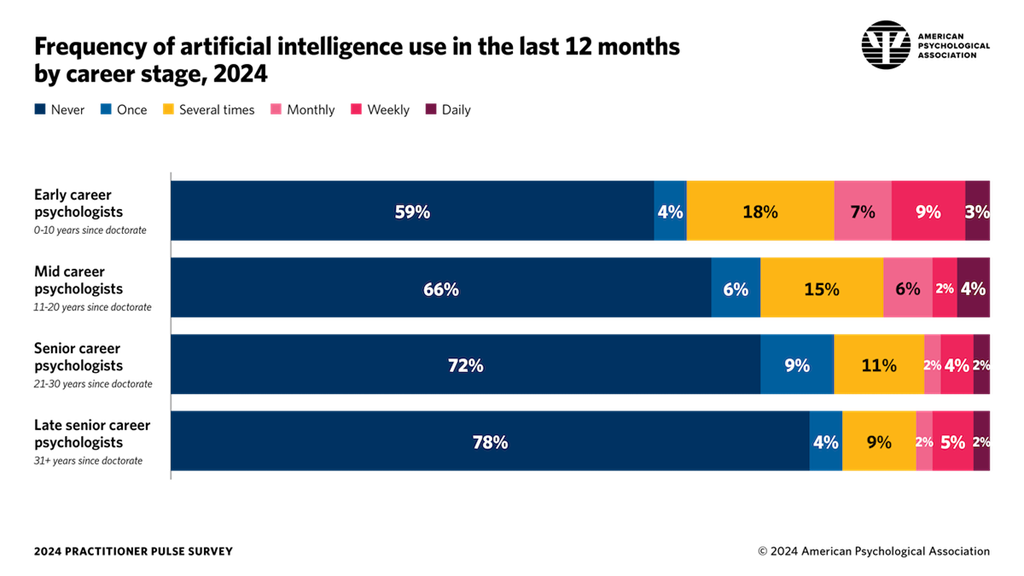
While half of psychologists agreed or strongly agreed they are knowledgeable about AI, more than 7 in 10 psychologists (71%) said they have not used AI tools at work in the last 12 months, and fewer than 1 in 10 psychologists (6%) reported they used them once. A similar percentage of psychologists reported using them several times in the past 12 months (12%) as those who used AI tools at work at least monthly (11%).
Of the 247 psychologists who used AI tools at least once in the past 12 months, 58% used AI for writing assistance (email drafting, etc.), 36% used AI for content generation (generating images, text, or other media), 29% used AI for summarization (clinical notes, digital articles, etc.), and 27% used it for note-taking or dictation. They were less likely to use AI tools for task automation, clinical diagnosis assistance, data analysis, and chatbot assistance for patients or clients.
Early career psychologists also reported more frequent use of AI in their practices than psychologists further into their careers.
Methodology
The APA Practitioner Pulse Survey series has been conducted annually since 2020. Originally intended to track changes in psychological practice during the Covid-19 public health emergency, the survey has since been revised to track ongoing changes in the workforce after the public health emergency expired in May 2023.
The survey was conducted online through the Alchemer survey platform and distributed via email. The survey utilized a probability-based random sample, giving all potential survey invitees an equal opportunity to be selected for the survey. Those targeted for inclusion were psychologists licensed in at least one U.S. state. Emails were gathered both from APA membership data and from state licensing data purchased from a data vendor.
Invitations were sent to the sample of 35,000 on September 4, 2024, and several reminder emails were sent to encourage survey completion. Of the 35,000 in the sample population, 7,685 did not receive the invitation due to email bounces or other errors, and 127 unsubscribed from notifications and did not complete the survey. Of the remaining 27,188 licensed psychologists, 853 psychologists completed the survey. The survey closed on September 30, 2024, with a completion rate of 3.1%.