

Many U.S. adults are avoiding political discussions and, in some cases, family members they disagree with while they celebrate the holidays this year, according to an APA survey.
Before the 2024 U.S. presidential election, APA’s 2024 Stress in America™ survey revealed that more than three-quarters of adults (77%) said the future of the nation was a significant source of stress in their lives and about half (51%) said the uncertainty about the election caused them stress. To see how that may have changed now that results of the election are known, The Harris Poll conducted a survey on behalf of APA among more than 2,000 U.S. adults aged 18+ between November 25 and 27, 2024.
After the election, stress about the future of the nation shifts
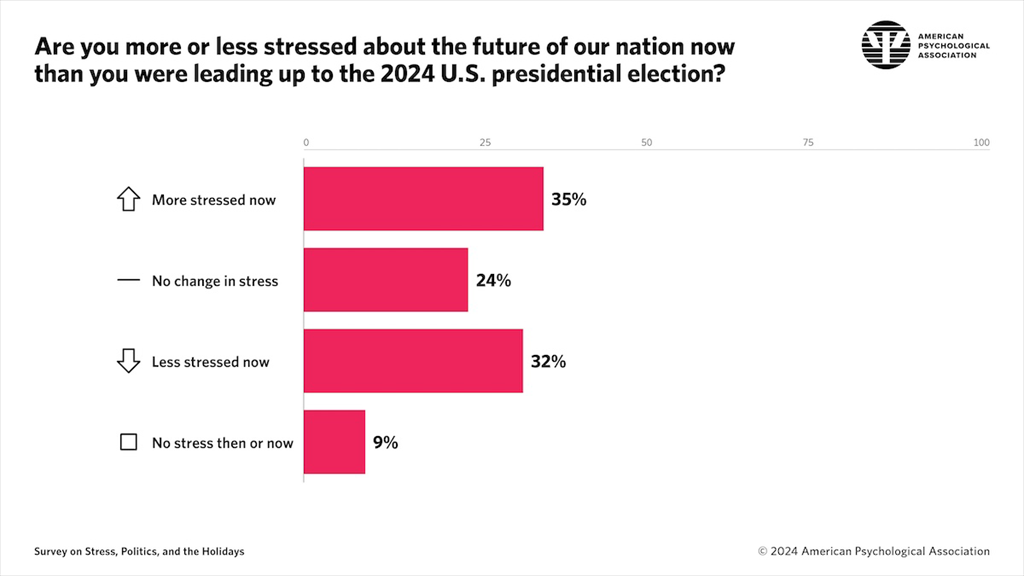
The survey found that more than one-third of adults (35%) said they are more stressed about the future of the nation now than they were leading up to the 2024 U.S. presidential election while another third of adults were now less stressed (32%). A quarter of adults (24%) said their stress about the future of the nation is unchanged and 9% said they were not stressed about the future of the nation then or now.
Adults 65 or older were significantly more likely than adults ages 18–54 to say that they are now more stressed about the future of the nation than they were before the election (33% ages 18–34, 31% ages 35–44, 26% ages 45–54, 37% ages 55–64, and 44% ages 65+).
A majority of U.S. adults (65%) said that stress about the future of the nation had a physical or emotional impact on their lives in the past month, such as feeling nervous or anxious (31%), having negative thoughts (22%), feeling depressed or sad (21%), or having a headache (15%).
Related content
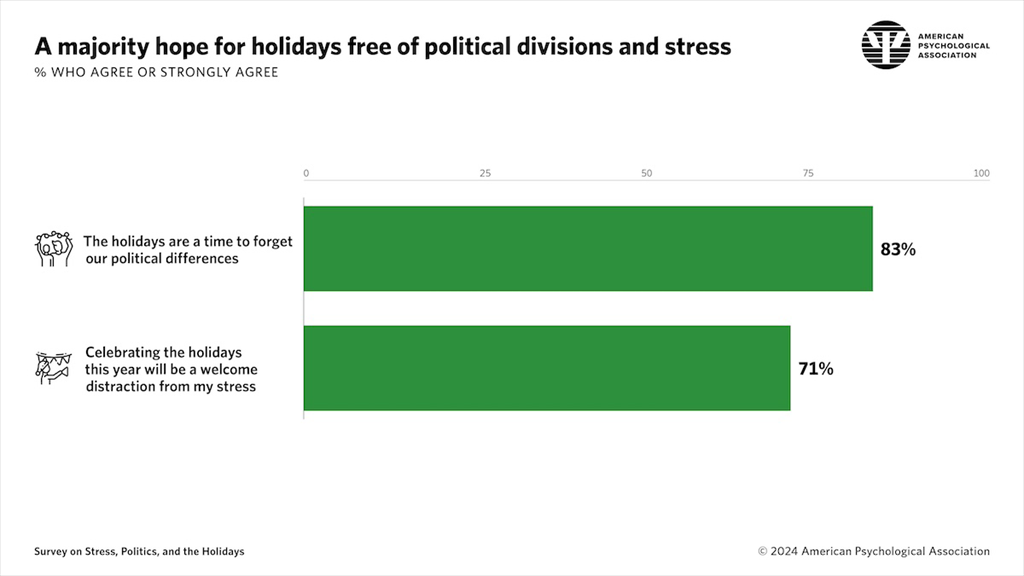
The majority of U.S. adults (83%) agreed that the holidays are a time to forget our political differences. This remains true across the political spectrum; 82% of adults whose preferred candidate lost the election agreed, as did 84% of adults whose preferred candidate won.
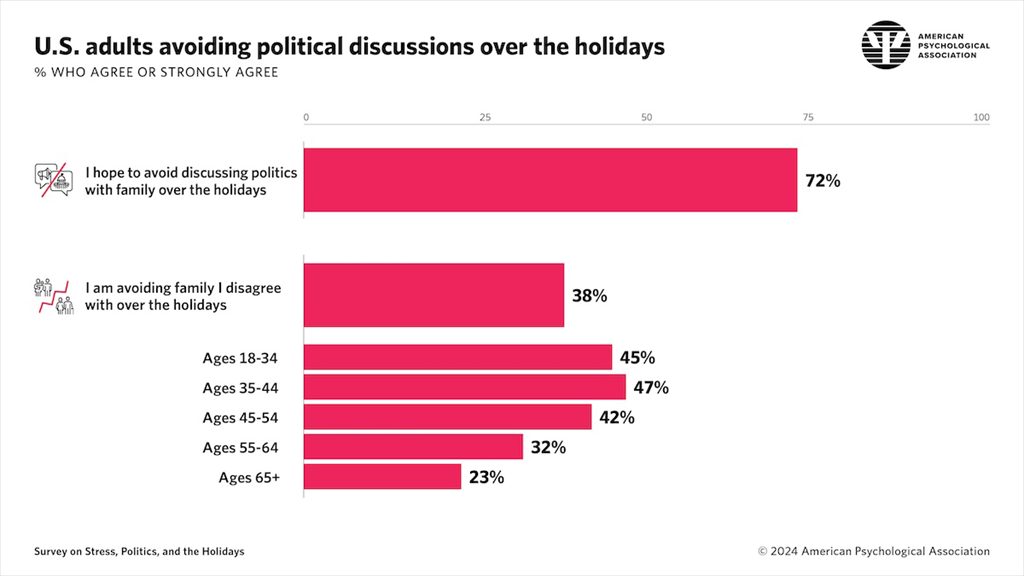
Nearly three-quarters of adults (72%) said they hope to avoid discussing politics with family over the holidays. Though 65% of adults said they were not worried that political discussions would hurt their relationship with their family members during the holidays, nearly 2 in 5 adults (39%) said they were stressed by the thought of politics coming up at holiday gatherings. Less than one-third of adults (32%) said they were looking forward to talking about politics with family over the holidays.
Nearly 2 in 5 adults (38%) also said that they are avoiding family they disagree with over the holidays, though adults age 65 or older were significantly less likely to agree than their younger counterparts (45% ages 18–34, 47% ages 35–44, 42% ages 45–54, and 32% ages 55–64 vs. 23% ages 65+).
Coping with stress over the holidays
While approximately 7 in 10 adults (71%) said that celebrating the holidays this year will be a welcome distraction from stress, the holiday season is not entirely stress-free. Only 16% of adults said they do not experience stress during the holiday season.
For people who said they do experience stress during the holiday season, 9 in 10 (90%) said they do something to cope with the stress. More than 2 in 5 adults who said they experience stress during the holidays said they talk with people around them such as their friends, family, or spouse (48%) or prioritize their well-being (42%). More than a third (37%) said they manage their expectations and a quarter (27%) said they try to remind themselves that the holidays will pass.
Harmful coping mechanisms like isolating oneself by avoiding gatherings or minimizing interactions (22%), changes in eating habits such as overindulging or restricting eating (19%), and relying on substances to feel better (18%) were much less common. A little more than 1 in 10 adults (14%) said they seek help from a therapist or counselor to cope with stress during the holiday season.

Methodology
This survey was conducted online within the United States by The Harris Poll on behalf of APA from November 25–27, 2024, among 2,083 U.S. adults ages 18+. Data are weighted where necessary by age, gender, region, race/ethnicity, household income, education, marital status, size of household, and political party affiliation to bring them in line with their actual proportions in the population.
Respondents for this survey were selected from among those who have agreed to participate in our surveys. The sampling precision of Harris online polls is measured by using a Bayesian credible interval. For this study, the full sample data is accurate to within ±2.5 percentage points using a 95% confidence level. This credible interval will be wider among subsets of the surveyed population of interest.
All sample surveys and polls, whether or not they use probability sampling, are subject to other multiple sources of error which are most often not possible to quantify or estimate, including, but not limited to coverage error, error associated with nonresponse, error associated with question wording and response options, and postsurvey weighting and adjustments.
The 2024 Stress in America™ survey was conducted online within the United States by The Harris Poll on behalf of APA between August 1–23, 2024, among 3,305 adults ages 18+ who reside in the U.S. that serves as a nationally representative sample. In addition to the national sample, oversamples were collected to allow for subgroup analysis within race/ethnicity groups. Sample sizes across the national and oversamples are as follows: 801 Black, 855 Hispanic, and 804 Asian. Interviews were conducted in English and Spanish.