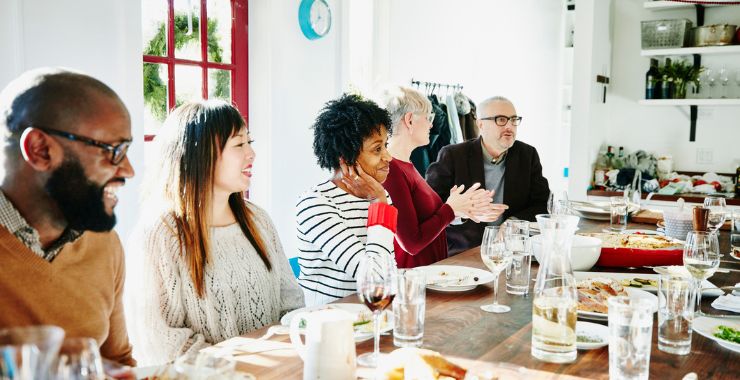
’Tis the holiday season, often a time when complicated relationships with family members come to a head. That may be especially true this December, a new APA survey suggests.
The survey, which included over 2,000 U.S. adults and was conducted right before Thanksgiving 2024, found that nearly 2 in 5 (38%) participants—and a whopping 45% of those between ages 18 to 34 and 47% of those ages 35 and 44—said they’re avoiding relatives they disagree with this holiday season.
Black and Latino/a/e adults are particularly likely to opt out of potentially distressing interactions, with 49% and 44% respectively saying they’re avoiding family they disagree with compared with 33% of White adults. And even if they do show up, most Americans yearn for politics-free holiday events this year, as more than 7 in 10 (72%) said they hope to avoid discussing politics with family over the holidays.
After a stressful lead-up to the November election, “a lot of people are making conscious choices right now to reduce the presence of politics in their lives and in their minds,” says Tania Israel, PhDopens in new window, a professor of counseling psychology at the University of California, Santa Barbara, and author of the 2024 book Facing the Fracture: How to Navigate the Challenges of Living in a Divided Nationopens in new window. “That seems to be a choice that people are making in part for their mental health, and also in part for their ability to maintain relationships with other people.”
Sometimes it’s the right choice, says Jessica Smedley, PsyDopens in new window, a licensed psychologist in private practice in Washington, D.C. Her patients are primarily African American women, many of whom are feeling a sense of erasure or invisibility along with grief and disappointment—but not surprise—at the election results, she says. “It really might mean some people are opting out and choosing ‘chosen family’ over blood relatives,” says Smedley, who’s also the 2024 president of the DC Psychological Association.
“People should feel empowered to make their own rules and decisions based on their needs, and work through the guilt that sometimes comes with not pleasing others or others not agreeing with those decisions,” she adds. That could mean skipping some professional year-end events, too.
But avoidance might not be a sustainable strategy for mental health and relationships long-term, psychologists say. Here are their suggestions for alternative ways to cope and how to bridge divides.
Think flexibly about how you engage with challenging situations or people
Try not to swear off all political discussions for good—nor commit to always voicing your views on the state of affairs. “It’s a good skill to be able to do either one of those, and also to be able to discern which of those is the best choice to make in any given situation,” Israel says.
While it’s important to know when and how to create boundaries, she adds, “the most empowered and healthy and wise we can be is when we are capable of staying in these challenging conversations—and are also able to exit the conversations or to not engage with the conversations.”
[Related: When and how to engage constructively in family arguments during the holidays]
Use stories, not data
If you find yourself chatting with a neighbor or coworker with opposing views at a holiday gathering, refrain from rattling off statistics and slogans to make your point. Research shows that it’s personal stories that actually help open other people’s minds, Israel says.
“The best thing that we can do is to create a warm and trusting connection where we are trying to understand the other person,” she says. “And often, we think that what we’re supposed to do looks more like what happens on a debate stage, where we are trying to make our case with the best information and argument that we can. That actually does not serve our purposes.”
Recognize your own biases
Israel says the general public has recently become more aware of concepts like confirmation bias, or when we pay attention to information that supports what we already believe while ignoring messages that conflict with our views. Ironically, she says, “people seem to recognize that other people do this, but we still have a lot of trouble recognizing our own biases.”
Acknowledging that you may not be coming from a completely objective place—or that you don’t necessarily comprehend the complexity of people’s values and beliefs based on the terms they use or the slogans they wear or even whether they put their pronouns on their Zoom screen—can start to break down communication walls, Israel says.
Turn away from media and toward real-life community
While it’s not necessarily advised to completely disengage with all current events, “at a certain point, there’s diminishing returns” to being too tuned in, says C. Vaile Wright, PhD, the senior director of the Office of Health Care Innovation at APA. “Exposing yourself to that level of negativity is not a particularly healthy coping response—regardless of which side you fall down on.”
Healthier coping mechanisms include connecting with your purpose and values in the real world, maybe by engaging in local advocacy or community projects or by strengthening relationships with local leaders, Smedley says.
Focus on what you can control
No matter how you voted, the election is over and beyond personal reach. It’s now helpful to look toward everyday practices you can control, Wright says. That could mean engaging in activities like volunteering for a cause that’s important to you, taking long walks, listening to music, seeing friends, and getting plenty of sleep. “Act in ways that fill you up, but that don’t overtax you either,” Wright says. “There’s a certain level of just allowing yourself to ‘be’ even if that [includes] some sadness right now.”
Self-care and self-preservation strategies are critical for psychology providers too, Smedley adds. “We must take care of ourselves as well and be mindful of our schedules and how to advocate for personal and professional needs in the weeks to come.”