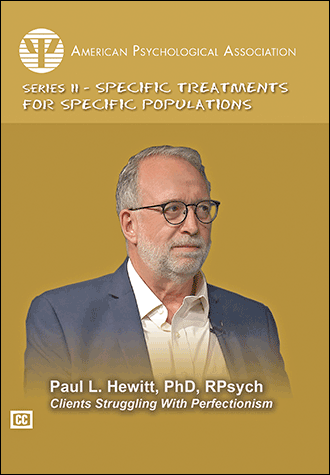
Clients Struggling With Perfectionism
ISBN: 978-1-4338-3133-1Available formats
Streaming options
Perfectionism, or the tendency to demand or require perfection for oneself or others can be seen as an attempt to gain acceptance and avoid rejection or abandonment. Simultaneously, however, perfectionism can interfere with the establishment and maintenance of interpersonal connections and close relationships.
Although perfectionism develops in a relational context, the impact it has on other behaviors can result in the fear of being criticized or judged. Effective therapists must acknowledge these nuances and work with the client to explore components of the client's perfectionism, while effecting changes so that the client can meet his or her own needs without feeling the need to be perfect.
In this video program, Dr. Paul L. Hewitt demonstrates his approach to helping clients who struggle with perfectionism, an integration of psychodynamic psychotherapy and interpersonal theory framework that emphasizes the importance of clinical formulation and the establishment of an effective therapeutic relationship.
The dynamic relational treatment model for perfectionism integrates psychodynamic and interpersonal principles (see Hewitt, Flett, & Mikail, 2017; Hewitt et al., 2015) and emphasizes the relational basis of human behavior including relationships with others and with self.
In particular the approach focuses on underlying needs for belonging and self-esteem, focusing on how perfectionistic behavior offers a false promise to securing these needs. While individuals with perfectionism may recognize their perfectionistic behavior, they may not have insight into the contingent nature of perfection with relatedness and self-esteem, how it developed, nor how perfectionistic behaviors actually thwart these needs.
Thus, treatment aims to first develop awareness regarding the relational dynamics and unique interpersonal patterns underlying their need for perfection. The clinician can then help the patient move toward more adaptive and flexible ways of securing these needs of belonging and self-esteem.
Paul L. Hewitt, PhD, RPsych, is a professor of psychology at the University of British Columbia and a registered clinical psychologist whose research interest focuses primarily on personality vulnerabilities and their implications for psychological difficulties among adults, adolescents, and children.
- Hewitt, P. L., Flett, G. L., & Mikail, S. F. (2017). Perfectionism: A relational approach to conceptualization, assessment, and treatment. New York: The Guilford Press.
- Hewitt, P. L., Mikail, S. F., Flett, G. L., & Dang, S. (2017). Specific Formulation Feedback in Dynamic-Relational Group Psychotherapy of Perfectionism. Psychotherapy, 55, 179–185
- Hewitt, P. L., Mikail, S. F., Flett, G. L., Tasca, G., Flynn, C. A., Deng, X., Kaldas, J., Chen, C. (2015). Psychodynamic/Interpersonal group psychotherapy of perfectionism: Evaluating a short term treatment. Psychotherapy, 52(2), 205–217.
APA Videos
- Cognitive Behavioral Therapy for Obsessive–Compulsive Disorder
Eric A. Storch - Cognitive Behavioral Therapy for Social Anxiety
Amy Wenzel - Cognitive–Behavioral Psychoeducation for Clinical Anxiety
Jonathan S. Abramowitz - Cognitive–Behavioral Therapy for Clients With Anxiety and Panic
Bunmi O. Olatunji - Cognitive–Behavioral Therapy for Perfectionism Over Time
Martin M. Antony - Obsessive–Compulsive Behavior
Martin M. Antony - Obsessive–Compulsive Disorder
R. Reid Wilson
APA Books
- Behavioral Interventions in Cognitive Behavior Therapy: Practical Guidance for Putting Theory Into Action, Second Edition
Richard F. Farmer, and Alexander L. Chapman - Cognitive Therapy
Keith S. Dobson - Cognitive–Behavioral Therapy for Refractory Cases: Turning Failure Into Success
Edited by Dean McKay, Jonathan S. Abramowitz, and Steven Taylor - Strategic Decision Making in Cognitive Behavioral Therapy
Amy Wenzel