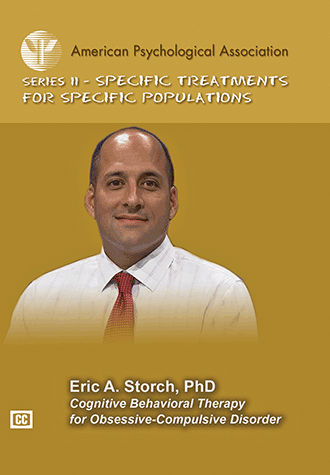
Cognitive Behavioral Therapy for Obsessive–Compulsive Disorder
ISBN: 978-1-4338-2005-2Available formats
Streaming options
Obsessive–compulsive disorder (OCD) is characterized by unwanted, distressing and repeated thoughts and images that lead to compulsive actions. In the past, OCD was considered a complex disorder that was challenging to diagnose and effectively treat. More recently, there has been substantial progress in terms of both treating and assessing this once illusive disorder.
Cognitive behavioral therapy (CBT) with exposure and response prevention is an evidence-based approach to treating OCD that encourages the client to be gradually and systematically exposed to the distress provoking trigger without engaging in rituals. This video features a discussion and demonstration of this proven CBT technique that involves first exposing the client to fear-producing stimuli and then encouraging the client to refrain from engaging in compulsive behaviors.
In this video, Dr. Eric Storch takes an active role in encouraging and directing a female client to help prevent habitual obsessive-compulsive responses to her fear of contamination.
Dr. Eric Storch's approach to treating obsessive–compulsive disorder (OCD) focuses primarily on exposure and response prevention. This involves having the person with OCD face his or her fear or the possibility of the feared outcome taking place while refraining from engaging in repetitive, time-consuming compulsions. This is based on the notion that rituals serve to reduce anxiety and distress and are thus reinforcing. Triggers are approached gradually with easier stimuli targeted initially. The person remains in the distress-provoking situation until anxiety and distress habituates naturally (i.e., in the absence of rituals or other behaviors to reduce anxiety such as relaxation).
Eric A. Storch, PhD, is professor and All Children's Hospital Guild Endowed Chair in the Departments of Pediatrics and Psychiatry and Behavioral Neurosciences, University of South Florida. He has published more than 300 peer-reviewed journal articles and book chapters and has given more than 300 conference presentations.
In addition to his peer-reviewed articles, Dr. Storch has edited or coedited 6 books dealing with treatment of complex cases in children, obsessive–compulsive disorder, and childhood anxiety.
He has received grant funding for his work in obsessive–compulsive disorder (OCD), related disorders (e.g., tics), and anxiety from the National Institutes of Health, Agency for Health Care Research and Quality, CDC, International OCD Foundation, pharmaceutical companies, Tourette Syndrome Association, and National Alliance for Research on Schizophrenia and Affective Disorders.
In addition to treatment outcome, Dr. Storch has specific research interests in treatment augmentation and dissemination.
He directs the University of South Florida Obsessive–Compulsive Disorder Program and is highly regarded for his treatment of pediatric and adult OCD patients.
- Abramowitz, J.S., McKay, D., Taylor, S. (2008). Obsessive–Compulsive Disorder: Subtypes and Spectrum Conditions. Philadelphia, PA: Elsevier Press.
- Hudak, R., Dougherty, D. (2011). Clinical Obsessive–Compulsive Disorders in Adults and Children Cambridge, United Kingdom: Cambridge University Press.
- Storch, E. A., Geffken, G.R., Murphy, T., (Eds.). (2007). Handbook of Child and Adolescent Obsessive–Compulsive Disorders. New York, NY:Lawrence Erlbaum Associates.
- Storch, E. A., Larson, M., Adkins, J., Geffken, G. R., Murphy, T. K., & Goodman, W. K. (2008). Evidence Based Treatment of Pediatric Obsessive–Compulsive Disorder. In R. Steele, M. Roberts, D. Elkin (Eds.), Handbook of Evidence Based Therapies for Children and Adolescents. New York, NY: Springer Publishers.
APA Videos
- Behavior Therapy for Obsessive–Compulsive Disorder
Samuel M. Turner - Cognitive Behavioral Therapy for Social Anxiety
Amy Wenzel - Cognitive–Behavioral Therapy for Clients With Anxiety and Panic
Bunmi O. Olatunji - Mindfulness for Anxiety
Ronald D. Siegel - Obsessive–Compulsive Behavior
Martin M. Antony - Obsessive–Compulsive Disorder
R. Reid Wilson