Constructivist Therapy
ISBN: 978-1-59147-178-3Streaming options
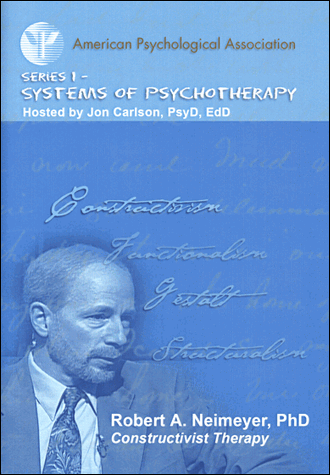
Constructivist therapy is more of a theory of knowledge than a system of therapy. Constructivist theory holds that humans are meaning makers, and in a very real sense the meaning we create in turn creates our experience of the world. Thus, constructivists focus on the meaning clients attribute to their world and the ways these shape and constrain clients' sense of themselves, their relationships, and their difficulties.
In this approach, therapists pay close attention to where the client wants to go, both within the therapy session overall and moment-to-moment during the session. The client is central, and the therapist's job is to ask questions that will lead the client toward his or her own answers, not toward answers the therapist may have. Constructivists refer to this as "leading from one step behind."
Because of the centrality of the client, constructivist therapy has no fixed structure, seeking instead to follow the "affect trail" efficiently toward a rapid and deep contact with the client's central issues. In each conversational turn, therapy takes its orientation from the client, so it is important for the therapist to empathically enter the client's world of constructed meaning, whether conveyed verbally, coverbally or nonverbally in the client's responses.
However, the therapist is by no means a passive visitor to the client's experiential world but, rather, subtly directs the process of their exploration toward emotionally significant "growing edges" of the client's awareness, fostering greater contact with the painful discrepancies in the client's story and the often hidden purposes served by the problematic feeling, pattern, or behavior.
Discovering the significance of the symptom typically fosters the symbolization and articulation of new meaning, and an emerging sense of wholeness and possibility that permits the client to move forward in novel ways.
- Neimeyer, R. A. (2000). Research and practice as essential tensions: A constructivist confession. In S. Soldz & L. McCullough Vaillant (Eds.), Reconciling empirical knowledge and clinical experience (pp. 123–150). Washington, DC: American Psychological Association.
- Neimeyer, R. A. (Ed.). (2001). Meaning reconstruction and the experience of loss. Washington, DC: American Psychological Association.
- Neimeyer, R. A. (2005a). The construction of change: Personal reflections on the therapeutic process. Constructivism in the Human Sciences, 10, 77–98.
- Neimeyer, R. A. (2005b). Re-storying loss: Fostering growth in the posttraumatic narrative. In L. Calhoun & R. Tedeschi (Eds.), Handbook of posttraumatic growth: Research and practice. Mahwah, NJ: Erlbaum.
- Neimeyer, R. A., & Bridges, S. (2003). Postmodern approaches to psychotherapy. In A. Gurman & S. Messer (Eds.), Essential psychotherapies (2nd ed., pp. 272–316). New York: Guilford Press.
- Neimeyer, R. A., & Mahoney, M. J. (1995). Constructivism in psychotherapy. Washington, DC: American Psychological Association.
- Neimeyer, R. A., & Raskin, J. (Eds.). (2000). Constructions of disorder. Washington, DC: American Psychological Association.
- Neimeyer, R .A., & Stewart, A. E. (2000). Constructivist and narrative psychotherapies. In C. R. Snyder & R. E. Ingram (Eds.), Handbook of psychotherapy (pp. 337–357). New York: Wiley.
APA Videos
- Adlerian Therapy
Jon Carlson - Affect-Focused Dynamic Psychotherapy
Leigh McCullough - Brief Dynamic Therapy
Stanley B. Messer - Client-Centered Therapy
Nathaniel J. Raskin - Client-Directed Outcome-Focused Psychotherapy
Scott D. Miller - Cognitive–Affective Behavior Therapy
Marvin R. Goldfried - Cognitive–Behavior Therapy
Jacqueline B. Persons - Constructivist Therapy Over Time
Robert A. Neimeyer - Ethnocultural Psychotherapy
Lillian Comas-Diaz - Experiential Psychotherapy
Alvin R. Mahrer - Gestalt Therapy
Gordon Wheeler - Multimodal Therapy
Arnold A. Lazurus - Narrative Therapy Over Time
Stephen Madigan - Process Experiential Psychotherapy: An Emotion-Focused Approach
Leslie S. Greenberg - Prescriptive Eclectic Therapy
John C. Norcross - Short-Term Dynamic Therapy
Donald K. Freedheim
APA Books
- Handbook of Bereavement Research: Consequences, Coping, and Care
Edited by Margaret S. Stroebe, Robert O. Hansson, Wolfgang Stroebe, and Henk Schut - Identity and Story: Creating Self in Narrative
Edited by Dan P. McAdams, Ruthellen Josselson, and Amia Lieblich - Meaning Reconstruction and the Experience of Loss
Edited by Robert A. Neimeyer - Turns in the Road: Narrative Studies of Lives in Transitions
Edited by Dan P. McAdams, Ruthellen Josselson, and Amia Lieblich