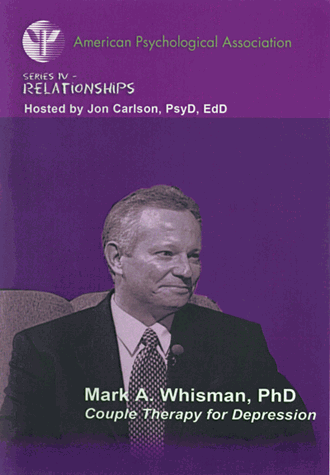
Couple Therapy for Depression
ISBN: 978-1-59147-260-5Available formats
Streaming options
In Couple Therapy for Depression, Dr. Mark A. Whisman shows his approach to treating couples in which one or both partners are experiencing depression. His cognitive–behavioral approach focuses on building relationship skills and behavioral patterns, as behavior can usually be changed more readily than emotions, and oftentimes a change in affect follows a change in behavior.
In this session, Dr. Whisman works with a married couple in which the husband has bipolar disorder and the wife is experiencing depression. Both partners are dealing with issues outside their marriage, including financial demands from ex-spouses. Dr. Whisman works with the couple on discerning the crux of their presenting issues, and then he introduces them to some problem-solving and communication skills so they might support each other more effectively.
The cognitive–behavioral approach used in this video focuses on building relationship skills, thereby alleviating co-occurring depression in one or both partners. When couples come to therapy, often one or both partners is experiencing some form of depression. There is a reciprocal link between depression and relationship problems: Depression may be triggered by relationship problems, and relationship problems are often made worse by depression. Couples with depression usually do not provide a lot of support to one another, thereby increasing problems with the relationship as well as the depression.
One goal of this therapeutic approach is to strengthen these relationships by building skills such as problem solving and communication. Relationship building helps with depression in couples: Research shows that stronger relationships may alleviate or even prevent the onset of depression.
This approach is based on cognitive–behavioral couples therapy. Although depression is a mood disorder that manifests itself in the client's affect, its effect on a client's life may be influenced by the client's behavior. If the therapist can help the client to change his or her behavior, emotional change may follow.
The logic behind this is that although we cannot change our feelings, we can change our behavior. In the case of couples therapy, changing behavior in one or both partners may help to build the relationship, thereby increasing support within the couple and possibly helping to alleviate some of the depression.
Dr. Whisman's approach is to first assess the couple's strengths and whatever issues they may be dealing with. First he looks at the couple as a unit, then at each individual, listening to their problems and experiences. After assessment, Dr. Whisman focuses on increasing positive interactions between the partners. He does this by
- teaching caring gestures that partners may use with each other,
- improving the frequency of companionship activities, and
- encouraging both partners to recognize the good in each other so as to increase their self-esteem.
These three behaviors counteract some of the effects of depression on the relationship, and may help to lessen the depression by, for instance, raising a partner's self-esteem, something that may have been decreased by depression.
Mark A. Whisman, PhD, is an associate professor in the Department of Psychology at the University of Colorado at Boulder. He received his PhD in clinical psychology from the University of Washington.
Dr. Whisman's focuses include couples and depression, communication and cognitive aspects of couple functioning, and cognitive theory and therapy of depression. He is coeditor of the book Treating Difficult Couples: Helping Clients With Coexisting Mental and Relationship Disorders (with D. K. Snyder) as well as numerous articles and book chapters.
He is a founding fellow of the Academy of Cognitive Therapy and conducts workshops on individual and couple approaches to cognitive and behavior therapy.
- Beach, S. R. H., Sandeen, E. E., & O'Leary, K. D. (1990). Depression in marriage: A model for etiology and treatment. New York: Guilford Press.
- Snyder, D. K., & Whisman, M. A. (Eds.). (2003). Treating difficult couples: Helping clients with coexisting mental and relationship disorders. New York: Guilford Press.
- Whisman, M. A., & Uebelacker, L. A. (1999). Integrating couple therapy with individual therapies and antidepressant medications in the treatment of depression. Clinical Psychology: Science and Practice, 6, 415–429.
- Whisman, M. A., & Weinstock, L. M. (2002). Cognitive therapy with couples. In F. Kaslow (Series Ed.) & T. Patterson (Vol. Ed.), Comprehensive handbook of psychotherapy: Vol. 2. Cognitive–behavioral approaches (pp. 373–394). New York: Wiley.
APA Videos
- Cognitive–Behavior Therapy for Depression Video Series
Jacqueline B. Persons, Joan Davidson, and Michael A. Tompkins - Cognitive–Behavioral Couples Therapy
Arthur Freeman - Emotion-Focused Therapy for Depression
Leslie S. Greenberg - Enhanced Cognitive–Behavioral Couple Therapy
Donald H. Baucom
APA Books
- Bipolar Disorder: A Cognitive Therapy Approach
Cory F. Newman, Robert L. Leahy, Aaron T. Beck, Noreen Reilly-Harrington, and Laszlo Gyulai - Children of Depressed Parents: Mechanisms of Risk and Implications for Treatment
Edited by Sherryl H. Goodman and Ian H. Gotlib - Couple Power Therapy: Building Commitment, Cooperation, Communication, and Community in Relationships
Peter L. Sheras and Phyllis R. Koch-Sheras - Emotion-Focused Therapy for Depression
Leslie S. Greenberg and Jeanne C. Watson - Enhanced Cognitive–Behavioral Therapy for Couples: A Contextual Approach
Norman B. Epstein and Donald H. Baucom - Essential Components of Cognitive–Behavior Therapy for Depression
Jacqueline B. Persons, Joan Davidson, and Michael A. Tompkins - Experiences of Depression: Theoretical, Clinical, and Research Perspectives
Sidney J. Blatt