Consulting With Teachers
ISBN: 978-1-59147-352-7Available formats
Streaming options
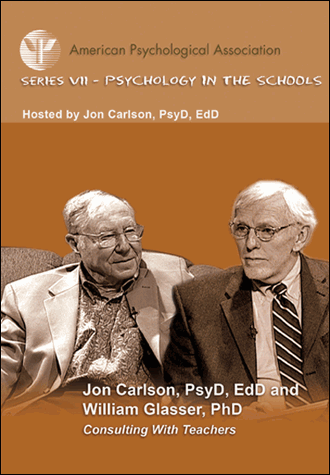
In Consulting With Teachers, Drs. Jon Carlson and William Glasser demonstrate effective techniques for psychologists, counselors, and social workers consulting with teachers individually and in groups. This program provides a step-by-step, empirically supported approach to working with teachers. The consultation approach is illustrated in three interviews with real teachers, including a group consultation, making this program an indispensable tool for mental health professionals working in schools.
DVD Bonus Feature: Both the individual and group-format consultations feature a voiceover commentary about the fine points of consulting.
Dr. Glasser's present approach focuses on mental health as a separate entity from mental illness. In the same way that doctors can prescribe healthy habits and diet to encourage physical health, Dr. Glasser proposes ways to encourage mental health in his clients.
Choice theory is the primary theory behind his counseling approach. According to this theory, unhappiness and relationship problems, either in school or in one's personal life, derive from the fact that all humans have learned to use external control psychology. This type of thinking and behavior is founded on a person thinking "I know what's right for you." This thought leads people to try to control or change one another, and it is a frequent approach that teachers and school administrators take with students. Using external control or allowing another to use it on you leads to unhappiness in any relationship, whether it is with your spouse, colleagues, or students.
Dr. Glasser's consultation with schools involves teaching people to respect one another. Better relationships between teachers and students will increase the quality of the school, which will result in increased learning. According to choice theory, the primary way to foster this respect is to reduce external control and increase choice. For example, when consulting with teachers, Dr. Glasser teaches them ways to convey to students that they have a choice as to whether they learn or not. When teachers give students this choice—and it is a real choice, not simply the false sense of choice—they begin to eliminate external control and allow the classroom relationship to change positively.
Good schools and classrooms are all about relationships. Dr. Glasser characterizes external control with a list of "seven deadly habits" that destroy relationships: criticizing, blaming, complaining, nagging, threatening, punishing, and bribing or rewarding to control. He recommends replacing these habits with "seven caring habits" that improve all relationships: supporting, encouraging, listening, accepting, trusting, respecting, and negotiating differences.
When counseling teachers, Dr. Glasser models the seven caring habits in all his interactions with his clients. Doing so creates and strengthens the counseling relationship, which in turn shows teachers how to improve their relationships with students. If teachers change at least a few of the habits of external control by replacing them with some of the caring habits, they will see positive results in the classroom.
Dr. Carlson follows an Adlerian approach to working with teachers. He uses a seven-step process that allows him to work in a brief (yet effective) fashion. His ideas are highlighted in his recent book, coauthored with Don Dinkmeyer Jr., Consultation: Creating School-Based Interventions.
Jon Carlson, PsyD, EdD, is distinguished professor in the Division of Psychology and Counseling at Governors State University in University Park, Illinois, and director of the Lake Geneva Wellness Clinic in Lake Geneva, Wisconsin. Dr. Carlson is diplomate in family psychology from the American Board of Professional Psychology. He has been named a Living Legend and received several professional development and social interest awards from the American Counseling Association. He has authored more than 35 books, including Adlerian Therapy (American Psychological Association, 2006) and has produced more than 200 training videos in psychotherapy and related areas. He serves as the founding editor of The Family Journal and past president of the International Association of Marriage and Family Counseling.
William Glasser, MD, is an internationally recognized psychiatrist who is best known as the author of Reality Therapy, a method of psychotherapy he created in 1965 that is now taught all over the world. A renowned lecturer and the author of more than 20 books, Dr. Glasser is also the founder and president of the William Glasser Institute, an international organization that provides training in Choice Theory, Reality Therapy, quality performance in schools, and lead-management in the workplace. Dr. Glasser's current emphasis is on helping people to improve their own mental health, as explained in his 2003 book Warning: Psychiatry Can Be Hazardous to Your Mental Health.
- Dinkmeyer, D., & Carlson, J. (2006). Consultation: Creating school-based interventions. New York: Routledge.
- Glasser, W. (1998). Choice theory: A new psychology of personal freedom. New York: HarperCollins.
- Glasser, W. (2000). Getting together and staying together. New York: HarperCollins.
- Glasser, W. (2001). Counseling with choice theory: The new reality therapy. New York: HarperCollins.
- Glasser, W. (2003). For parents and teenagers: Dissolving the barrier between you and your teen. New York: HarperCollins.
- Glasser, W. (2003). Warning: Psychiatry can be hazardous to your mental health. New York: HarperCollins.
- Glasser, W., & Carlson, J. (2005). Defining mental health as a public health problem [DVD]. Chatworth, CA: William Glasser Institute
APA Videos
- Bullying Prevention
Arthur M. Horne - Harm Reduction With High School Students
Mary E. Larimer - Performance Psychology
Charles H. Brown Jr. - Teenage Girls
Karen Zager - Treating Adolescents With ADHD
Robert J. Resnick - Working With Children With ADHD
Vincent J. Monastra - Working With Children Who Have Experienced Neglect or Abuse
Wes Crenshaw
APA Books
- Bullying Prevention: Creating a Positive School Climate and Developing Social Competence
Pamela Orpinas and Arthur M. Horne - Enhancing Relationships Between Children and Teachers
Robert C. Pianta - Psychosocial Treatments for Child and Adolescent Disorders: Empirically Based Strategies for Clinical Practice, Second Edition
Edited by Euthymia D. Hibbs and Peter S. Jensen
Magination Press Books
- Sam and Gram and the First Day of School
Dianne Blomberg; Illustrated by George Ulrich - A Terrible Thing Happened: A Story for Children Who Have Witnessed Violence or Trauma
Margaret M. Holmes; Illustrated by Cary Pillo