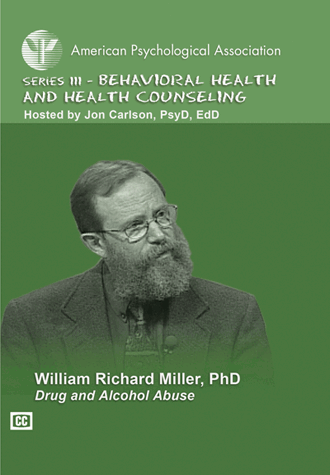
Drug and Alcohol Abuse
ISBN: 978-1-59147-463-0Available formats
Streaming options
In Drug and Alcohol Abuse, Dr. William Richard Miller demonstrates his approach to treating clients with problems involving substance abuse. Drug and alcohol abuse are a common presenting problem in therapy, second only to depression, so it benefits therapists to have an approach ready for this issue. Dr. Miller uses motivational interviewing, a Rogerian technique designed to increase a client's sense that he or she is capable of handling the problems they confront.
In this session, Dr. Miller works with a woman who has been in and out of recovery for use of various substances who is aiming toward reducing her substance use. By reflectively listening and pointing out her strengths, Dr. Miller guides the client toward recognizing other interests in her life with which she can replace drug and alcohol use.
William Richard Miller, PhD, is distinguished professor of psychology and psychiatry at the University of New Mexico (UNM) and codirector of UNM's Center on Alcoholism, Substance Abuse, and Addictions. A fellow of the American Psychological Association (APA) and the American Psychological Society, he has also served as director of clinical training for UNM's APA-approved doctoral program in clinical psychology.
Dr. Miller's publications include 25 books and more than 300 articles and chapters, focusing especially on the treatment of alcohol problems and other addictive behaviors.
His research group has developed and evaluated a variety of innovative clinical strategies, including motivational interviewing, the drinker's checkup, behavioral self-control training, and the community reinforcement approach. He has also designed various treatment assessment tools for the addiction field.
He has served as principal investigator for numerous research grants and contracts; founded a private practice group; and served as a consultant to many organizations, including the U.S. Senate, the World Health Organization, the National Academy of Sciences, and the National Institutes of Health (National Institute on Alcohol Abuse and Alcoholism, National Institute on Drug Abuse, and National Institute of Mental Health). Dr. Miller was the 1994 recipient of the Jellinek Memorial Award in recognition of his research contributions to the treatment of alcoholism.
He maintains an active interest in pastoral counseling and the integration of spirituality and psychology. He is supported by a 15-year Senior Career Research Scientist Award from the National Institute on Alcohol Abuse and Alcoholism, to focus full-time effort on clinical research. He received his PhD in clinical psychology from the University of Oregon in 1976.
- Miller, W. R. (Ed.). (1999). Treatment Improvement Protocol (TIP) Series 35: Enhancing motivation for change in substance abuse treatment (DHHS Publication No. SMA 99-3354). Rockville, MD: U.S. Department of Health and Human Services, Substance Abuse and Mental Health Services Administration, Center for Substance Abuse Treatment.
- Miller, W. R., & Rollnick, S. (2002). Motivational interviewing: Preparing people for change (2nd ed.). New York: Guilford Press.
- Moyers, T. B., & Rollnick, S. (2002). A motivational interviewing perspective on resistance. Journal of Clinical Psychology, 58 (2), 185–193.
- Rollnick, S., Mason, P., & Butler, C. (1999). Health behavior change: A guide for practitioners. New York: Churchill Livingstone.
- Rollnick, S., & Miller, W. R. (1995). What is motivational interviewing? Behavioural and Cognitive Psychotherapy, 23, 325–334.
APA Videos
- Assessing Alcohol Problems Using Motivational Interviewing
Linda Carter Sobell and Mark Sobell - Client-Centered Therapy
Nathaniel J. Raskin - Cognitive–Behavioral Relapse Prevention for Addictions
G. Alan Marlatt - Mindfulness for Addiction Problems
G. Alan Marlatt - Relapse Prevention Over Time
G. Alan Marlatt - Smoking Cessation
Bonnie J. Spring
APA Books
- Preventing Youth Substance Abuse: Science-Based Programs for Children and Adolescents
Edited by Patrick Tolan, José Szapocznik, and Soledad Sambrano